
Broward County's Bold Bet on Immersive Learning
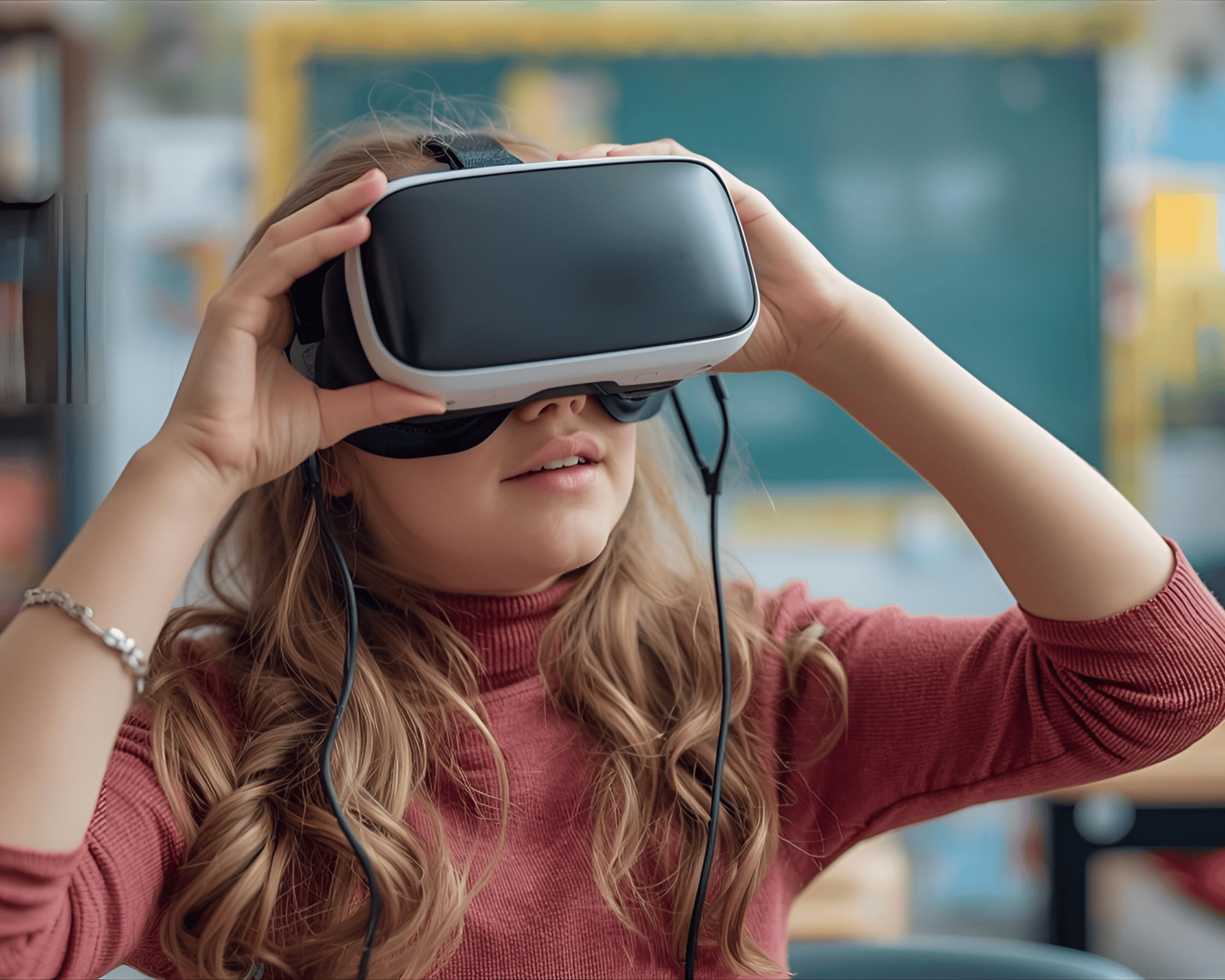
Step into Dillard High School and you might think you were stepping onto the set of a science fiction movie. In algebra class, students wear virtual reality (VR) headsets – not for gaming, but to physically step inside mathematical concepts and apply formulas to real-world architecture and engineering problems. The traditional paper and pencil have been replaced by technology.
This isn’t just some glimpse into the future; it’s happening right now in Broward County, one of America's largest school districts, where a $5.1 million bet on a revolutionary approach to teaching could reshape how students across South Florida learn.
The Missing Piece
For decades, educators have embraced digital tools ranging from learning management systems to artificial intelligence platforms. But despite these technological advances, something fundamental was still missing: the ability to learn through space, movement, and physical interaction with abstract concepts.
"Students should learn how to use language, notation, and eventually shorthand representation of thoughts from deeply human experiences," explains Anurupa Ganguly, founder and CEO of Prisms VR and former New York City math administrator. After a decade working with some of the nation’s largest districts, she concluded that traditional teaching methods fail to tap into the multiple ways humans naturally process and understand information.
The numbers back her up. Roughly 70% of U.S. eighth graders are not proficient in math, with Black, Native American, and low-income students facing the steepest challenges. Broward County's answer, formalized in Superintendent Howard Hepburn's 2022-2027 Strategic Plan, makes immersive technology a cornerstone in their effort to close that gap.
A District-Wide Commitment to Transformation
The 247,000 students enrolled in Broward County Public Schools, Florida's second-largest school district, are the new face of this district-wide implementation. The commitment is significant: a $3.9 million expansion for the 2025-26 academic year brings total investment to over $5.1 million. The funding covers 3,600 new VR headsets, software licenses for up to 50,500 students, and four full-time VR coaches dedicated to professional development.
The results are hard to ignore. Broward County earned its first "A" rating from the Florida Department of Education since 2011, a distinction it has maintained in 2024-25. More than half of the district's schools now carry an A rating, and for the first time since 1999, Broward has eliminated all D and F-rated institutions.
"This continued achievement not only validates the hard work within BCPS, but it also signals to families, businesses, and the wider community that Broward County offers a top-tier public education system," said Superintendent Dr. Howard Hepburn in a press release. The timing coincides directly with aggressive investments in immersive learning technologies.
The Numbers Don't Lie
A landmark randomized control trial by WestEd found that students using Prisms VR demonstrated an 11% advantage in post-test scores on exponential functions compared with their peers in traditional classrooms. In Broward, 92% of pilot teachers reported improved student performance and expressed desire to continue using the program.
This progress isn’t limited to VR-specific interventions. District-wide FAST assessment results show striking gains: Algebra 1 proficiency jumped from 28% to 65% in 2024-25 alone, while Geometry soared from 13% to 62%.
"Using Prisms, I feel like I'm able to grasp math better because I'm able to use it in real-life scenarios," one student explains. "Especially when we do word problems it makes so much more sense to me because I'm actually able to understand that what I'm reading is something else I've done."
Kiera Brown, a Dillard High School student, publicly credited VR with significantly improving her grades. Teacher, Trudi Croy, echoed this success, stating that "Prisms is fostering a strong sense of perseverance in my students. That's something I had seen lacking in the classroom before. Struggle was perceived as negative. To hear them say 'let me try again' was really powerful."
Beyond Mathematics
While Prisms VR anchors the math initiative, Broward's vision encompasses all subjects. At Millennium 6-12 Collegiate Academy, students use AR headsets to visualize geological processes in 3D and explore the Apollo 11 lunar capsule interior.
Science students now conduct cruelty-free virtual dissections and chemistry experiments in risk-free environments. Literature students take virtual walks through Shakespeare's Globe Theatre, while CTE students practice automotive repairs and engineering design in simulated environments before graduating to actual equipment.
"Students are excited to put on headsets and interact with virtual content which would be otherwise inaccessible or incomprehensible to them," explains Lauren D'Apuzzo, a Broward County teacher. "Seeing students collaborate with each other and understand complex concepts makes me so proud as a teacher."
Dr. Lisa Milenkovic, a STEM and Computer Science Supervisor, emphasizes the practical implementation focus: "We couldn't justify putting XR in classrooms until we had a solution that would help teachers use their headsets and integrate the technology seamlessly into their existing curriculum."
Closing the Digital Divide
Perhaps most notably, Broward has put equity at the center of its strategy. Through the Verizon Innovative Learning Schools program, every student and teacher in select Title 1 middle schools receives a free iPad with a four-year data plan, guaranteeing round-the-clock access. Five Verizon Innovative Learning Labs have been strategically deployed in the district's highest-need schools, transforming under-resourced institutions into innovation hubs equipped with AR/VR, 3D printing, and AI tools.
This reach extends beyond the classroom to the Broward County Library, where the "Gear to Go" program, lends AR/VR headsets and MERGE Cubes to patrons aged 10 and up. With 100 MERGE Cubes and 90 headsets available across multiple branches, families can borrow equipment for 21 days, using their own smartphones to access content from NASA, National Geographic, and Disney.
By funding from capital budgets rather than general operating funds, schools in underserved communities like Margate and Coconut Creek gain access to cutting-edge tools without sacrificing other resources. Multilingual support extends that inclusion.
Education Meets Innovation Economy
Broward's investment comes as South Florida has begun to cement its status as an emerging technology hub. The region accounted for 65% of all venture capital raised in Florida’s IT sector, with organizations like eMerge Americas and Florida Funders establishing Miami, Fort Lauderdale, and West Palm Beach as premier tech destinations. The Research Park at Florida Atlantic University reported $708 million in economic output for 2024, with Tech Hub South Florida working to develop a local talent pipeline for tech companies and startups.
For students, mastering spatial computing isn’t just about improving test scores—it’s preparation for joining a workforce where AR interfaces and spatial reasoning are baseline expectations. "We intend to become the next textbook; the next textbooks will be spatial and experiential," Ganguly says.
A National Model for Educational Innovation
Broward County’s embrace of immersive technology shows how a large public school system can deploy emerging tools to tackle longstanding educational challenges. Its approach balances ambition with pragmatism: substantial investment paired with rigorous evaluation, equity-focused deployment, and comprehensive teacher coaching and support through institutes like the two-day Prisms VR Teacher Institute.
For South Florida's venture capital and business communities, Broward's initiative offers a compelling case study in how public institutions can serve as laboratories for educational technology at scale. Prisms VR is now deployed in 140 school districts across 30 states, and the EdTech sector is expected to surpass $680 billion by 2027.
As traditional educational models face increasing pressure to evolve, Broward County Public Schools has positioned itself at the forefront of that transformation. By turning classrooms into immersive spaces where students literally step inside the concepts they're studying, the district is reimagining what's possible in public education and in the process, helping cultivate the next generation of innovators who will shape South Florida’s growing tech economy.


YouTube sensation IShowSpeed, also known as Darren Watkins Jr., has reportedly invested $10.75 million in a Miami-Dade warehouse to establish a dedicated content creation and production studio. The 26,600-square-foot property represents a major step in the creator's expansion from livestreaming into a larger media enterprise. Miami real estate broker Jordan Karp represented IShowSpeed in the transaction. The investment highlights South Florida's growing role in the creator economy, connecting digital entertainment, technology, commercial real estate, and entrepreneurship.