
Florida Universities Power the eVTOL Revolution
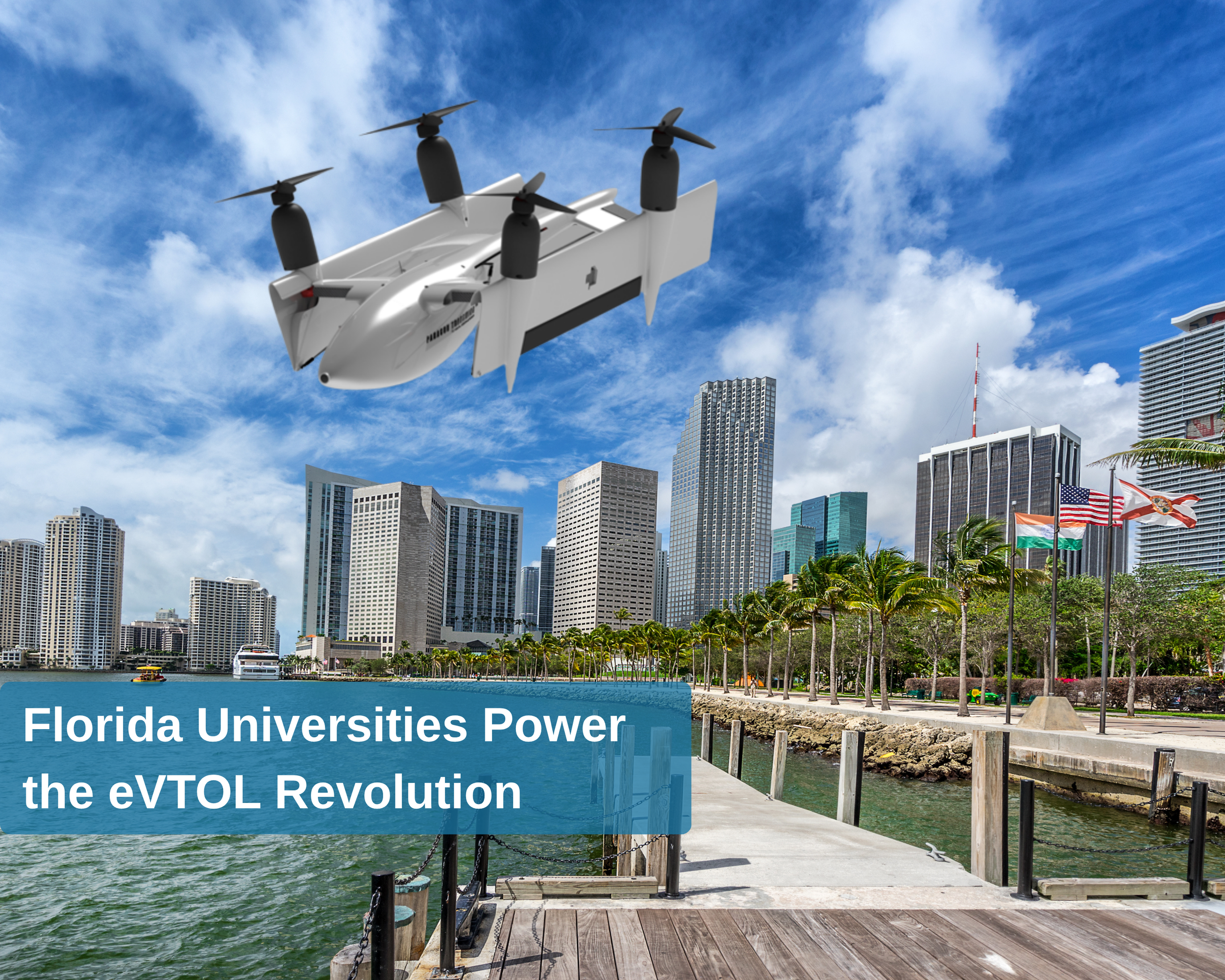
Florida is quickly becoming a national hub for advanced air mobility (AAM), and universities across the state are at the forefront of this transformation.
The state is one of the most popular destinations in the United States for international flight training. With year-round flying weather, active airspace, and a high concentration of aviation academies, students from around the world come here to earn their Private, Instrument, and Commercial certifications.
By producing skilled talent, advancing research, and leveraging testing infrastructure, Florida’s academic institutions are shaping the future of eVTOL aircraft and urban air mobility.
Why Florida Universities Matter to eVTOL
Florida’s universities are central to the state’s eVTOL ecosystem because they:
Build a pipeline of engineers, pilots, and air traffic specialists
Conduct research on electric propulsion, autonomous systems, and urban air mobility
Collaborate with industry and government agencies to test and integrate new technologies
Prepare cities and infrastructure for the future of air mobility
Florida’s strong presence in aviation, aerospace engineering, autonomous systems, space technology, and transportation infrastructure gives its universities a unique advantage in supporting the industry’s growth.
Leading Universities Driving AAM Research
Embry-Riddle Aeronautical University (Daytona Beach & Prescott)
Embry-Riddle is a global leader in aviation education and a cornerstone of Florida’s eVTOL workforce.
Key Initiatives:
Electric aircraft propulsion system research
Autonomous flight and airspace integration
Urban Air Mobility operational frameworks
Simulation of air traffic management for eVTOL aircraft
Collaborations & Impact:
Works with NASA, the FAA, and aerospace companies
Produces engineers, pilots, and systems designers trained for electric and autonomous aviation
University of Central Florida (Orlando)
UCF is a major hub for aerospace and future mobility research.
Focus Areas:
Unmanned aerial systems (UAS)
Autonomous air traffic management
Policy planning and infrastructure studies for AAM
Collaboration with the Orlando aerospace cluster
Strengths:
Proximity to NASA and major aerospace companies
Strong industry partnerships for applied research
Florida Institute of Technology (Melbourne)
Florida Tech advances aviation research leveraging its proximity to Kennedy Space Center.
Research Focus:
Electric propulsion systems
Flight dynamics and control
Autonomous aircraft navigation
Integration of new aircraft into existing airspace
Impact:
Supports the Space Coast aerospace ecosystem
Aligns with AAM and next-generation aviation technologies
University of Miami (Miami)
The University of Miami contributes to AAM through smart-city and urban mobility research.
Research Areas:
Smart city transportation systems
Integration of autonomous mobility technologies
Urban infrastructure planning for emerging transportation
Relevance:
Miami is a potential early market for air-taxi networks
Research informs operational planning, passenger experience, and urban mobility integration
Florida International University (Miami)
FIU is expanding programs in aerospace, robotics, and drone technology relevant to AAM.
Key Focus Areas:
Unmanned aircraft systems
Robotics and AI
Urban infrastructure and smart transportation
Impact:
Supports South Florida’s tech and aerospace startup ecosystem
Bridges academic research with industry innovation
Across Florida, hundreds of students are developing eVTOL-related projects and prototypes, gaining hands-on experience in aircraft design, autonomous systems, and smart urban mobility. This interest has been popular for almost nearly a decade now.
For example, Florida Atlantic University (FAU) recently featured Paragon Transwing in a student design showcase, giving students the opportunity to demonstrate real-world applications of advanced air mobility concepts. At other institutions, student-led engineering clubs and design competitions at universities such as UCF, Embry-Riddle, and Florida Tech are fostering innovation in electric propulsion, autonomous navigation, and vertiport integration.
University-hosted events and expos further provide students with platforms to present their ideas to industry partners, encouraging collaboration and potential commercial adoption. These projects not only give students practical experience but also strengthen Florida’s talent pipeline for the emerging eVTOL and advanced air mobility industry.
State Testing Infrastructure Supporting Universities
SunTrax Transportation Technology Testing Facility (Polk County)
SunTrax is a state-supported innovation center expanding to support AAM testing.
Capabilities:
Dedicated vertiport testing infrastructure
Controlled eVTOL flight environments
Integration testing between air mobility and ground transportation
Collaboration:
Florida universities work with SunTrax for hands-on research
Supports workforce development and applied learning for students and faculty
Building a Workforce for the Future
Florida universities are more than educational institutions, they are shaping the operational standards, research, and policies that will define the eVTOL and AAM industry. By combining cutting-edge research, skilled talent, and state-of-the-art testing facilities, Florida is positioning itself as a national leader in urban and regional air mobility.
As commercial eVTOL adoption grows, Florida’s universities will ensure engineers, pilots, and planners are ready to meet the demands of this rapidly evolving transportation landscape.




Florida Atlantic University is leading a $5.7 million initiative to improve literacy in Broward County schools while preparing educators to use artificial intelligence responsibly. Through LEAP-AI, FAU and its partners aim to strengthen teacher training, expand career pathways, and build South Florida's future workforce.