
NextEra Energy - Dominion Energy Plans $67B Merger: What It Means for Florida’s Energy Future
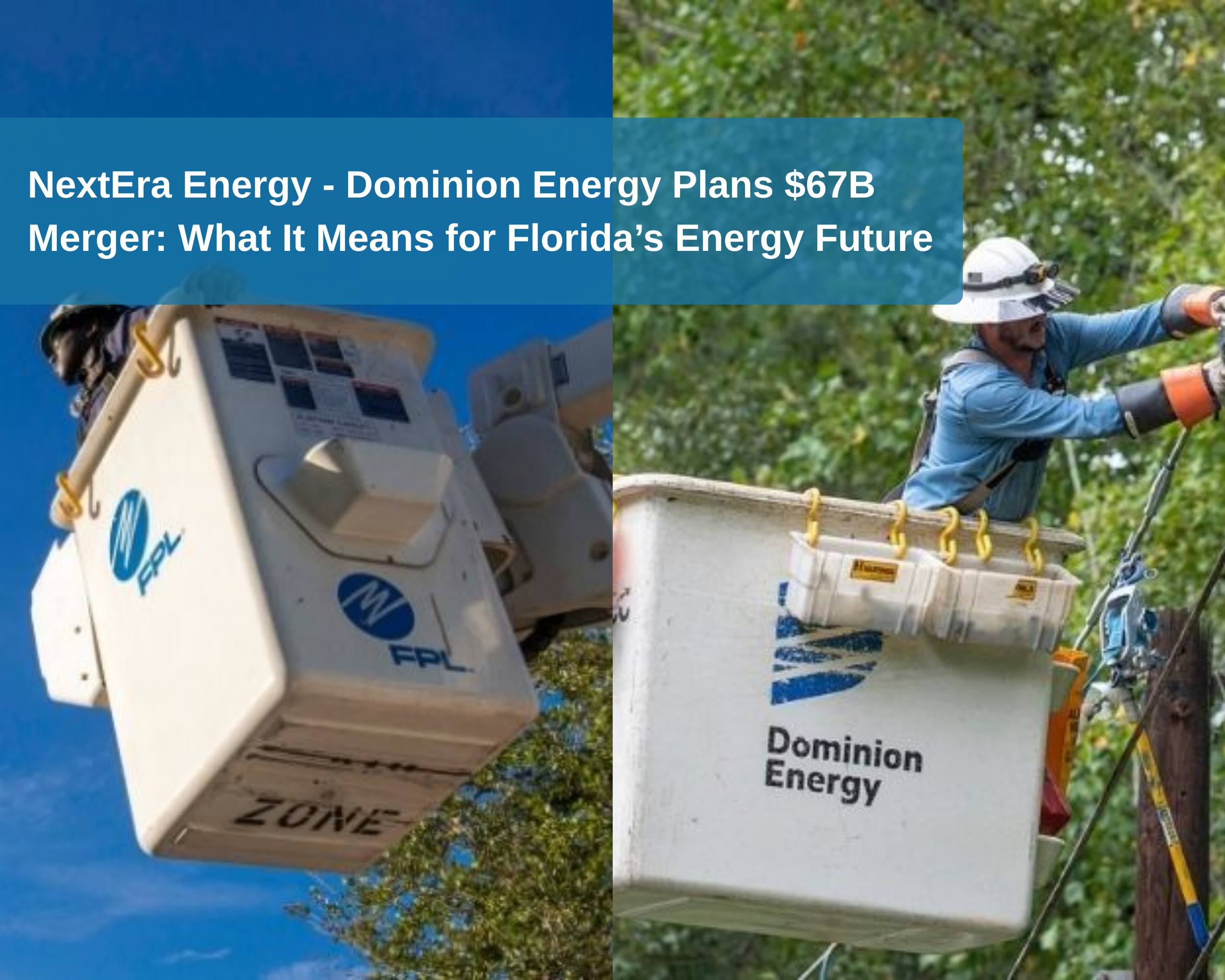
NextEra Energy and Dominion Energy have announced a landmark all-stock merger that will create the largest regulated electric utility business in the world by market capitalization. The combined company will serve approximately 10 million customer accounts across Florida, Virginia, North Carolina, and South Carolina, and operate a highly diversified energy infrastructure platform spanning renewables, nuclear, natural gas, and grid modernization.
While the announcement is national in scope, its impact is especially significant for Florida, home to Florida Power & Light (FPL), a NextEra Energy subsidiary and one of the most influential utilities in the United States.
Florida, AI Infrastructure, And The New Energy Economy
Florida has long been central to NextEra Energy’s success through Florida Power & Light (FPL), which serves more than 12 million residents and businesses. With the proposed merger between NextEra Energy and Dominion Energy, that role becomes even more significant as the combined company positions itself to meet rapidly rising electricity demand driven by AI infrastructure, hyperscale data centers, population growth, and industrial expansion.
The combined company will operate as a heavily regulated utility platform, with more than 80% regulated assets across four high-growth states: Florida, Virginia, North Carolina, and South Carolina. Within that structure, Florida represents one of the company’s most stable and predictable revenue bases, making it a critical financial anchor for long-term expansion.
A major driver behind the merger is the explosive growth in electricity demand tied to AI and data center development. Dominion Energy’s Virginia territory includes “Data Center Alley,” one of the largest concentrations of data centers in the world and a rapidly expanding hub for artificial intelligence infrastructure.
While Florida is not currently the epicenter of the data center boom, it plays a different but equally important role. FPL’s consistent earnings, strong regulatory environment, and predictable load growth help provide the financial stability needed to support large-scale investments in generation, transmission, and grid infrastructure across the combined company’s footprint.
In many ways, the merger creates a complementary balance:
Virginia drives high-growth electricity demand through AI and data centers
Florida provides operational and financial stability through one of the nation’s strongest regulated utility platforms
Together, the two regions form a powerful foundation for what could become one of the most influential energy infrastructure companies in the world.
What Florida Customers May See: Investment, Innovation, And Long-Term Infrastructure Growth
The proposed merger between NextEra Energy and Dominion Energy includes several consumer-focused commitments, including $2.25 billion in bill credits for Dominion Energy customers in Virginia, North Carolina, and South Carolina. Florida customers are not included in the direct credit program, but the state is still expected to play a major role in the combined company’s long-term operational and infrastructure strategy.
While the merger does not directly change FPL’s regulatory structure, Florida customers could experience indirect benefits tied to the larger scale and financial strength of the combined company. Improved credit ratings may help lower borrowing costs, while expanded purchasing power and construction efficiencies could reduce long-term infrastructure expenses across the system. The merger may also strengthen investments in storm resilience, grid modernization, and reliability initiatives that are especially important in hurricane-prone regions like Florida.
At the same time, Florida will likely remain a major focus for future infrastructure spending. Continued population growth, electrification, AI-related energy demand, and hurricane hardening efforts will require substantial investments in generation, transmission, battery storage, and grid resilience. Those investments could continue to place pressure on future rate discussions, even as the company argues that increased scale will help improve efficiency over time.
“By uniting two industry leaders with 238 years of collective experience, this combination creates a stronger company for customers and a stronger long-term value proposition for shareholders. Customers will benefit from $2.25 billion in bill credits and over time from the scale, operating and capital efficiencies this combination unlocks,” shared NextEra Energy Chairman and CEO John Ketchum emphasizing that the merger is intended to create both operational efficiencies and long-term customer value.
He continued, “They will also benefit from the shared expertise and best practices of America's leading regulated utilities, laser-focused on low customer bills, customer service, storm resiliency and reliability, making the customer experience seamless in the near term and best in class over time. Shareholders will benefit from a broader regulated growth runway, a larger opportunity set and a more diversified platform. This is a unique situation where we believe one plus one equals three.”
Beyond customer rates and infrastructure costs, Florida is also expected to emerge as a central innovation hub within the combined company. FPL has already established itself as a national leader in solar deployment, battery storage integration, storm response, and digital grid modernization. With greater access to capital and expanded operational scale, many of those capabilities are expected to be further developed and replicated across the combined company’s footprint.
This positions Florida not only as a major utility market, but as a testing ground for the next generation of energy infrastructure, resiliency planning, and grid technology in the United States.
Florida’s Strategic Role In The Future Of Energy Infrastructure
The decision to maintain dual headquarters in Juno Beach, Florida, and Richmond, Virginia, reinforces Florida’s importance not only within the combined company, but within the broader future of the American energy industry. FPL’s leadership team will remain in place, and Florida Power & Light will continue operating under its existing brand and structure, signaling that Florida is not being diminished within the merger, but elevated as one of the central pillars of a much larger national energy platform.
Dominion Energy Chair, President and CEO Robert Blue emphasized that the merger is designed to preserve local leadership while strengthening the combined company’s ability to invest in long-term infrastructure and reliability.
“Dominion Energy and NextEra Energy share a deep commitment to delivering reliable and affordable energy and to the customers and communities we are honored to serve. This combination brings together two strong operating platforms and creates an even stronger energy partner for Virginia, North Carolina, South Carolina and Florida, with the scale and balance sheet to deliver the generation, transmission and grid investments our customers and economies need,” shared Blue.
The structure of the merger also reflects a broader transformation happening across the utility sector. As electricity demand surges due to population growth, electrification, AI infrastructure, and hyperscale data centers, utility companies are increasingly pursuing scale to manage the enormous capital requirements tied to modern grid infrastructure.
In this environment, size is no longer simply about market share. Scale is becoming essential for:
Financing major generation and transmission projects
Meeting rapidly growing AI-driven electricity demand
Building more resilient and storm-ready grid systems
Managing supply chain complexity and construction costs
Accelerating deployment of renewable energy and battery storage
The NextEra–Dominion combination is one of the clearest examples yet of utilities evolving beyond traditional regional service models into large-scale infrastructure platforms capable of supporting the next era of economic and technological growth.
Within that transformation, Florida’s role becomes especially significant. With FPL already recognized as a national leader in utility operations, resilience, and grid modernization, the state is positioned to remain at the center of how the combined company develops, tests, and scales future energy infrastructure across the country.
What It Means For Florida’s Energy Future
“This is a historic moment for our two companies and for the states we are privileged to serve. Electricity demand is rising faster than it has in decades. Projects are getting larger and more complex. Customers need affordable and reliable power now, not years from now. We are bringing NextEra Energy and Dominion Energy together because scale matters more than ever—not for the sake of size, but because scale translates into capital and operating efficiencies. It enables us to buy, build, finance and operate more efficiently, which translates into more affordable electricity for our customers in the long run,” stated NextEra Energy CEO John Ketchum.
For Florida, the implications are significant:
It strengthens FPL’s role as one of the most important utilities in the United States
It ties Florida’s energy future more closely to national AI and infrastructure growth trends
It reinforces Florida’s position as a stable, investment-grade foundation for a rapidly expanding energy system
It increases the importance of regulatory decisions made by Florida policymakers, as they now indirectly influence a much larger national platform
Florida is no longer just a major utility market: it is a cornerstone of a continental energy strategy.
Final Takeaway
"The Dominion Energy name isn't changing, nor is how we operate locally, serve our customers or engage with the community. The same leaders and the same teams customers know and trust will continue serving Virginia, North Carolina and South Carolina. Both companies put our customers and teams first, as well as the communities we serve,” shared NextEra CEO Ketchum.
The NextEra–Dominion merger is more than a corporate transaction. It represents a structural shift in how electricity is generated, financed, and delivered across the United States.
And at the center of it all, Florida plays a quiet but critical role, not as the fastest-growing demand center, but as the financial and operational backbone helping power the next era of American energy infrastructure.





The Hispanic Entrepreneur Initiative celebrated its seventh anniversary with the 2nd Annual HEI Day & Business Pitch Competition at Lynn University in Boca Raton. Featuring seven entrepreneurs, a distinguished panel of judges, and four Prosperity Catalyst Award recipients, the event highlighted the power of community collaboration in advancing Hispanic entrepreneurship and economic opportunity across South Florida.