

The White House's Second Quantum Executive Order Completes the Strategy. South Florida Has a Role to Play.
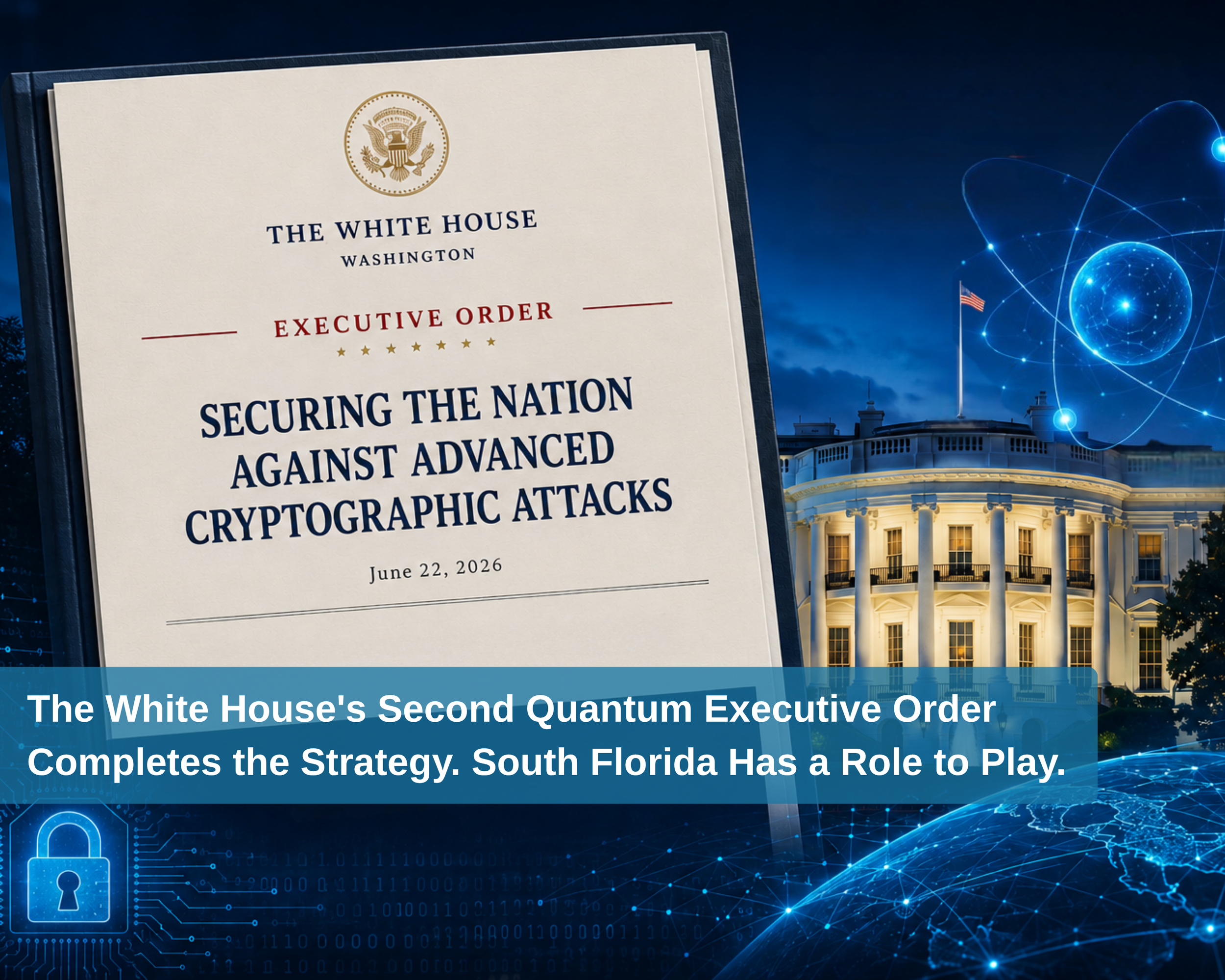
Just after issuing an Executive Order designed to accelerate American leadership in quantum technology, the White House released a second order focused on a different, but equally important, challenge: protecting the nation's digital infrastructure from the very technology it hopes to lead.
In our previous article, The White House's Quantum Strategy Is Here. South Florida Is Already Building It, we explored how Palm Beach County's growing quantum ecosystem, from research and commercialization to advanced networking infrastructure and workforce development, already aligns with the Administration's vision for maintaining American leadership in quantum innovation.
This second Executive Order tells the other half of the story. Building quantum technology is only part of the challenge. Securing the nation against quantum-enabled cyber threats is the other.
Together, the two Executive Orders create a coordinated national strategy: accelerate quantum innovation while simultaneously preparing the United States for the cybersecurity implications that innovation will bring.
For South Florida, that's more than a policy announcement. It's another signal that the region is positioned to contribute to both sides of the quantum equation.
The Quantum Threat Isn't Tomorrow, It's Already Here
One sentence from the Executive Order captures why the Administration is acting now:
"Ongoing cyber activity against our Nation also presents the risk of adversaries collecting United States information now, and decrypting it later once large-scale quantum computers are operational."
Cybersecurity professionals refer to this as "harvest now, decrypt later."
Nation-state adversaries don't need a quantum computer today to create tomorrow's intelligence advantage. Instead, they can quietly collect encrypted communications, intellectual property, financial transactions, healthcare records, critical infrastructure data, and government information now storing it until quantum computers become capable of breaking today's encryption.
For data that must remain confidential for decades, the threat has already begun.
That reality is driving what may become the largest cryptographic modernization effort in the history of the Federal Government.
Moving Beyond Traditional Encryption
Today's digital economy depends on public-key cryptography.
Every day, algorithms such as RSA and Elliptic Curve Cryptography protect:
Banking transactions
Government communications
Cloud infrastructure
Software updates
Digital identities
Healthcare records
Defense systems
Critical infrastructure
These systems remain secure against classical computers.
Large-scale quantum computers, however, are expected to solve the mathematical problems behind many of these algorithms dramatically faster than today's machines, making current encryption methods increasingly vulnerable.
Rather than waiting for that day to arrive, the Executive Order directs Federal agencies to begin transitioning to Post-Quantum Cryptography (PQC), cryptographic algorithms specifically designed to resist attacks from both classical and quantum computers.
Importantly, this isn't theoretical research.
The migration centers on the National Institute of Standards and Technology's newly standardized Federal Information Processing Standards (FIPS), giving government and industry a common framework for implementing quantum-resistant security.
A National Roadmap With Firm Deadlines
Unlike many cybersecurity initiatives that focus on recommendations, this Executive Order establishes measurable milestones.
Every Federal agency must designate a Post-Quantum Cryptography migration lead responsible for inventorying cryptographic assets and overseeing agency-wide migration.
Agencies will also be required to:
Inventory High Value Assets and High Impact Systems.
Develop comprehensive migration plans.
Transition high-value systems to post-quantum key establishment by December 31, 2030.
Complete migration of digital signatures by December 31, 2031.
The message is clear: quantum readiness is becoming an operational requirement rather than a long-term research objective.
This Isn't Just a Government Initiative
Although the Executive Order focuses on Federal agencies, its implications extend well beyond Washington.
The Department of Homeland Security and the Cybersecurity and Infrastructure Security Agency (CISA) are directed to work alongside Sector Risk Management Agencies to help critical infrastructure operators develop their own migration strategies.
That includes industries such as:
Financial services
Energy
Healthcare
Telecommunications
Transportation
Manufacturing
Water systems
These sectors operate infrastructure expected to remain in service for decades, making long-term cryptographic planning increasingly important.
The Executive Order also signals future procurement changes.
Federal contractors will eventually be required to comply with NIST's post-quantum cryptographic standards, meaning technology providers, cloud companies, software developers, cybersecurity firms, and defense contractors should begin evaluating their cryptographic environments well before compliance deadlines arrive.
For many organizations, quantum readiness will soon become a competitive differentiator.
A New Concept: The Cryptographic Bill of Materials
One of the most forward-looking provisions in the Executive Order calls for the creation of public guidance around a Cryptographic Bill of Materials (CBOM).
Many organizations have already begun implementing Software Bills of Materials (SBOMs) to better understand software dependencies.
A CBOM takes that concept one step further by documenting where cryptographic algorithms are embedded throughout hardware and software environments.
Why does that matter?
Because many organizations don't actually know where all of their encryption lives.
Before replacing outdated cryptography, organizations first need visibility into what they're protecting.
Why This Matters for South Florida
The first Executive Order highlighted the importance of quantum research, commercialization, workforce development, and innovation ecosystems.
That's where South Florida has already begun making national headlines.
As we explored in our previous article, Florida Atlantic University's investment in one of the nation's first commercially available advanced quantum computing systems, Florida LambdaRail's growing role in building quantum networking infrastructure, and Palm Beach County's expanding innovation ecosystem demonstrate that the region is already participating in America's quantum future.
That momentum is also being reflected across the region's technology community. At ISACA South Florida's annual WOW conference earlier this year, quantum computing and post-quantum cybersecurity were among the featured topics, bringing together industry leaders to discuss both the opportunities and security challenges that quantum technologies will introduce.
This second Executive Order creates another opportunity. South Florida isn't simply developing quantum technologies. It is also home to one of the country's fastest-growing cybersecurity communities.
Organizations such as ISACA South Florida, university cybersecurity programs, public-private research partnerships, and a growing concentration of technology companies across Palm Beach, Broward, and Miami-Dade counties are helping build the workforce and expertise needed to secure tomorrow's digital infrastructure.
As post-quantum cryptography becomes a national priority, regions with both quantum innovation and cybersecurity capabilities may become increasingly important.
Quantum Leadership Requires Quantum Security
The two Executive Orders released in June should not be viewed independently.
The first challenges America to lead the world in quantum innovation. The second challenges the nation to prepare for the security implications that leadership brings. Together, they represent something much larger than research funding or cybersecurity policy.
They establish a national strategy that recognizes quantum computing as both an extraordinary opportunity and a transformational security challenge.
For technology executives, cybersecurity leaders, investors, universities, startups, and regional innovation ecosystems, the message is becoming increasingly clear.
The quantum era is no longer a distant possibility. The transition has already begun.
And for South Florida, the opportunity extends beyond helping invent the future.
The next chapter may be helping secure it.



Levita Magnetics is expanding in Miami as its MARS robotic surgery platform makes its Florida debut at HCA Florida Mercy Hospital. The technology combines magnetics and robotics to reduce incisions during minimally invasive procedures. Miami will also serve as a hub for surgeon training and expansion across the East Coast and Latin America. The move strengthens South Florida’s growing medtech and healthcare innovation ecosystem.