

Six Million People. No East-West Transit. South Florida's Growing Mobility Crisis
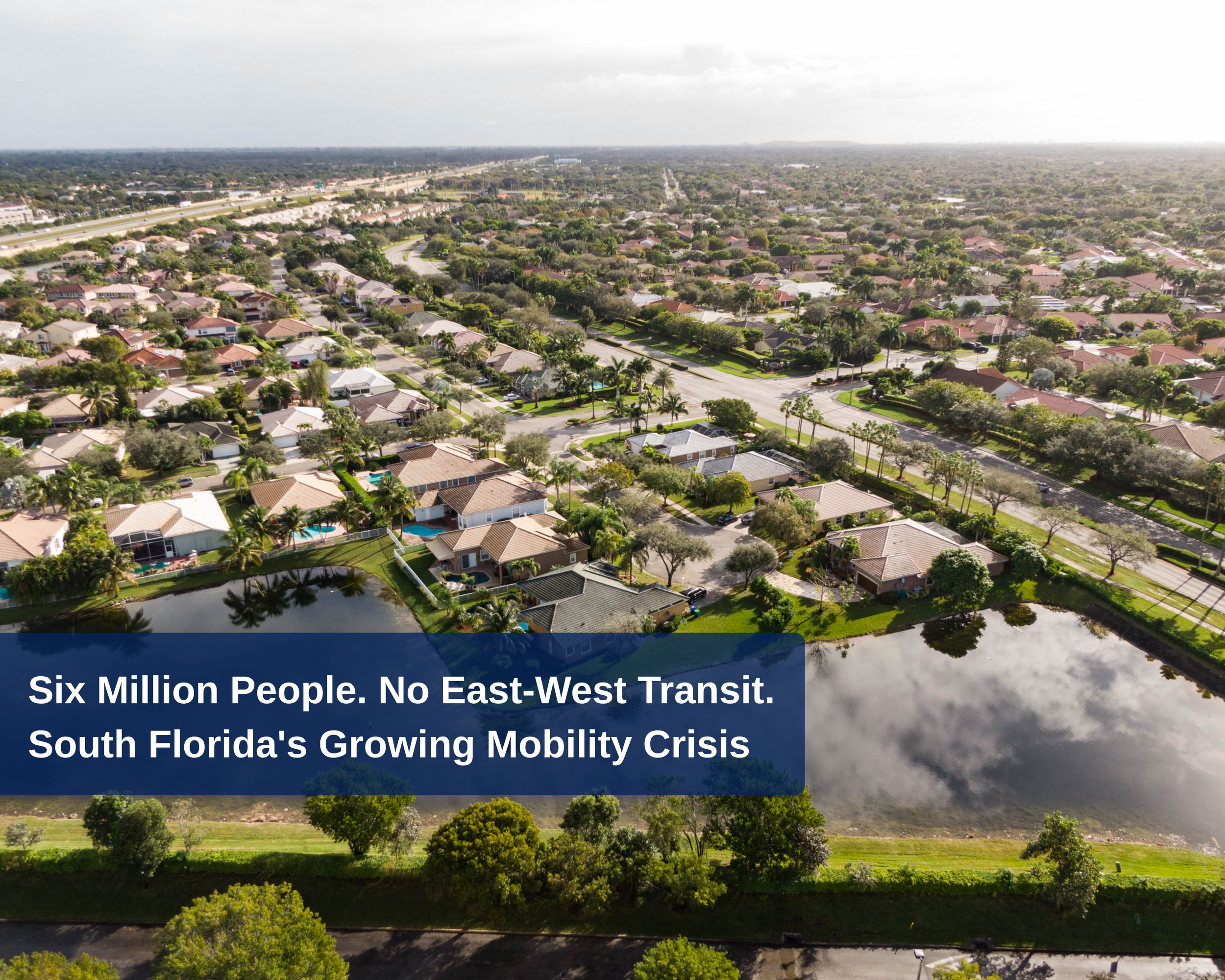
South Florida moves north-south.
Brightline runs north-south. Tri-Rail runs north-south. Nearly every major transit investment made across the region over the past three decades has focused on north-south mobility.
The problem is that many workers don't.
They live west. They work east. Every morning and every evening, they funnel onto the same roadways, corridors designed for a smaller, slower South Florida that no longer exists.
This is the first article in a series examining the east-west transit gap across Palm Beach County, Broward County, and Miami-Dade County. More than six million residents experience this challenge every day. Decision-makers at every level have studied it, acknowledged it, and, for the most part, deferred meaningful action.
The Gap Is Structural
South Florida's development pattern created the problem.
Employment is concentrated along the coast, in downtown business districts, airport corridors, medical campuses, ports, and university centers. Residential growth, meanwhile, expanded west into communities built almost entirely around the automobile.
Today, communities including Doral, Pembroke Pines, Miramar, Coral Springs, Margate, Wellington, Royal Palm Beach, and The Acreage are home to well over two million residents. None are served by east-west rapid transit. Instead, commuters depend on increasingly congested corridors including US-27, SR-84, Okeechobee Boulevard, Southern Boulevard, Boynton Beach Boulevard, and Glades Road. Bus service exists on portions of these routes. Rail service does not.
The imbalance was manageable when South Florida was smaller. That is no longer the case.
Growth Is Accelerating the Problem
South Florida is no longer growing primarily from within. It is growing through migration.
New residents continue arriving from New York, California, Chicago, and Boston, as well as from Bogotá, São Paulo, and Buenos Aires. Many settle first in Miami before moving north as housing costs rise, relocating to Fort Lauderdale, Boca Raton, West Palm Beach, and the western suburbs that support all three urban centers.
Palm Beach County alone grew by approximately 11 percent between 2015 and 2024. At the same time, corporate relocations accelerated, bringing financial firms, family offices, technology companies, and professional services firms into the region.
These workers increasingly live in western communities while commuting east to employment centers on infrastructure designed decades ago for a much smaller population.
International professionals are also choosing Palm Beach County over Miami in growing numbers. Miami's density and rising cost of living continue pushing experienced executives and entrepreneurs north, where Palm Beach offers greater affordability, lower density, and a different quality of life.
They also arrive with different expectations. In a modern metropolitan region, multiple transportation options are the norm. Across much of South Florida, they simply do not exist.
Palm Beach County: Where the Challenge Is Most Visible and the Opportunity Is Greatest
Okeechobee Boulevard has become the defining east-west transportation corridor in Palm Beach County.
Stretching approximately 13.5 miles from the western communities of Loxahatchee and Royal Palm Beach, home to more than 200,000 residents, to downtown West Palm Beach, it connects directly to Tri-Rail, Amtrak, and Brightline. Yet despite carrying roughly 67,500 vehicles each day near the Florida Turnpike, and more than 126,000 combined daily vehicle movements at the Military Trail intersection, the corridor has no rapid transit service, and none is currently planned.
Pressure on the corridor will only increase.
Westlake continues adding thousands of new homes. Wellington's more than 65,000 residents rely almost exclusively on automobiles to reach employment centers. The Acreage's 42,000 residents face the same reality.
Improving this single corridor could dramatically reduce commute times for tens of thousands of daily travelers while connecting western Palm Beach County to the region's broader rail network for the first time.
Several transportation technologies deserve consideration.
Bus rapid transit offers the lowest capital cost but requires dedicated roadway capacity and provides relatively modest increases in passenger throughput. Light rail offers substantially greater capacity but typically costs between $36 million and $100 million per mile while requiring lengthy permitting and construction timelines.
Aerial gondola systems, already operating successfully in Medellín, La Paz, Bogotá, and now Paris, in addition to well-known systems such as those at Disney World, represent another alternative. They require no road-level footprint, can often be built in years instead of decades, and generally cost less than traditional rail infrastructure.
Each option carries meaningful tradeoffs. Each deserves objective evaluation.
The Venture Tech Chronicle has completed a preliminary feasibility analysis examining an aerial gondola concept along the Okeechobee Boulevard corridor, including capital costs, operating expenses, ridership projections, revenue scenarios, and potential financial performance under multiple operating assumptions.
The analysis is not intended as an endorsement. It is intended as a starting point for a conversation South Florida can no longer afford to postpone.
The Cost of Action Is Significant. The Cost of Inaction Is Greater.
There is no inexpensive solution.
Any meaningful east-west rapid transit investment across Palm Beach, Broward, or Miami-Dade counties will require hundreds of millions of dollars. An aerial gondola system along the Okeechobee corridor could range from approximately $400 million to $1 billion, depending on scope. Light rail would likely cost more. Subway infrastructure would cost substantially more. Bus rapid transit would cost less, but would also deliver less long-term capacity.
The more important comparison, however, is not construction cost. It is the cost of doing nothing.
Every year, South Florida pays through lost productivity, longer commutes, constrained labor markets, increased congestion, and businesses that struggle to attract talent because daily travel has become increasingly unsustainable.
South Florida's east-west transit gap is no longer a future challenge. It is a present-day economic competitiveness issue. Population growth continues. Corporate migration continues. Investment continues. The question is no longer whether the region needs to address east-west mobility.
The question is whether South Florida will solve it before congestion becomes one of its greatest competitive disadvantages.


Miami-based TrustedRouter has raised $1.25 million in seed funding as demand grows for infrastructure connecting businesses with multiple AI models. The startup provides access to more than 600 models across over 81 providers while helping users select models based on performance, cost, privacy, and reliability. TrustedRouter is also emphasizing confidential computing and open-source technology to protect sensitive customer data. The funding adds another AI infrastructure startup to South Florida’s growing technology ecosystem.