
As South Florida's technology and innovation economy evolves, so does the need for a workforce equipped with practical, industry-relevant skills. Yet for many college students, gaining meaningful professional experience before graduation remains a challenge, while smaller businesses often lack the resources to establish traditional internship programs.
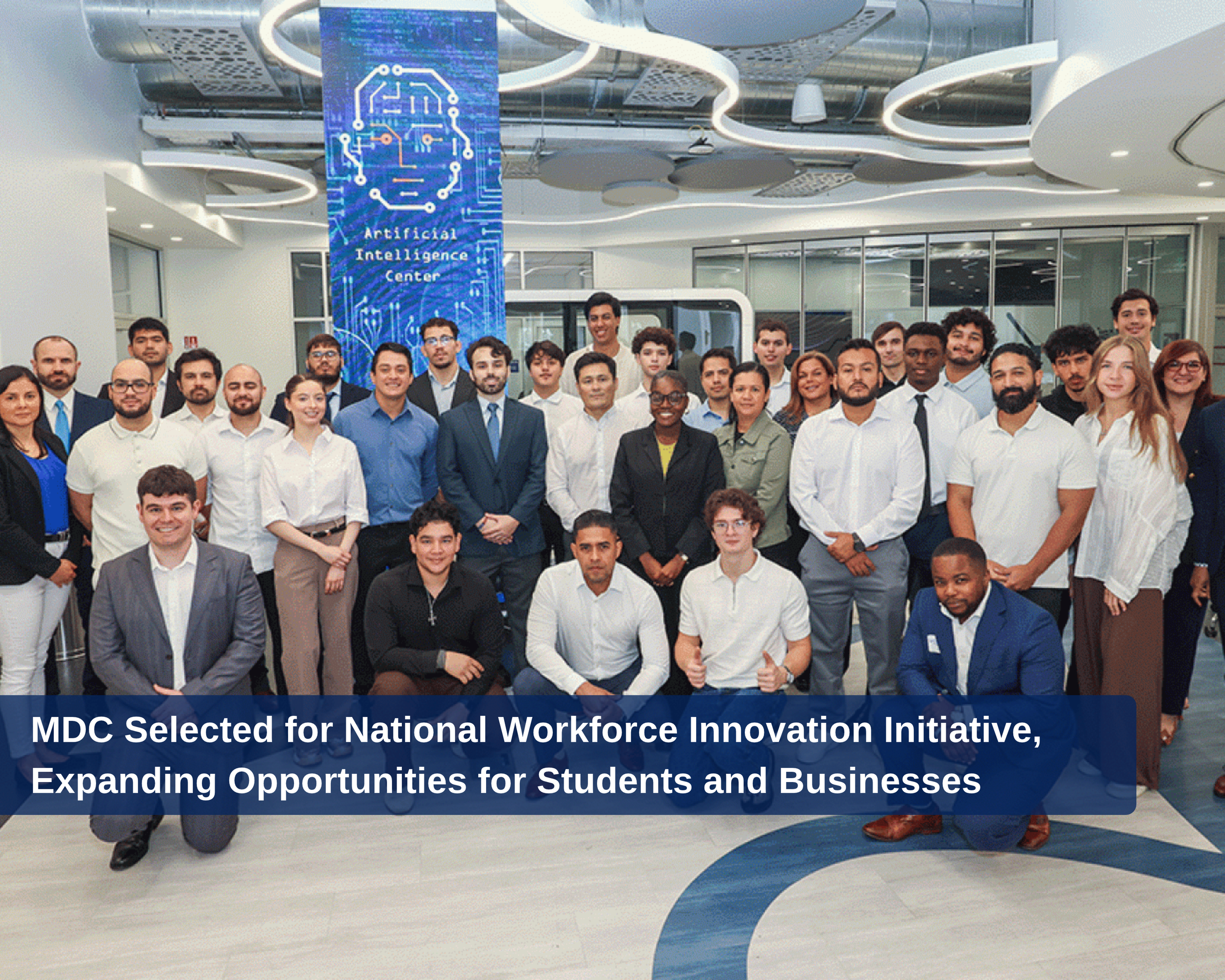
Miami Dade College (MDC) has been selected as one of 12 colleges and universities nationwide to participate in the Business-Higher Education Forum's (BHEF) Expanding High-Quality Work-Integrated Learning initiative. MDC is the only Florida institution chosen for the program, which will explore more flexible ways for students to gain hands-on experience while helping small and midsize employers access emerging talent.
Supported by Ascendium Education Group, the two-year initiative will provide participating institutions with grants of up to $65,000 each to design and test approaches such as micro-internships, short-term industry projects, and other work-based learning experiences.
“Miami Dade College is pleased to be part of this national cohort,” said MDC President, Madeline Pumariega. “This pilot will allow us to develop work-based learning experiences that fit the realities of our students’ lives and the capacity of small and midsize employers in our community. We look forward to building these opportunities together and sharing what we learn.”
Together, the 12 institutions aim to engage at least 1,200 students and 36 employer partners through October 2028:
Bowling Green State University (OH)
Drake University (IA)
East Stroudsburg University (PA)
Harrisburg University of Science and Technology (PA)
Houston City College (TX)
Miami Dade College (FL)
Montgomery College (MD)
San Jacinto College (TX)
SUNY Polytechnic Institute (NY)
University of Idaho (ID)
University of Nebraska at Omaha (NE)
University of North Texas (TX)
While the funding is relatively modest, the broader opportunity could be significant for South Florida's workforce and economic development ecosystem, particularly as businesses navigate rapid technological change and growing demand for specialized skills. Miami Dade College was the only Florida institution chosen.
Bridging the Gap Between Education and Employment
The initiative addresses a persistent challenge in higher education: the gap between students seeking professional experience and employers able to provide it.
According to BHEF's national announcement, approximately 8.2 million learners sought internships, but only 3.6 million secured one. At the same time, small and midsize businesses account for roughly 46% of the American workforce yet participate less frequently in structured internship programs than larger corporations.
For smaller employers, traditional internships can require time, supervision, and administrative resources that may be difficult to accommodate. Shorter, project-based experiences offer an alternative, allowing businesses to collaborate with students on specific challenges without committing to a full-scale internship program.
"Small and midsize employers need early-career talent as much as any organization, but most work-integrated learning models were built around the hiring cycles and staffing capacity of large organizations," said Kristen D. Fox, CEO of BHEF.
Through its Work-Integrated Learning Innovation Center, BHEF is working to develop approaches that can be adopted across different educational institutions and industries, with particular attention to expanding access for students who may not otherwise have opportunities to participate.
Building on Miami Dade College's Existing Workforce Programs
MDC enters the national initiative with experience connecting students and employers through hands-on learning programs, particularly in emerging technology fields.
One example is the college's AI Elite Talent Hub, launched in September 2026. The 10-month program connects students with 15 industry partners through applied artificial intelligence projects, mentorship, professional development, and opportunities to transition into paid summer internships.
The program reflects a growing emphasis on integrating classroom instruction with real-world business applications, allowing students to develop technical expertise while gaining exposure to workplace expectations and industry challenges.
Another initiative demonstrating this approach is the Employer Provided Innovation Challenge (EPIC), operated through Miami Tech Works. Developed in partnership with the U.S. Chamber of Commerce Foundation and Riipen, EPIC pairs student teams with South Florida employers to complete short-term projects involving artificial intelligence, automation, web development, data analysis, marketing, and process improvement.
According to MDC, participation grew from 20 students working with four companies in summer 2025 to 53 students and 13 employers in spring 2026. The growth illustrates increasing interest in practical learning experiences that provide value to both students and businesses.
These existing programs offer MDC a foundation for its participation in the BHEF initiative, with an opportunity to refine and expand approaches that can serve more employers and learners across the region.
What This Could Mean for South Florida's Innovation Economy
South Florida's business community includes a diverse mix of startups, technology firms, healthcare organizations, financial services companies, manufacturers, and professional services providers. Many are exploring ways to integrate artificial intelligence, automation, and other emerging technologies into their operations.
For these businesses, access to skilled talent is an important component of growth and competitiveness. Yet smaller organizations may struggle to recruit and develop employees through conventional channels. Work-integrated learning offers a different approach.
A startup could engage students to evaluate a new product concept or research an emerging market. A healthcare technology company might collaborate with a student team on workflow improvements, while a small business could explore opportunities to automate routine processes or strengthen its digital marketing strategy.
Although these are illustrative examples rather than confirmed projects under the new initiative, they demonstrate how targeted collaborations could benefit employers while providing students with relevant professional experience. Such partnerships could also strengthen relationships among educational institutions, local businesses, chambers of commerce, technology associations, and economic development organizations.
For a region working to attract and retain innovative companies, building stronger connections between education and industry may prove just as important as attracting investment.
Expanding Access and Building Long-Term Workforce Solutions
Beyond connecting students with employers, the initiative aims to expand career opportunities for learners who have historically faced barriers to traditional internships, including first-generation college students, Pell Grant recipients, and those balancing education with employment or family responsibilities.
By introducing shorter projects, virtual opportunities, and more flexible learning models, participating institutions hope to make professional experience more accessible while creating pathways to meaningful employment and greater economic mobility.
Over the next two years, MDC and the other participating institutions will work with BHEF to develop, test, and evaluate these approaches. Through technical assistance, coaching, and peer collaboration, the initiative will identify effective practices that can be shared through the BHEF Work-Integrated Learning Innovation Center, potentially allowing other colleges and employers to replicate successful models.
For South Florida, success will depend on more than student participation. Key measures will include the quality of learning experiences, employer engagement, transitions into paid internships or employment, and whether businesses see measurable benefits through improved productivity, access to talent, and recruitment opportunities.
While MDC-specific participation and employment targets have not yet been publicly detailed, the initiative presents an opportunity to establish sustainable partnerships that extend beyond the initial grant period.
Ultimately, the program's long-term impact will be measured not simply by the number of students served, but by its ability to create lasting connections between education and industry, expand economic opportunity, and strengthen South Florida's workforce.
Investing in South Florida's Future Workforce
As artificial intelligence, automation, and digital transformation reshape industries, the relationship between higher education and business is becoming increasingly important. Preparing students for the future workforce requires more than academic credentials. It also requires opportunities to apply knowledge, develop professional relationships, and understand how emerging skills translate into real business needs.
MDC's selection for this national initiative represents an opportunity to strengthen those connections while exploring models that could benefit businesses traditionally underserved by formal internship programs. For South Florida, the larger opportunity is to build a workforce development ecosystem in which colleges, employers, startups, and community partners collaborate more directly to develop and retain local talent.
The true measure of success will not be the size of the grant, but whether these partnerships create sustainable career pathways for students while helping South Florida businesses grow, innovate, and compete.





Miami Dade College has been selected as Florida's only institution in a national workforce innovation initiative led by the Business-Higher Education Forum. Building on programs like AI Elite Talent Hub and EPIC, the college aims to expand hands-on learning opportunities, connect students with small and midsize businesses, and strengthen South Florida's growing technology talent pipeline.