

AutoNation Turns to Starlink to Strengthen Connectivity Across Its Nationwide Dealership Network
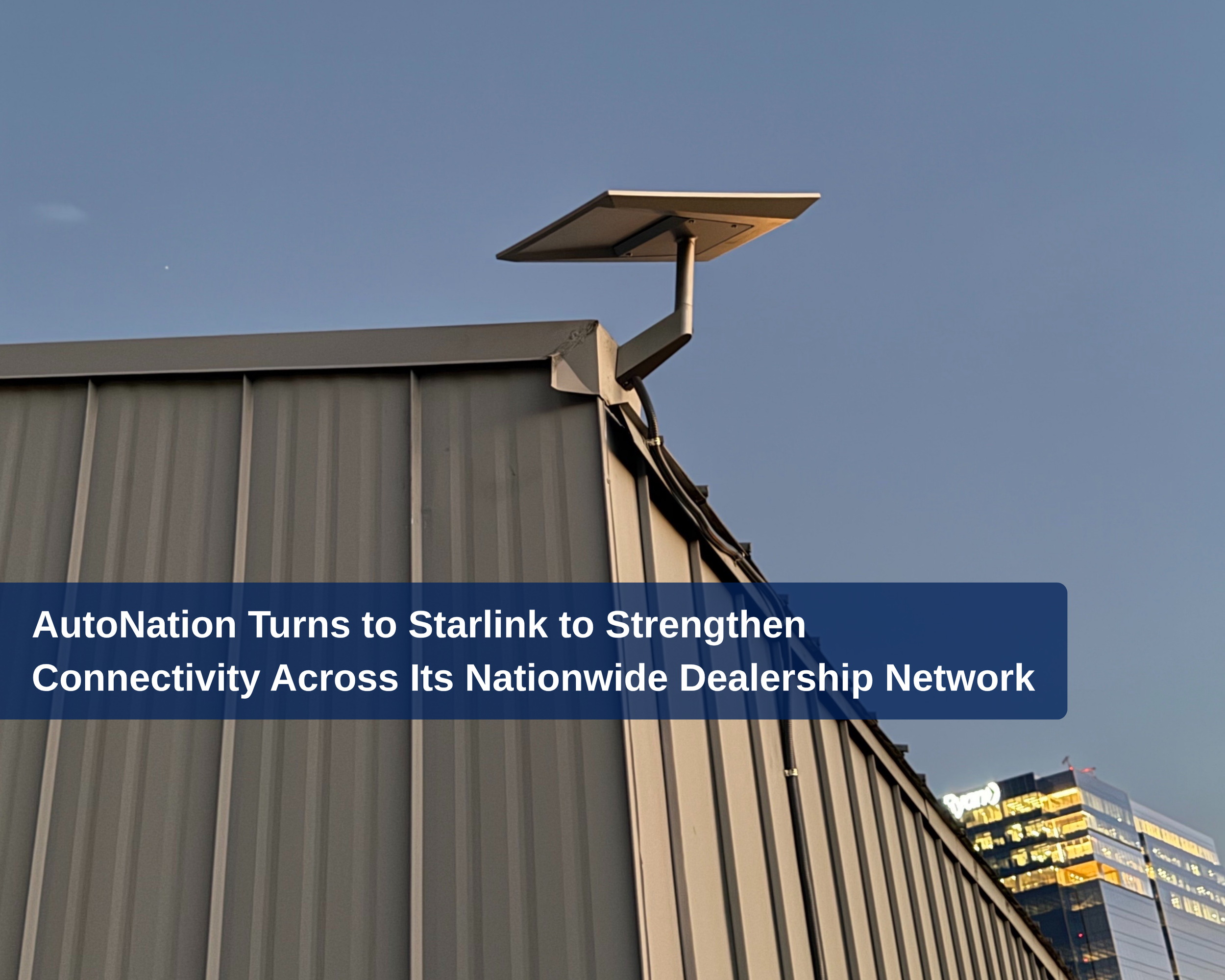
As businesses become increasingly dependent on always-on connectivity, one of South Florida's largest companies is looking beyond traditional terrestrial networks to keep its operations running.
Fort Lauderdale-based AutoNation has deployed Starlink connectivity across more than 70 retail locations nationwide, becoming what the company says is the first automotive retailer to implement the satellite technology at scale.
The deployment is designed primarily to strengthen network resiliency and business continuity at dealerships where traditional secondary broadband options are limited. AutoNation operates across 18 states, and reliable connectivity supports functions ranging from vehicle sales and financing to service operations, parts ordering and customer communications.
Rather than replacing AutoNation's existing connectivity, Starlink is being used to address gaps in traditional network infrastructure and provide another option for keeping dealerships connected when adequate backup broadband isn't available.
“Reliable connectivity is foundational to how our stores serve customers every day,” said Adam Rasner, Vice President of Technology Operations at AutoNation. “Terrestrial networks are more susceptible to outages, and integrating Starlink's connectivity into our network strategy has strengthened our ability to keep dealership operations running where traditional backup solutions are limited or too slow to deploy.”
From Pilot to More Than 70 Locations
The project did not begin at its current scale. According to AutoNation, the Starlink deployment started with a small subset of stores before expanding to more than 70 locations. The company points to Starlink's ability to scale without requiring significant infrastructure changes as one of the advantages that allowed it to expand the deployment.
AutoNation also reports that the deployment provides higher-performance, low-latency connectivity compared with the traditional connectivity alternatives available to these locations. Starlink's solution allows capacity to be pooled across locations, an approach designed to provide greater flexibility across a distributed enterprise network.
Rasner said separately that AutoNation's Technology team worked alongside Starlink on the deployment and that the solution has helped the company maintain connectivity and avoid operational or transactional impact at participating locations.
For an automotive retailer, connectivity interruptions can have consequences extending far beyond internet access. Dealership networks support transactions and operational systems involved in selling, financing, servicing and maintaining vehicles.
Part of a Larger Network Modernization Strategy
The Starlink deployment builds on a broader network modernization effort underway at AutoNation. Years before adding satellite connectivity, AutoNation began moving its retail network away from legacy Multiprotocol Label Switching, or MPLS, infrastructure and toward software-defined wide area internet curcuits..
Palo Alto Networks reported in 2021 that AutoNation had more than 350 distributed locations at the time and was dealing with a wide area network architecture that had become complex, slow and unreliable. The retailer ultimately selected Prisma SD-WAN and moved forward with deployment across its branch locations.
The results were significant. Palo Alto Networks reported that AutoNation reduced the time required to bring a new branch location online by 95% and increased bandwidth while reducing annual operating expenses by millions of dollars.
More recently, Palo Alto Networks reported that Prisma SD-WAN is deployed across AutoNation's stores, data centers and cloud environments. The company also said AutoNation can now deploy the technology at new branches in approximately 30 minutes, compared with previous waits of 60 to 90 days for new MPLS circuits.
The addition of Starlink introduces another form of connectivity into that evolving network strategy. The Starlink system relies on a constellation of satellites in low Earth orbit rather than the terrestrial infrastructure used by conventional wired broadband. For AutoNation, the technology provides an alternative connectivity option at stores where conventional secondary broadband may be unavailable or impractical to deploy.
A New Role for Satellite Connectivity
AutoNation's implementation also demonstrates how satellite connectivity is finding a place within enterprise technology environments.
Historically, satellite internet has often been associated with remote areas lacking wired broadband. AutoNation's deployment instead positions the technology as part of a business-continuity strategy for a large company operating a geographically distributed network of physical locations.
“AutoNation is using Starlink in a way that reflects the future of business connectivity — resilient, scalable, and designed to support critical operations,” said Lauren Dreyer, Vice President of Starlink Business Operations at SpaceX. “We are proud to support AutoNation’s commitment to operational continuity and customer service across its national retail footprint.”
For AutoNation, that resiliency challenge isn't new. The company's previous network modernization efforts were also driven in part by reliability and scalability. Palo Alto Networks reports that AutoNation's legacy corporate and store networks experienced outages and performance problems while the company's bandwidth requirements continued to grow. Its transition to SD-WAN allowed the retailer to use standard broadband connections while centrally managing connectivity across its distributed locations.
Adding a satellite-based option creates another potential pathway for keeping a dealership connected when terrestrial alternatives are inadequate.
The Deployment May Not Stop at 70 Locations
AutoNation has not announced plans to deploy Starlink throughout its entire retail network, but the company has made clear that it is evaluating additional applications for the technology.
Those potential uses include connectivity for new locations, disaster recovery and broader network resiliency across AutoNation's operations. That could make the current 70-plus-location deployment an important test case for how satellite connectivity fits into AutoNation's longer-term infrastructure strategy.
For a company whose retail operations increasingly depend on cloud applications, digital transactions and connected systems, network redundancy is no longer simply an IT consideration. Connectivity can directly affect whether employees can serve customers and conduct business.
AutoNation's adoption of Starlink illustrates how the definition of enterprise connectivity is expanding as companies combine traditional broadband, software-defined networking and emerging satellite infrastructure to build more resilient operations.
For a company headquartered in South Florida, a region where business continuity and disaster preparedness carry particular importance, that evolution is one worth watching.




Miami-based TrustedRouter has raised $1.25 million in seed funding as demand grows for infrastructure connecting businesses with multiple AI models. The startup provides access to more than 600 models across over 81 providers while helping users select models based on performance, cost, privacy, and reliability. TrustedRouter is also emphasizing confidential computing and open-source technology to protect sensitive customer data. The funding adds another AI infrastructure startup to South Florida’s growing technology ecosystem.