
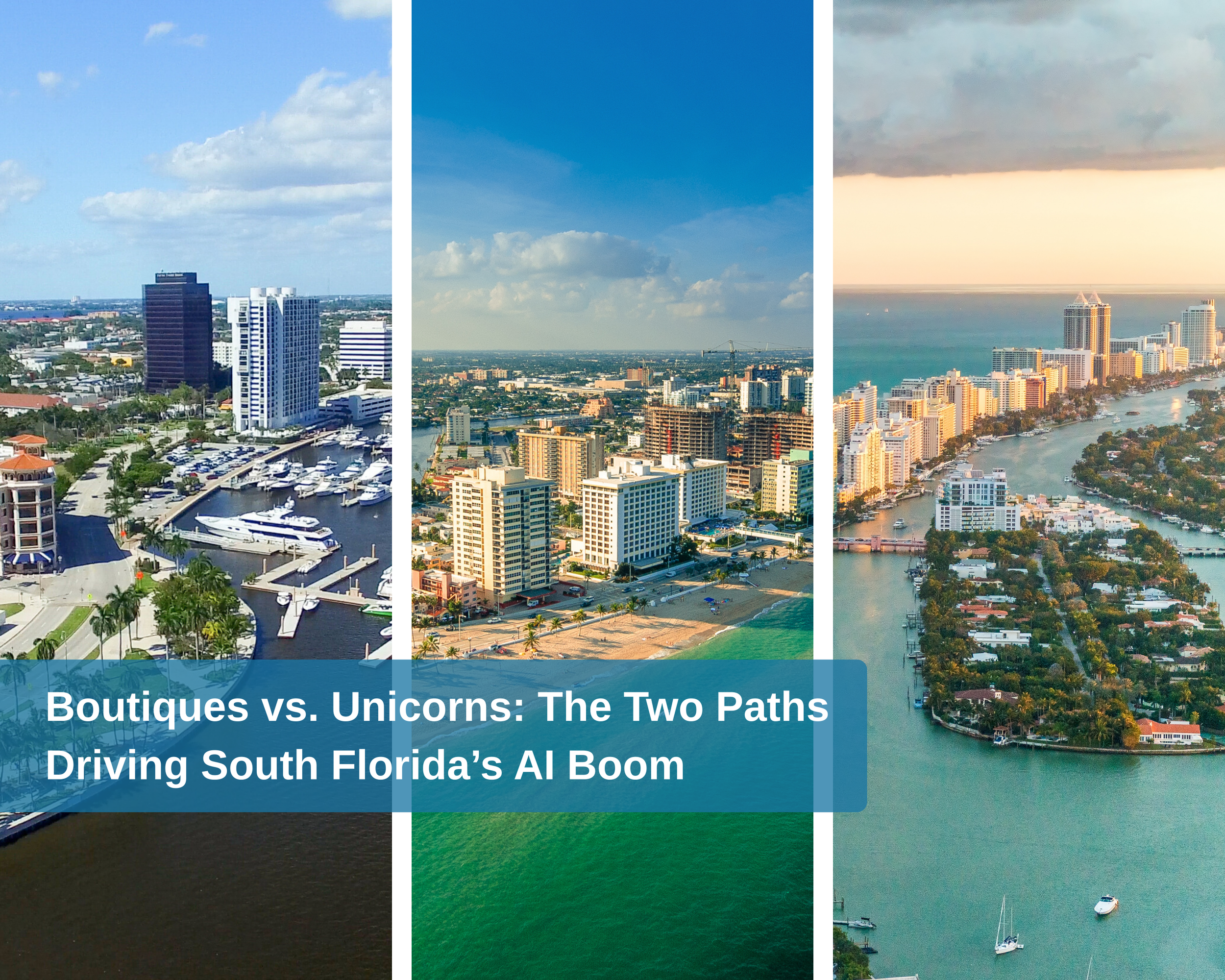
Boutiques vs. Unicorns: The Two Paths Driving South Florida’s AI Boom
On a weekday morning in Fort Lauderdale, a small law firm signs a five-figure contract with a local AI consultancy to streamline client intake, draft first-pass documents and triage email. That same week, a Miami cloud automation startup closed a nine-figure funding round that pushes it close to unicorn status.
Both headlines point to “AI growth” in South Florida, but they reflect very different strategies. Fort Lauderdale is leaning into boutique AI agencies that deliver hands-on projects for service businesses. Miami is courting late-stage capital, near-unicorn valuations and platform-scale companies.
For executives, investors and policymakers, the question is no longer whether South Florida has an AI story. The question is what kind of AI economy the region wants to build.
Broward and Palm Beach AI Boutiques: High-Touch and Local
Fort Lauderdale has begun attracting a cluster of AI consultancies and agencies focused on practical implementation for local companies. Firms such as Opinosis Analytics, AI Powered Consulting, Agent Architects and SG1 promote AI audits, workflow automation and staff training aimed at midmarket companies and small businesses.
The pattern among these firms is consistent. They tend to:
Package projects as fixed engagements rather than open-ended experiments.
Focus on sectors that anchor Broward County’s economy, including real estate, health care, legal services, marine industries, tourism and professional services.
Pricing models reflect this approach. One Palm Beach County AI consultancy offers “Starter,” “Growth” and “Premium” packages ranging from about $15,000 to $35,000, typically including audits, staff training and ongoing optimization with a stated return-on-investment goal.
This model appeals to owners running clinics, brokerages or medspas who want clear value rather than experimental technology. They do not need to build AI models. They need fewer manual steps, faster proposals, cleaner data and less staff time spent on repetitive tasks. A boutique consultancy can study existing workflows and integrate AI into the tools employees already use.
The capital structure also differs from venture-backed startups. These firms often operate with small teams and minimal infrastructure. Revenue comes from project fees and retainers rather than large equity rounds.
Growth depends heavily on reputation and referrals across Palm Beach and Broward’s business networks, including the offices along Las Olas Boulevard, across Boca Raton, and downtown West Palm Beach. Curated directories of “top AI development companies” now list multiple vendors, suggesting growing demand across the two counties.
In many ways, this model brings AI to “Main Street” first. Dental practices, homeowners associations, logistics firms and yacht service providers gain access to automated scheduling, risk scoring and content generation long before they encounter a pitch from a Silicon Valley venture firm.
Miami Metro AI Startups and Unicorn Ambitions
The Miami Metro region tells a different AI story.
First, let’s define the “Miami Metro region.” The Miami metropolitan area, often called South Florida, the Gold Coast, or the Tri-County Area, is the most populous region in Florida and the Southeastern U.S., with over 6.4 million residents. It consists of Miami-Dade, Broward, and Palm Beach counties, stretching over 100 miles north-to-south, including major cities like Miami, Fort Lauderdale, and West Palm Beach.
Miami Metro region statistics are often confused with or promoted as the City of Miami or from the county alone. In order to truly understand the statistical significance, this distinction must be understood. Historically, local media outlets haven’t done a great job of defining this by making the distinction which causes misunderstanding from readers and those trying to educate themselves about the region. With that said, although the larger, more impressive number comes from the region as a whole, the county of Miami-Dade certainly pulls its weight.
The Miami Metro region ranks 22nd globally and 10th in the United States in the 2025 Global Startup Ecosystem Report from Startup Genome, which analyzes more than 350 startup ecosystems and more than 5 million companies.
Funding data reinforce that position.
An eMerge Americas insights report found that the Miami–Fort Lauderdale metropolitan area attracted roughly $2.77 billion in startup funding in a recent year, capturing the majority of Florida’s venture capital investment.
AI sits near the center of that activity. In the first half of 2025, AI-related deals accounted for roughly 42% of local venture activity in South Florida, representing about $830 million in capital.
One example is Cast AI, a Miami-based cloud infrastructure automation company that helps organizations reduce the cost of AI and Kubernetes workloads. The company recently closed a $108 million Series C round, pushing its valuation to an estimated $850 million to $900 million (just short of unicorn status) and bringing its total funding to more than $180 million.
The larger “Miami model” often pushed by Miami-Dade County centers on platform-scale ambition. Companies target global user bases, large recurring revenue streams and exits driven by national or international markets. Local customers matter, but investor presentations tend to focus on total addressable markets far beyond South Florida.
Two Risk Profiles for One Region
These two approaches carry different risk profiles.
Palm Beach and Fort Lauderdale’s boutique consulting model ties revenue closely to local business cycles. A slowdown in Broward tourism or real estate could reduce consulting budgets. However, project-based work can remain resilient during venture capital downturns because business owners still need to reduce manual work and improve efficiency.
Miami’s venture-backed AI startups follow a different pattern. When funding is abundant, companies can rapidly expand headcount and salaries for engineers and product leaders. When venture markets tighten, hiring freezes and layoffs can arrive just as quickly. National venture data from 2022 through 2024 already showed sharp swings, and Miami is not immune to those cycles.
Job types also differ. Venture-backed startups recruit cloud architects, research engineers and global go-to-market leaders. Boutique consultancies employ process analysts, trainers, prompt engineers and account managers who work directly with local clients.
In practice, the region already functions as a corridor. Employees commute across county lines, and capital raised in Miami often funds projects implemented in Broward and Palm Beach counties. Transit connections and regional mobility apps linking buses and trains increasingly support that cross-county movement.
What South Florida Business Owners Should Watch
For a Palm Beach medical practice or Ft. Lauderdale logistics company, the first practical step into AI often begins with a boutique consultancy. Local agencies that understand Florida regulations and industry terminology can map workflows, run pilot programs and train employees.
These firms also act as intermediaries between global technology platforms and local teams. A Miami startup may provide a powerful cloud-based product, but a Fort Lauderdale consultant often handles configuration, data preparation and change management so staff members actually adopt the tool.
For midmarket companies operating in several states, the most effective strategy often combines both models. Leadership may adopt a Miami-developed platform for core infrastructure and then hire boutique firms to integrate it across locations in Broward, Palm Beach and beyond.
For founders, however, the choice can be clearer. A small firm in Fort Lauderdale must decide whether it wants steady project revenue or whether it intends to pursue venture funding and platform scale in Miami. Attempting both strategies for too long can create confusion for employees and investors.
Policy Choices for a Shared AI Future
Local governments and economic development leaders do not need to choose between Palm Beach and Broward’s boutique consultancies and Miami’s venture-backed startups. Policies can support both models.
In Broward County and Fort Lauderdale, the focus may be on accelerating small-business AI adoption. That could include matching grants for automation projects, procurement programs that allow local AI firms to serve county departments and workforce training that helps office workers develop AI literacy.
Miami-Dade County, by contrast, may focus on research talent, capital formation and global visibility. Initiatives could include stronger ties between universities and AI companies, visa support for founders from Latin America and industry conferences centered on AI infrastructure, fintech and health technology.
Regional planning organizations can collaborate on shared priorities such as data governance standards for public-sector AI projects, ethical guidelines for AI use in real estate and health care and joint marketing that positions South Florida as a unified technology region with diverse strengths.
Looking Ahead for South Florida AI
Over the next five to ten years, the success of South Florida’s AI economy is unlikely to hinge on a single Miami IPO or a viral case study from a Palm Beach consultancy.
A more resilient scenario looks different: Miami-based AI platforms attract global customers and investment, while Palm Beach and Fort Lauderdale boutiques translate those tools into operational improvements for clinics, logistics firms and marinas.
The traffic along Interstate 95 may remain heavy, but the economic connection between Palm Beach, Broward and Miami-Dade counties could grow stronger.
If that vision takes shape, “South Florida AI” will come to mean both the software running in global data centers and the consultants standing in conference rooms, helping local teams learn how to use it.



2150 co-founder Christian Hernandez Gallardo is leaving venture capital to become Executive Chair of Boca Raton-based Blue Frontier, helping the climate-tech company scale manufacturing, expand internationally and capitalize on growing demand for energy-efficient cooling as AI and data centers place new pressure on the electrical grid.