
eMerge Americas 2026: South Florida Steps Fully Into the Global Innovation Arena
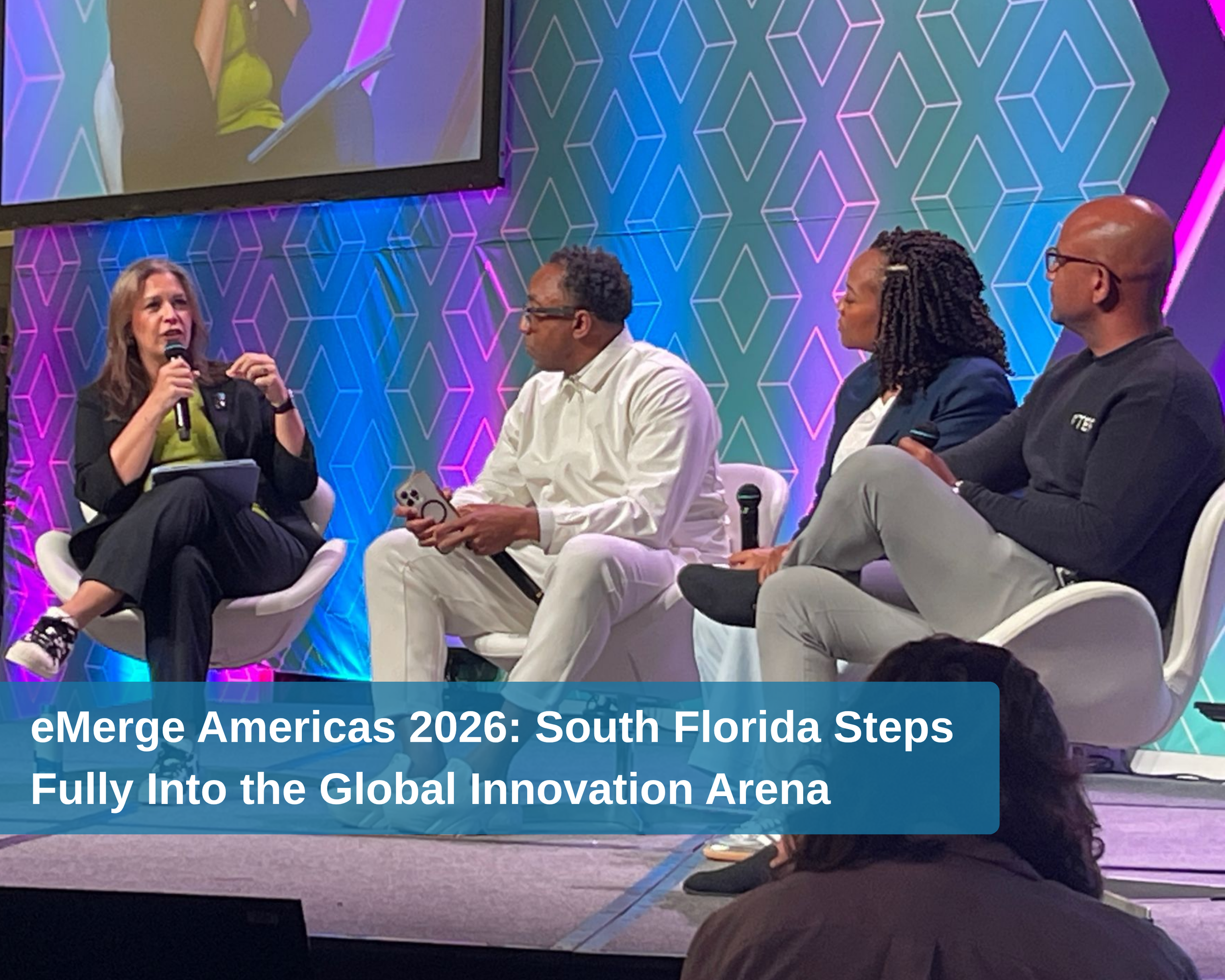
South Florida’s tech week wrapped its most expansive run yet, and the message coming out of Miami Beach was unmistakable: the region is no longer positioning itself as an emerging tech hub because it is actively operating as a global one.
More than 20,000 attendees from 60 countries converged on eMerge Americas 2026, filling the Miami Beach Convention Center with founders, investors, corporate leaders, and policymakers for two days of programming across AI, national security, healthtech, fintech, and small business innovation.
What stood out most wasn’t just scale - it was confidence. The tone across stages, side conversations, and startup showcases reflected a region no longer asking for validation, but demonstrating impact.
International Expansion Takes Center Stage Before eMerge Opens
Ahead of the main conference, the Market Expansion & Trade Forum 2026, presented byIMPACTIFI, set the tone for the week.
Held April 20–21 at The LAB Miami, the international immersion program connected global companies, investors, and trade organizations in curated working sessions designed to accelerate cross-border growth.
The numbers alone reflected the scale and intent behind the gathering:
200+ registered attendees
29 international countries represented
50+ international companies actively exploring U.S. market entry
14 consulate representatives in attendance
17 trade office representatives in attendance
There was global representation from trade commissions, consulates, and strategic partners across Spain, Chile, Colombia, Costa Rica, the Netherlands, England, France, Mexico, Ecuador, the United Arab Emirates, and beyond.
But what stood out most wasn’t just participation - it was purpose.
What stood out most wasn’t just the numbers, but the intent as companies didn’t show up to learn; they showed up to enter, expand, and execute and this is exactly where IMPACTIFI operates.
That execution-focused mindset carried across the sessions, where conversations moved quickly from introductions to implementation, covering regulatory readiness, partnerships, and commercialization strategy.
And perhaps most importantly, the experience reinforced a deeper truth about how international growth actually happens.
“Expanding into a new market is more than a strategy. It requires the right ecosystem, “shared Teresa Grandal Cusse, IMPACTI’s CEO and co-founder. “At IMPACTIFI, we support companies through the market entry process by connecting them to the partners, resources, and context needed to succeed, while leveraging South Florida as a strategic gateway and testing ground for broader global expansion.”
Rather than focusing solely on visibility, the forum emphasized commercialization, compliance, and market readiness, reinforcing South Florida’s growing role as a gateway for international innovation and investment.
This wasn’t just a networking event. This was global alignment happening in real time.
The momentum generated during these early sessions created a natural runway into eMerge Americas 2026, underscoring how the region is evolving from hosting global conversations to facilitating real market entry, collaboration, and expansion.
The Big Show: A Conference That Now Looks Global
eMerge Americas 2026 has steadily evolved since its first conference in 2014, but the 2026 edition marked a clear inflection point, one where the scale, sectors represented, and caliber of participation reflected a conference operating firmly on the global stage.
This year’s event featured:
20,000+ attendees from more than 60 countries
4,000+ unique companies represented across the expo floor
300+ exhibitors showcasing emerging and enterprise technologies
1,000+ investors and venture leaders engaging with startups and founders
2,500+ startups participating across showcases and programming
The structure of the conference itself reinforced this global positioning. Rather than operating as a single-track event, the experience was built around four major industry pillars, Artificial Intelligence, Finance, Health, and National Security, creating dedicated spaces for sector-specific collaboration while encouraging cross-industry innovation.
These focused pavilions weren’t just thematic because they reflected the industries most shaping the future of digital infrastructure, public safety, healthcare delivery, and financial resilience.
Title partners Mastercard and Recorded Future anchored the conversation at the intersection of fintech, cybersecurity, and global digital infrastructure. Their presence extended beyond branding, including keynote programming, curated networking sessions, and a 2,500-square-foot interactive technology showcase, reinforcing the role of trusted infrastructure as a foundation for global digital growth.
But what made the conference feel fundamentally different this year wasn’t just the numbers, it was the composition of the room. Government leaders, enterprise executives, venture capital firms, founders, and research institutions weren’t operating in silos. Instead, the conference floor felt increasingly integrated, reflecting a model where public-private collaboration is becoming essential to advancing innovation at scale.
The mainstage programming reflected that same shift.
Speakers spanned disciplines rarely seen together on a single platform, from entrepreneurs and national security leaders to healthcare innovators and global technology executives. Leaders such as Tim Tebow, Dr. Alex Oshmyansky, and Nicole Malachowski highlighted themes ranging from leadership resilience to healthcare access and national security innovation.
The result was a mainstage lineup that felt less like a regional showcase and more like a national, and increasingly international, policy and innovation forum, where conversations extended beyond technology into infrastructure, workforce development, and global competitiveness.
Mainstage Moments That Defined the Narrative
Bitcoin, Infrastructure, and Florida’s Economic Position
One of the most discussed sessions brought together Eric Trump, American Bitcoin’s Asher Genoot, and former Miami Mayor Francis X. Suarez, framing Bitcoin not as a speculative asset, but as infrastructure-level technology.
The conversation reflected a broader regional posture: Florida is increasingly positioning itself as a place where financial systems, digital assets, and policy innovation converge.
Leadership, Business Climate, and Florida’s Growth Narrative
Tim Tebow emphasized leadership grounded in discipline and purpose, while real estate and business leader Stephen Ross reinforced a sentiment echoed throughout the week, Florida’s position as one of the most competitive business environments in the country.
Together, these messages tie into a larger narrative: talent and capital are increasingly flowing toward regions that combine opportunity with execution speed.
Defense, AI, and the Future of Government Collaboration
A standout moment came from Emil Michael of the Office of the Under Secretary of War for Research & Engineering, who addressed one of the most persistent barriers for startups: working with government systems. He described the traditional defense procurement process as slow and opaque, likening it to “walking into the DMV without speaking the language.” New initiatives from DARPA and the Office of Strategic Capital, however, are aiming to streamline engagement with startups in AI, cyber, quantum, photonics, and advanced infrastructure, delivering “fast yes or fast no” decision-making.
This was one of the clearest signals that dual-use technology and national security innovation are becoming central pillars of the South Florida ecosystem.
Healthtech Disruption and Real-World Impact
Dr. Alex Oshmyansky of Mark Cuban Cost Plus Drug Company illustrated how structural innovation can dramatically reduce healthcare costs. His example, bringing a drug like albendazole from approximately $400 per tablet down to $5, highlighted how alternative supply chains and transparency models can fundamentally reshape healthcare access.
Autonomous Systems at Scale
Waymo’s chief product officer Saswat Panigrahi confirmed Miami’s growing role in autonomous mobility, noting the city is now the company’s eleventh full-service market, supporting 500,000 weekly autonomous trips across its network.
The scale-up, 10x growth in two years, reinforced Miami’s role as a real-world testing ground for advanced mobility systems.
Startup Showcase: Global Winners, Local Impact
The finale of eMerge Americas Startup Showcase brought together 100 qualifying startups, ultimately narrowing the field to five finalists who pitched live before a panel of seasoned judges, including Marcus Lemonis, Marcus Bodet, and Andrew Lane. The competition offered more than visibility as it delivered meaningful resources to help founders scale, including a $125,000 investment from eMerge Americas and B.I.G. Capital, along with $80,000 in pro bono legal services provided by Holland & Knight.
A standout moment of the week came when Nigerian startup Toluwai captured the Grand Prize, demonstrating how innovation continues to transcend geographic boundaries. The company delivers real-time production intelligence for the energy sector, helping operators “produce better, faster, and smarter,” according to co-founder Tosin Joel, who emphasized the team’s combined 60 years of industry experience. Their victory underscored one of the conference’s defining themes: innovation is increasingly borderless, and global founders are looking to South Florida as a launch point for growth.
Second place went to Grid, which secured $60,000 in legal services to support its continued development in the energy innovation space. Meanwhile, Remetian, representing Miami’s growing startup ecosystem, earned third place and $40,000 in legal services, marking an important local presence on an increasingly global stage.
The outcomes of the competition reflected a broader pattern seen throughout the week. The international momentum sparked during the IMPACTIFI Market Expansion & Trade Forum 2026 carried directly onto the eMerge show floor, where startups from Miami to Nigeria demonstrated that innovation is no longer bound by geography, but fueled by collaboration across borders.
A Region Claiming Its Position
Perhaps the most important takeaway from eMerge Americas 2026 was not a single announcement or keynote, but the collective signal emerging from across the event.
South Florida is no longer positioning itself as a “rising” tech hub. It is operating as one.
That shift is reflected not only in attendance numbers and investment activity, but in the diversity of global startups, the seriousness of policy conversations, and the increasing alignment between public institutions, private capital, and frontier technologies.
According to eMerge Americas, the company has contributed an estimated $2.51 billion in economic impact within their first decade in business and supported nearly 9,900 jobs across the region. But the 2026 edition suggests something even larger is underway: the transition from economic impact to ecosystem identity.
That identity is being shaped not just by events, but by collaboration, across industries, across borders, and across communities working together to build long-term infrastructure for innovation.
With the 2027 edition already scheduled for March 2–4 in Miami Beach, momentum is clearly accelerating. But the bigger question is no longer whether South Florida belongs in global tech conversations.
It’s how the region chooses to shape them next.



2150 co-founder Christian Hernandez Gallardo is leaving venture capital to become Executive Chair of Boca Raton-based Blue Frontier, helping the climate-tech company scale manufacturing, expand internationally and capitalize on growing demand for energy-efficient cooling as AI and data centers place new pressure on the electrical grid.