
The Fall of Spirit Airlines: What Happened, What It Means, and Why South Florida Is at the Center of What Comes Next
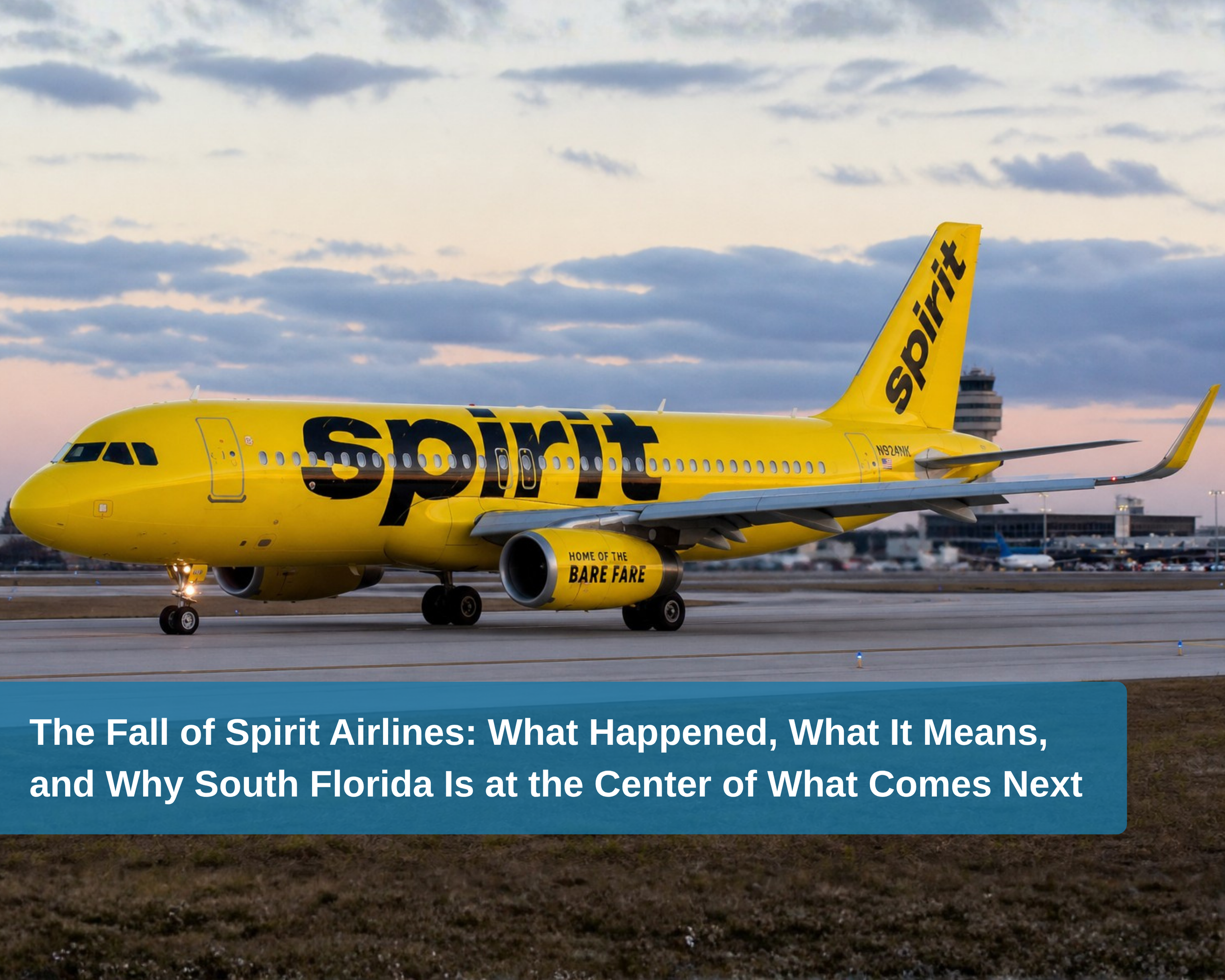
Today, Spirit Airlines ceased operations after more than three decades in business, marking one of the most significant airline collapses in the United States in recent history.
What began as an “orderly wind-down” quickly became a full shutdown: flights canceled, operations halted, and thousands of employees displaced almost overnight.
But Spirit’s story is not just about one airline. It’s about the evolving economics of aviation, the fragility of ultra-low-cost models, and a pivotal moment for regions like South Florida, where Spirit wasn’t just headquartered, but deeply embedded in the local economy.
A Collapse Years in the Making
Spirit’s shutdown was not caused by a single failure, but rather a convergence of pressures that had been building for years.
After multiple restructurings and mounting losses, the airline was already on unstable footing. A last-minute effort to secure a federal bailout ultimately fell through. Spirit sought a $500 million federal bailout to stay afloat. That deal ultimately collapsed after failing to gain sufficient support from creditors and policymakers, leaving the company without the liquidity needed to continue operations.
Spirit had already filed for bankruptcy twice since 2024 and had not sustained profitability since before the pandemic. Attempts to stabilize the business, including a blocked merger with JetBlue, left the company with limited strategic options. This merger could have offered a path forward, but never materializing, it closed off a critical strategic option.
A surge in jet fuel prices, driven by geopolitical instability and disruptions tied to the Iran conflict, significantly increased operating costs. For an ultra-low-cost carrier built on razor-thin margins, that shock proved fatal.
“For more than 30 years, Spirit Airlines has played a pioneering role in making travel more accessible and bringing people together while driving affordability across the industry,” said Dave Davis, Spirit’s President and Chief Executive Officer. “In March 2026, we reached an agreement with our bondholders on a restructuring plan that would have allowed us to emerge as a go-forward business. However, the sudden and sustained rise in fuel prices in recent weeks ultimately has left us with no alternative but to pursue an orderly wind-down of the Company. Sustaining the business required hundreds of millions of additional dollars of liquidity that Spirit simply does not have and could not procure. This is tremendously disappointing and not the outcome any of us wanted.”
Spirit’s ultra-low-cost model depended on high volume and tightly controlled costs. But in recent years fuel prices surged, labor costs increased, and operational complexity grew. These pressures exposed the limits of a model built on razor-thin margins.
What once made Spirit disruptive became increasingly difficult to sustain.
Spirit’s Legacy: A Lasting Impact on Air Travel
Despite its abrupt end, Spirit leaves behind a significant legacy, particularly in how Americans travel.
As one of the pioneers of the ultra-low-cost model in the U.S., Spirit fundamentally reshaped pricing across the airline industry. Its presence forced competitors to lower fares, even for passengers who never flew with the airline.
Nowhere was that impact more visible than in South Florida.
At Fort Lauderdale-Hollywood International Airport, Spirit helped establish the airport as a major low-cost gateway, connecting the region to domestic destinations, the Caribbean, and Latin America at accessible price points.
Its absence will not only reduce options, it will likely reshape pricing behavior across the region.
Industry Impact: Short-Term Disruption, Long-Term Reshaping
In the immediate term, Spirit Airlines’s shutdown is creating both disruption and redistribution across the aviation sector.
The most visible effects are operational. Flight cancellations, reduced seat capacity on other airlines, and a sudden displacement of both passengers and workforce are already rippling through the system. In response, airlines such as Southwest Airlines, American Airlines, Delta, and JetBlue are moving quickly to absorb demand and backfill critical routes.
At the same time, the shutdown is injecting a large pool of experienced aviation professionals into the market, including pilots, flight attendants, mechanics, and operational staff. For an industry that has been grappling with persistent workforce shortages, this creates a temporary but meaningful reprieve. Airlines gain faster access to certified talent, hiring cycles accelerate, and pressure on training pipelines eases.
Keith Sonderling, United States Acting Secretary of Labor, shared, “I’ve spoken with the Spirit Airlines CEO, union leaders of flight attendants and pilots, and U.S. Department of Transportation to coordinate support for impacted workers. He added, “ The U.S. Department of Labor is taking ACTION to support affected workers and help them get back to work quickly. From immediate unemployment support to job placement and retraining, here’s what DOL is doing for displaced workers now.”
However, this relief is expected to be short-lived. As demand for air travel remains strong, much of this workforce will be reabsorbed, and the underlying talent constraints will likely re-emerge.
Looking further ahead, Spirit’s exit signals deeper structural changes within the industry.
With one of the largest ultra-low-cost carriers gone, pricing pressure across the market is expected to ease. This will likely result in higher average fares, reduced access for price-sensitive travelers, and less competition across key leisure routes, particularly those that once relied on Spirit’s aggressive pricing model.
At the same time, the industry may shift toward a more consolidated and financially stable landscape. Remaining carriers could benefit from improved margins, more disciplined growth strategies, and stronger operational resilience.
The ultra-low-cost model itself is unlikely to disappear, but it will need to evolve. Spirit’s collapse underscores a broader reality: in today’s environment, scale, efficiency, and workforce stability are no longer advantages, they are requirements.
A Region at the Epicenter of Impact
Few regions will experience the impact of Spirit’s shutdown as directly as South Florida.
With a significant share of Spirit’s workforce based near Fort Lauderdale-Hollywood International Airport and Miami International Airport, the immediate effects are tangible: displaced employees, disrupted operations, and a sudden gap in one of the region’s most recognizable aviation employers.
At the same time, this disruption creates a rare and time-sensitive opportunity. A highly skilled, already-certified aviation workforce, pilots, mechanics, flight attendants, and operational staff, is now circulating within the regional labor market. For airlines and aviation employers, this represents immediate access to talent in an industry that has been constrained by persistent workforce shortages.
“With a sad heart, Spirit flew our last flight tonight. As we close our doors, I reflect deeply on this journey and all that it has meant to me. After 16 years with Spirit Airlines, it is still hard to put into words what this career has represented in my life,” shared Lisa Smith, Director of IT Ops at Spirit, in a heartfelt social media post.
She continued, “I began my path here as a contractor, never imagining that Spirit would become such an important and defining part of my professional and personal story. Over the years, I had the privilege of growing alongside the company—learning, adapting, and rising to new challenges as Spirit evolved.What I will cherish most are the people.”
The broader economic ripple effects are also significant. South Florida’s economy is deeply tied to tourism, cruise travel, and international connectivity, and Spirit played a meaningful role in keeping air travel accessible across these segments. Its absence is likely to result in higher average airfares, fewer budget-friendly travel options, and added cost pressure across tourism-dependent industries, including cruises and leisure travel.
Yet within this disruption lies a defining opportunity for the region.
Future Opportunity for South Florida
South Florida already possesses many of the core ingredients needed to lead in aviation workforce development: major international airports, established aviation training programs, and sustained demand for talent across the sector. What has been missing is alignment, between education providers, airlines, workforce organizations, and regional economic stakeholders.
If coordinated effectively, the region has the potential to evolve into a national hub for aviation workforce development, converting a moment of industry disruption into long-term structural advantage.
The shutdown of Spirit Airlines marks the end of an era in American aviation, one that helped democratize air travel and reshape fare competition across the country. Its absence will be felt immediately in pricing, access, and route availability. But its most lasting impact may be what it triggers locally.
For South Florida, this moment is not only about absorbing change, it is about organizing around it. In an industry defined by strong demand and constrained talent supply, the regions that move first to align education, workforce pipelines, and employer needs will define the next chapter of aviation growth.
And South Florida now has a rare window to do exactly that.





Palm Beach-based DeLorean Artificial Intelligence has been acquired by healthcare technology company WellStack in a deal combining predictive AI with healthcare data infrastructure. Founded in 2019, DeLorean developed technology designed to identify patient risks, predict disease progression, and support proactive interventions. The company had raised approximately $7.55 million before the acquisition. The transaction adds another healthcare AI exit to South Florida’s growing technology ecosystem.