
GBI Biomanufacturing Expands in South Florida, Signaling a Turning Point for the Region’s Life Sciences Infrastructure
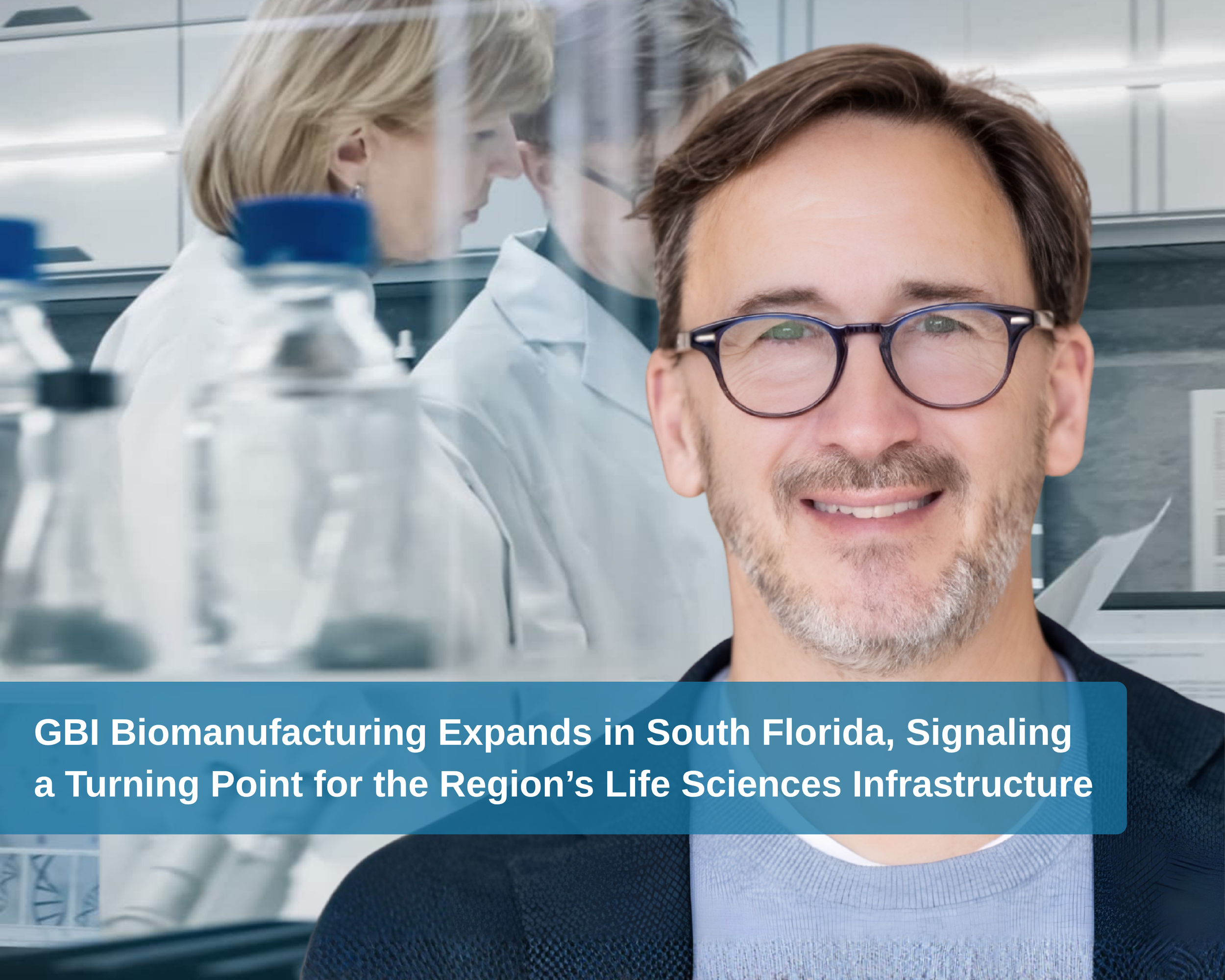
In a region long working to establish itself as a serious player in life sciences, GBI Biomanufacturing is making a move that may carry broader implications than its footprint suggests.
The Plantation-based biopharmaceutical contract development and manufacturing organization (CDMO) has entered a new phase of growth, marked by facility expansion, a significant ramp-up in stem cell production, and the appointment of industry veteran Jesse McCool as President.
Taken together, these developments position GBI not just as a service provider, but as a potential anchor in South Florida’s evolving biosciences ecosystem.
A Strategic Expansion Backed by Real Infrastructure
GBI recently signed a long-term lease to expand its headquarters and laboratory footprint in Plantation to 40,000 square feet, a more than 40% increase from its previous space. The expansion includes an additional 15,000 square feet of advanced bioreactor capacity and nearly $26 million in facility investment.
But this isn’t just a real estate story. It’s a manufacturing capability buildout.
In 1992 GBI, formerly Goodwin Biotechnology, Inc., was born from the longstanding non-profit Goodwin Institute for Cancer Research. Since 2023, GBI has been scaling a multi-product commercial cGMP facility designed to support complex biologics from development through commercial production. The expanded footprint includes:
Bioreactors ranging from 200L to 2,000L, across three dedicated process trains
A fully integrated process development lab with systems from 250mL to 40L for scale-up modeling
Downstream purification via multiple ÄKTA™ systems
Controlled bioconjugation using advanced synthesis platforms
A QC release lab and protein characterization lab
This tight integration between development and manufacturing is intentional, designed to enable seamless tech transfer from early-stage experimentation into GMP production.
On the production side, GBI has also invested in aseptic fill-finish capabilities, including automated systems capable of filling up to 10,000 vials and multi-format equipment supporting vials, syringes, and cartridges under FDA cGMP standards (21 CFR Parts 210 and 211).
The result is a facility built not just for flexibility, but for repeatability, compliance, and scale, which are often the limiting factors in bringing biologics to market.
Notably, this momentum has already drawn statewide recognition. In December 2025, GBI Biomanufacturing was named Manufacturer of the Year by BioFlorida at its 28th Annual Innovation Conference, highlighting the company’s role in advancing high-quality biomanufacturing across Florida.
Leadership for a New Growth Phase
In January 2026, the company appointed Jesse McCool as President, bringing more than two decades of experience across organizations such as Lonza Group, Wheeler Bio, and Cytovance Biologics.
His background spans:
Process development
Clinical and commercial GMP manufacturing
Advanced therapies, including plasmids and complex biologics
More importantly, his mandate is clear: translate scientific innovation into real-world impact.
Under his leadership, GBI is doubling down on its integrated CDMO model, offering coordinated development, analytical support, drug substance manufacturing, and fill-finish services under one roof.
Doubling Down on Stem Cell Production
At the center of GBI’s expansion is a clear bet: stem cells.
The company is doubling its production capacity, with plans to manufacture up to one million stem cell doses annually. These therapies are increasingly used in regenerative medicine applications, including:
Orthopedic injuries
Chronic pain management
Wound care
Tissue repair and regeneration
GBI’s infrastructure is particularly relevant here. Stem cell manufacturing requires tight environmental control, sterility, and viability assurance, areas where cGMP-grade facilities and validated processes are non-negotiable. According to McCool, the long-term goal is not just scale, but accessibility.
By industrializing production in a regulated environment, GBI aims to help bring down the cost of therapies that are currently not covered by insurance and often out of reach for most patients.
There’s also a competitive angle. Today, many patients travel internationally for stem cell treatments, often into loosely regulated environments. GBI’s approach positions Florida as a safer, domestically regulated alternative.
Policy Tailwinds and Real Risks
GBI’s expansion comes on the heels of a new Florida law allowing physicians to offer certain stem cell therapies not yet approved by the FDA, provided they meet specific manufacturing and safety requirements.
The legislation creates a structured pathway for access, but also introduces complexity.
On paper, the law mandates that:
Stem cells must be manufactured in FDA-registered facilities
Production must comply with cGMP standards
Physicians must verify post-thaw viability before use
In practice, however, enforcement remains unclear. That uncertainty is not trivial.
Without defined oversight, the market risks being diluted by noncompliant providers, undermining both patient safety and the credibility of legitimate manufacturers.
McCool himself has been direct about the challenge: the requirements are strong, but without enforcement, there is room for bad actors to cut corners.
Industry partners, including companies like Tavra Biosciences, have echoed similar concerns, particularly around contamination risks and product viability, critical factors when dealing with living cell therapies.
Why This Matters for South Florida
While GBI Biomanufacturing may not be a household name, its role is disproportionately important in understanding where South Florida’s life sciences ecosystem is headed.
Biotech ecosystems don’t scale on startups alone. They require a full stack of infrastructure, including research institutions, venture capital, talent pipelines, and critically, manufacturing capacity. GBI sits squarely in that last category.
Its expansion aligns with broader regional momentum, as companies like First Ascent Biomedical and Meso Scale Diagnostics continue to invest in South Florida operations. Together, these signals point to a region steadily building the operational backbone needed to support life sciences growth.
At the same time, structural gaps remain. A 2024 analysis found that while South Florida ranks among the largest U.S. life sciences markets by establishment count, it lags significantly in deeper ecosystem measures such as talent density, research output, and overall maturity. That gap is exactly where manufacturing-focused organizations like GBI become catalytic, translating scientific potential into scalable, regulated production capability.
Seen through that lens, GBI’s expansion is not just about facility size or output capacity. It reflects a broader shift underway: South Florida moving from a consumer of innovation to a producer of it.
But that transition is still in progress, and the outcome is not guaranteed. It will depend on whether the region can align regulatory clarity and enforcement, strengthen ties between industry and academia, and intentionally build a more connected innovation ecosystem across public and private sectors.
If those conditions come together, GBI’s investment could represent an early inflection point for a much larger transformation, one where South Florida is capable not only of supporting biotech innovation, but of scaling it globally. If not, it risks remaining an isolated success in a still-fragmented landscape.
Either way, the signal is clear: South Florida’s life sciences sector is no longer theoretical, it is operational and accelerating.



Palm Beach State College is investing $5.2 million in its automotive technology program at the Lake Worth campus. The investment combines $1.1 million in state funding with $4.1 million in federal funding to expand training in electric, hybrid, alternative-fuel, and diesel vehicle systems. A new 850-hour program is scheduled to launch in February 2027 with hands-on training in high-voltage systems, batteries, diagnostics, and advanced vehicle technology. The initiative reflects the growing intersection of skilled trades, software, electronics, and transportation technology.