South Florida Is Emerging as One of the First U.S. Regions Building a Full Quantum Pipeline System
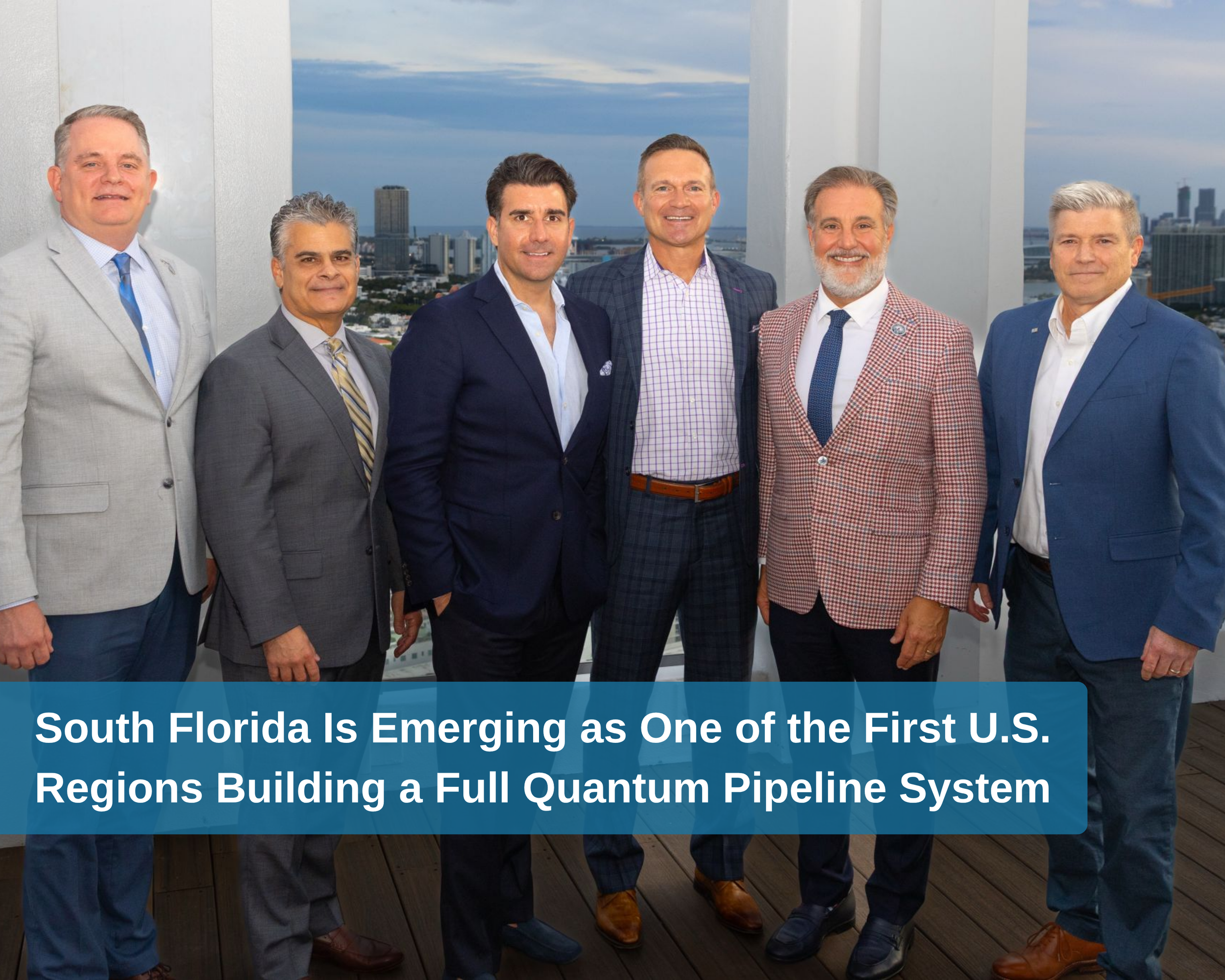
South Florida is beginning to take shape as something rare in the early quantum landscape: not just a cluster of research activity or pilot programs, but a coordinated, multi-layered ecosystem where infrastructure, workforce development, and applied deployment are starting to connect in real time.
Recent developments involving IonQ, Florida LambdaRail, and Florida Quantum point to a broader shift underway. Together with regional institutions like Florida Atlantic University and Palm Beach State College, these efforts suggest Florida is moving toward one of the first integrated quantum “pipeline systems” in the United States.
Rather than isolated initiatives, what is forming is a layered structure that connects talent, infrastructure, and real-world applications into a continuous ecosystem.
A Shift From Isolated Projects to a Connected System
Most emerging technology regions follow a familiar pattern: research develops in universities, industry adopts it later, and workforce training eventually tries to catch up.
What is unfolding in South Florida appears to be different in timing and structure. Multiple layers of the quantum ecosystem are developing simultaneously and within the same geographic corridor.
“This effort reflects a broader shift in how infrastructure is being designed. By aligning networks, institutions, and investment, Florida is laying the groundwork for a quantum ecosystem that has the potential to drive innovation, attract talent, and support new opportunities across the state,” said Matt Cimaglia, Managing Partner of Quantum Coast Capital and a founding member of Florida Quantum.
At the center of this shift is a growing alignment between four core components:
Infrastructure networks enabling secure, high-speed connectivity
Universities advancing applied quantum computing research
Colleges building workforce pipelines for technical roles
Ecosystem organizations coordinating development across sectors
This alignment is what begins to transform a set of projects into a system.
The Infrastructure Layer: Florida’s Quantum Backbone
The foundation of this emerging system is physical infrastructure. At the center of this effort is a planned 100-mile quantum corridor connecting Palm Beach County to Miami-Dade, built not as a concept or pilot, but on existing fiber already running through a statewide network.
That distinction matters.
Because while much of the country is still exploring quantum in theory, Florida is beginning to move it into real-world deployment.
Florida LambdaRail operates as Florida’s statewide fiber optic research network, connecting universities, healthcare systems, and public institutions through a 1,500-mile high-speed backbone.
In the latest initiative, Florida LambdaRail is serving as the deployment layer for a quantum-safe communications corridor in partnership with IonQ.
IonQ is a leading quantum technology company focused on building systems across quantum computing, networking, and secure communications. In this context, it is contributing quantum key distribution (QKD) technology designed to strengthen cybersecurity by enabling detection of any interception attempts during data transmission.
“Creating a statewide quantum network in Florida will mark another major milestone in the deployment of IonQ’s global quantum platform,” said Niccolo de Masi, Chairman and CEO of IonQ. “IonQ's quantum-secure communications and advanced networking capabilities strengthen innovation ecosystems, improve resiliency, and lay the foundation for future public and private sector applications.”
Together, these efforts are transforming existing fiber infrastructure into a testbed for quantum-secure communications, moving the concept from theory into real-world deployment.
“Florida LambdaRail's collaboration with IonQ in this innovative quantum initiative will enable partner universities, researchers, and students to move quantum from the lab setting to real-world deployment,” said Jason Ball, chair of the Florida LambdaRail Board of Directors and associate provost and chief information officer at Florida Atlantic University. "We're confident that this public and private project will be a catalyst to accelerate scalable quantum-secure connectivity across the state.”
The Applied Research Layer: Florida Atlantic University and D-Wave
At the applied research level, Florida Atlantic University is playing a central role in bridging academic work and real-world quantum use cases.
Through its partnership with D-Wave, FAU is integrating quantum computing systems directly into its research environment, making it one of the first universities in the region to host operational quantum hardware on campus.
D-Wave, the world’s first commercial supplier of quantum computers and the only company offering both annealing and gate-model quantum computing systems, software and services, will be relocating the company’s global headquarters to Boca Raton.
This shifts the university’s role beyond traditional research. Instead of only studying quantum theory, FAU is beginning to function as a testbed for applied quantum problem-solving in areas such as:
optimization
simulation
materials modeling
computational research tied to industry applications
This layer is critical because it connects academic exploration with practical deployment scenarios, helping translate quantum computing into usable tools.
The Workforce Layer: Palm Beach State College and Talent Development
A functioning quantum ecosystem also requires a workforce capable of supporting and maintaining it.
Palm Beach State College is addressing this need through the development of quantum-focused training programs designed to prepare students for technical and operational roles. The College was awarded $4.95 million from the Florida Job Growth Grant Fund to develop Florida’s first public-access Quantum Workforce Training Center, positioning Palm Beach County at the forefront of the state’s emerging quantum economy.
Unlike university-level research tracks, these programs focus on building practical skills needed to support emerging quantum infrastructure, including:
quantum lab and systems technicians
cybersecurity and infrastructure support roles
technical operations for advanced computing environments
applied STEM pathways aligned with industry needs
This workforce layer is essential for scalability. Without it, advanced infrastructure and research efforts risk remaining limited to small pilot programs rather than expanding into sustainable systems.
The Coordination Layer: Florida Quantum as Ecosystem Connector
Overlaying these efforts is a growing coordination structure led by Florida Quantum.
Rather than acting as a research institution or technology provider, Florida Quantum functions as an ecosystem connector. Its role is to align stakeholders across:
universities and colleges
private sector technology companies
infrastructure providers
and investment communities
This type of coordination is often what determines whether emerging technologies remain fragmented or evolve into scalable regional industries.
In this case, it is helping ensure that infrastructure deployment, academic research, and workforce development are not happening in isolation, but as parts of a shared strategy.
A Rare Moment of Convergence & Coordination
What makes South Florida notable in this context is not any single institution or project, but the convergence of all four layers within the same region:
A statewide fiber infrastructure backbone already in place
A leading quantum technology company enabling secure communications deployment
A university actively integrating quantum hardware into applied research
A college system building workforce pipelines aligned with future demand
A coordinating organization working across sectors to align development
Individually, each of these efforts would represent incremental progress. Together, they begin to form something more structurally significant.
Taken as a whole, South Florida is beginning to resemble one of the first regions in the United States where quantum is being built as a complete pipeline system:
Infrastructure layer - enables secure, high-speed quantum networking
Applied research layer - develops real-world quantum computing use cases
Workforce layer - trains and supplies technical talent
Coordination layer - aligns ecosystem development across institutions
This structure matters because it mirrors how mature innovation ecosystems evolve, where technology is not just invented, but continuously developed, deployed, and supported within a connected system.
This last layer, “The Coordination Layer,” is often where regions fall short. But here, organizations like Florida Quantum and Quantum Coast Capital are helping bridge those gaps, bringing together stakeholders that don’t always naturally operate in sync.
The result is something Florida doesn’t always get credit for: intentional ecosystem building.
A Region Looking Ahead
The significance of these developments is not only in what is being built today, but in what becomes possible as these layers begin to reinforce each other.
When infrastructure, talent, research, and coordination align within a single region, the result is not just technological advancement, it is ecosystem formation.
South Florida is still early in this process. But the direction is becoming clearer. Rather than waiting for quantum technologies to arrive fully formed, the region is beginning to participate in how they are built, tested, and deployed.
And in emerging industries, that distinction often defines who leads the next wave of innovation.


2150 co-founder Christian Hernandez Gallardo is leaving venture capital to become Executive Chair of Boca Raton-based Blue Frontier, helping the climate-tech company scale manufacturing, expand internationally and capitalize on growing demand for energy-efficient cooling as AI and data centers place new pressure on the electrical grid.