
Proposed Florida ‘AI Bill of Rights’ Seeks to Balance Innovation With Consumer Protection
Florida lawmakers are moving forward with legislation aimed at regulating artificial intelligence while simultaneously positioning the state as a destination for AI infrastructure investment.
The effort reflects a dual strategy taking shape across Florida’s technology policy landscape: establishing protections for consumers interacting with AI systems while attracting the data centers and computing facilities needed to support the rapidly growing industry.
The centerpiece of the initiative is the proposed Artificial Intelligence Bill of Rights, introduced in the Florida Senate as Florida Senate Bill 482 and backed by Governor Ron DeSantis.
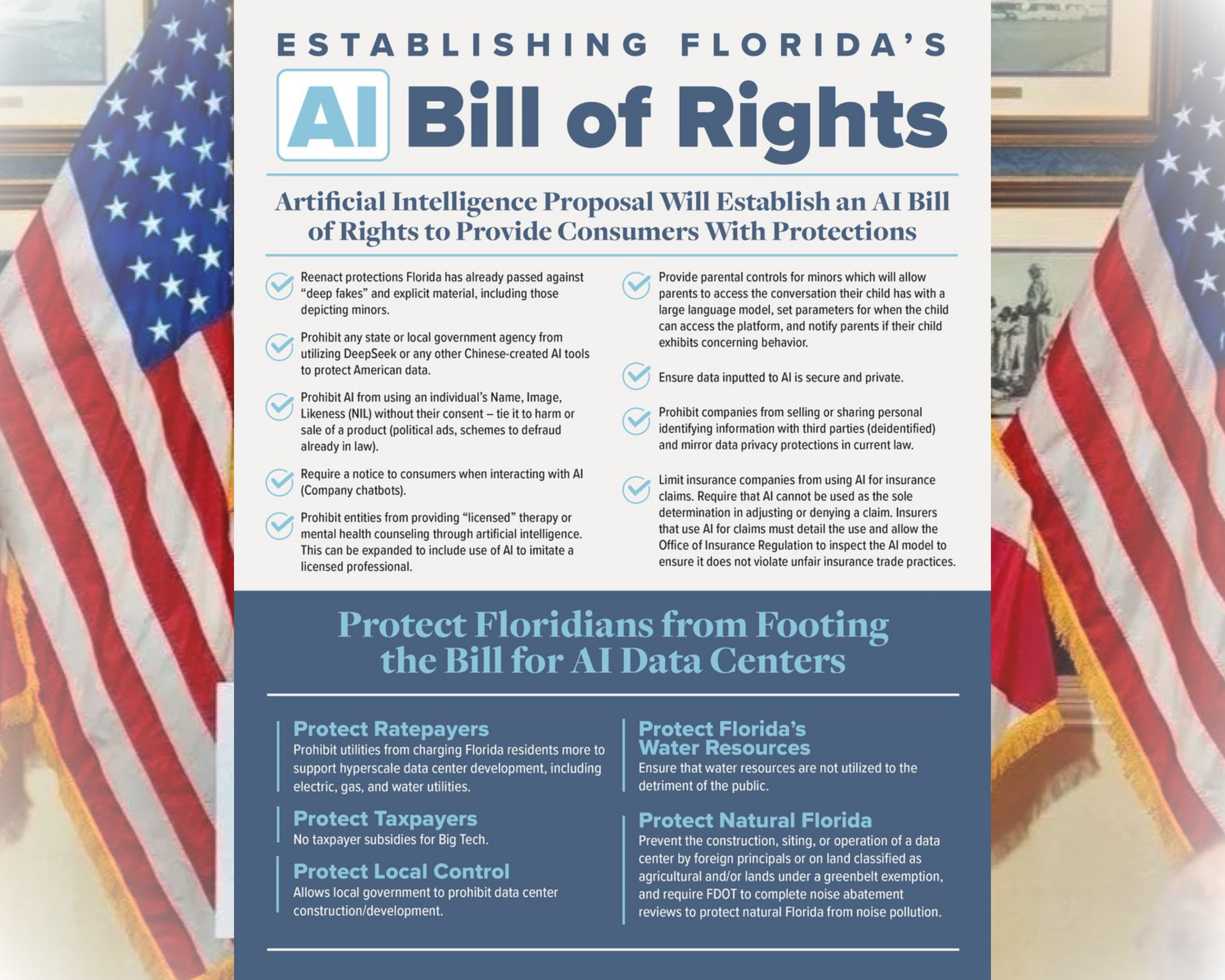
On December 4th, 2025, Governor DeSantis announced, “Today, I proposed new legislation on artificial intelligence and AI data centers to protect Floridians’ privacy, security, and quality of life. Our AI proposal will establish an Artificial Intelligence Bill of Rights to define and safeguard Floridians’ rights—including data privacy, parental controls, consumer protections, and restrictions on AI use of an individual’s name, image or likeness without consent.”
If approved by the Legislature, the bill would establish legal protections for Floridians related to AI-generated content, personal data and transparency in automated systems. The proposal could take effect July 1, 2026.
The legislation comes as states across the country begin implementing their own AI governance frameworks amid the absence of comprehensive federal regulation.
Consumer Data Privacy at the Center of AI Policy
One of the bill’s primary goals is to regulate how companies collect and use personal data within AI systems.
Under the proposed law, companies operating AI platforms would face new restrictions on selling or disclosing personal information unless it has been properly de-identified. Organizations would also be required to implement stronger safeguards when storing or processing data used to train or operate artificial intelligence systems.
The proposal further establishes a right for Floridians to understand how their personal data is used by AI technologies.The approach aligns Florida with broader national trends in consumer data privacy policy, including frameworks implemented in states such as California and Colorado.
For AI startups and technology companies, the provisions could require stronger internal controls around data governance and privacy compliance.
Identity and Likeness Protections Target Deepfakes
A significant component of the proposed legislation addresses growing concerns around AI-generated identity misuse.
The bill would prohibit the commercial use of a person’s name, image or likeness when generated by artificial intelligence without that individual’s consent. It would also allow individuals to pursue civil damages if their identity is used improperly through AI-generated media.
The measure aims to combat risks such as:
Deepfake videos
AI-generated voice cloning
Synthetic celebrity or influencer endorsements
Digital impersonation scams
The legislation effectively expands traditional right-of-publicity protections to include synthetic media generated by AI systems. Legal analysts say this provision could create new liability risks for companies building generative AI platforms capable of producing realistic images, voices or video content.
Transparency Requirements for AI Systems
The legislation also introduces new transparency requirements designed to inform consumers when they are interacting with automated systems.
Companies deploying AI technologies could be required to disclose when users are communicating with a chatbot or other AI-powered service rather than a human representative. The bill also suggests labeling requirements for certain types of AI-generated content.
One of the core rights proposed in the legislation states that Floridians should have the ability to know whether they are interacting with a human or a machine. Similar transparency provisions have been adopted in other regulatory frameworks, including international rules governing artificial intelligence technologies.
Child Safety Provisions Address AI Companion Platforms
Lawmakers also included provisions focused on protecting minors interacting with artificial intelligence systems, particularly conversational AI platforms designed to simulate human-like dialogue.
The proposal includes parental consent requirements for children using AI chatbot platforms and would give parents greater ability to monitor, restrict or control those interactions. The bill also contemplates additional safeguards that could require AI systems to notify parents if conversations suggest a minor may be experiencing emotional distress or expressing intent to harm themselves or others.
Some policymakers and child safety advocates have raised concerns that these systems can create strong emotional attachments among younger users, particularly when chatbots are designed to simulate empathy, encouragement or personal relationships.
Expanding Legal Liability for AI Misuse
Another key provision would expand legal remedies for individuals harmed by AI-generated content.
Under the proposal, Floridians could bring civil lawsuits if AI systems replicate their name, image or voice for commercial purposes without authorization. Legal claims could also arise in cases involving AI-generated defamation or impersonation.
The measure effectively extends existing publicity rights laws to cover synthetic media produced by artificial intelligence. Legal experts say the change could significantly affect companies developing generative AI tools, particularly those capable of producing realistic digital representations of individuals.
Restrictions on AI Providers Linked to Foreign Governments
The legislation also addresses national security concerns related to AI technology providers.
Under the proposal, Florida government agencies would be prohibited from contracting with artificial intelligence companies connected to countries classified as “foreign countries of concern.”
Those nations include China, Russia, Iran and North Korea.
The provision mirrors similar restrictions enacted in other technology sectors aimed at protecting sensitive infrastructure and government data systems.
Implications for Florida’s Technology Ecosystem
The legislation emerges as Florida continues to position itself as a growing hub for technology startups, venture capital investment and digital infrastructure development. Industry observers say the proposed rules could reshape how AI companies design their products and manage risk.
Startups may need to incorporate privacy safeguards and transparency mechanisms earlier in product development. Venture investors may also begin placing greater emphasis on compliance and data governance when evaluating AI startups.
At the same time, state officials are seeking to attract large-scale data center projects and AI computing infrastructure, part of a broader effort to expand Florida’s role in the digital economy.
Balancing Innovation and Regulation
The proposed Artificial Intelligence Bill of Rights reflects Florida’s attempt to balance innovation with consumer protection as artificial intelligence technologies become more widely deployed.
While the legislation continues to move through the state Legislature, some policymakers have questioned whether states should implement AI regulations before federal standards are established.
Regardless of the outcome, the proposal signals that Florida policymakers increasingly view artificial intelligence as a central economic and policy issue in the years ahead.






Tri-Rail enters a new era under Executive Director Dave Kubicek as growing ridership, new funding strategies, and regional development opportunities reshape the future of South Florida transit.