

AMPERA Unveils 3D-Printed Nuclear Reactor Module, Marking a Major Manufacturing Milestone
As global demand for electricity continues to accelerate, driven by artificial intelligence, advanced manufacturing, and data centers, the race to develop faster, safer, and more affordable nuclear energy technologies is intensifying. One South Florida company is aiming to reshape that future.
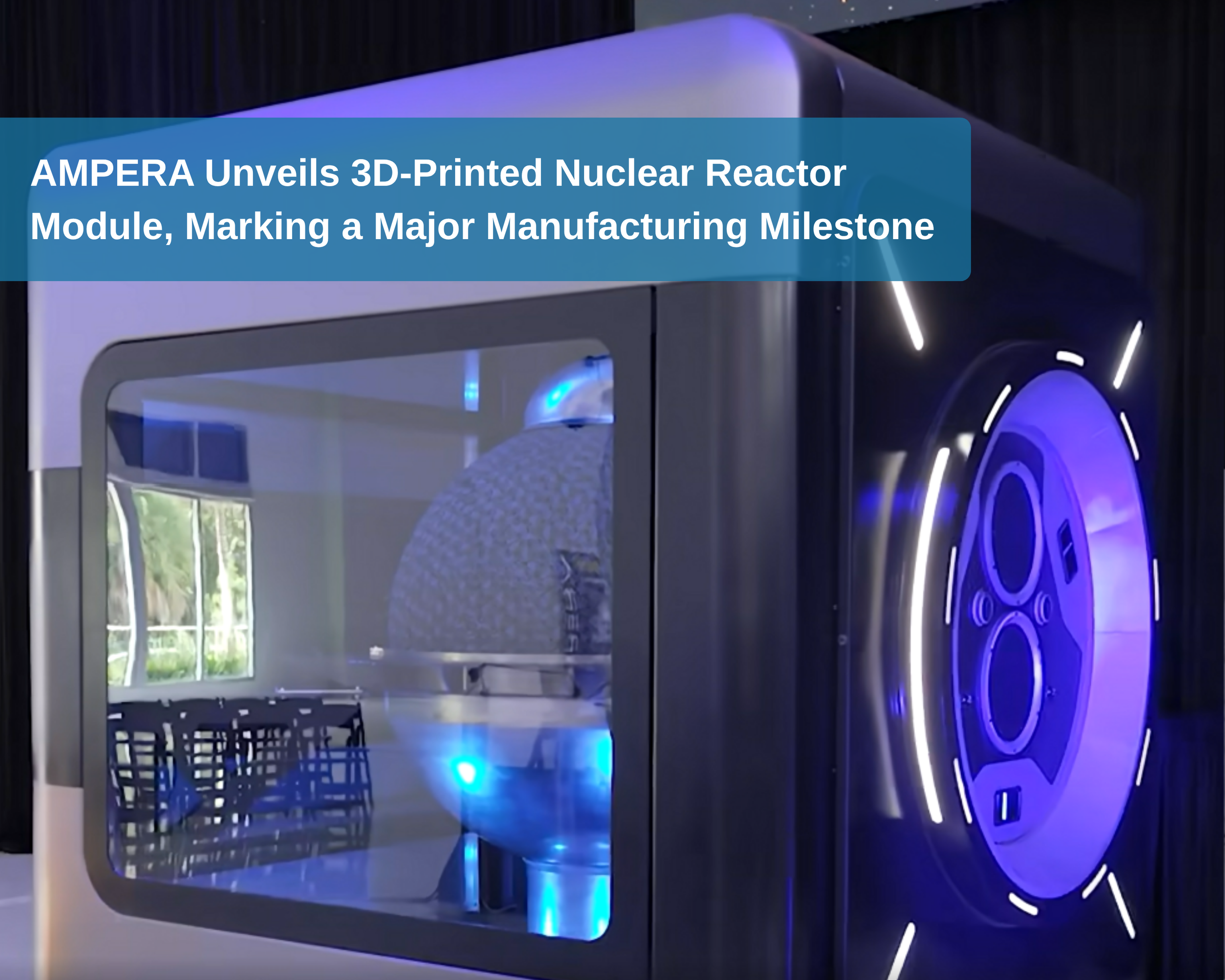
Palm Beach Gardens-based AMPERA recently unveiled what it describes as the world's first full-scale, fully 3D-printed nuclear reactor module, a significant manufacturing achievement that could help transform how next-generation nuclear reactors are designed, built, and deployed.
While the reactor has not yet been fueled or connected to the electrical grid, the unveiling represents an important engineering milestone and highlights South Florida's growing role in advanced energy innovation.
Rethinking How Nuclear Reactors Are Built
Traditional nuclear power plants are among the most complex infrastructure projects in the world. Construction often takes a decade or more, requires thousands of custom-fabricated components, and can cost billions of dollars.
AMPERA is taking a dramatically different approach.
Instead of constructing reactors piece by piece at the project site, the company is developing factory-built reactor modules using advanced additive manufacturing. By 3D printing major structural components, including the reactor core and pressure vessel, the company hopes to simplify manufacturing, improve quality control, reduce construction timelines, and lower overall costs.
"This next-generation nuclear core and pressure vessel sets the foundation for factory-built, mass-produced nuclear energy," said Brian Matthews, Founder and CEO of AMPERA. "The advanced technology and additive manufacturing used demonstrate a clear commercial path for new nuclear technology coming to market in an accelerated manner."
The prototype unveiled by the company features a full-scale reactor module built around a 3D-printed silicon carbide reactor core, paired with a matching pressure vessel designed for modular production.
Advanced Materials Meet Advanced Manufacturing
One of the most notable aspects of the design is the extensive use of silicon carbide, a material known for its exceptional strength, resistance to corrosion, and ability to withstand extremely high temperatures and radiation.
Unlike conventional reactor construction, which relies heavily on welded assemblies made from numerous individual parts, AMPERA's manufacturing process allows large, highly integrated components to be produced through industrial-scale 3D printing. Reducing welds and mechanical joints has the potential to simplify production while improving long-term reliability.
The company also plans to utilize TRISO fuel particles with thorium-based fuel cycles, an approach that has generated increasing interest within the advanced nuclear industry because of its enhanced fuel durability and potential safety benefits. In June, AMPERA announced it established an Australian subsidiary, Ampera Australia Pty Ltd, to secure thorium supply and support U.S. advanced nuclear fuel production.
"Thorium is the future for ultra-safe, clean power production," Matthews said. "By producing TRISO thorium kernels in the United States, we can ensure ample access to the needed fuel supply as we scale up and also minimize price volatility risk."
Safer Nuclear Technology for a New Generation of Energy
AMPERA's reactor design differs from conventional nuclear plants in several important ways. The company is pursuing a subcritical reactor architecture, meaning the nuclear chain reaction cannot sustain itself without an external neutron source. If that external source is removed, the fission process naturally stops, providing an additional layer of inherent safety compared to traditional reactors that maintain a self-sustaining chain reaction during normal operation.
This next-generation approach is designed not only to enhance safety but also to meet the growing demand for reliable, around-the-clock, carbon-free electricity. Rather than targeting large utility-scale power plants, AMPERA is focused on markets where resilient power is becoming increasingly critical, including artificial intelligence data centers, advanced manufacturing facilities, defense installations, maritime operations, remote industrial sites, and other critical infrastructure.
As AI computing and digital infrastructure continue to drive unprecedented electricity demand, many technology companies are exploring advanced nuclear energy as a dependable source of baseload power. Factory-built microreactors like AMPERA's could eventually provide a flexible alternative to large conventional nuclear plants, bringing clean, reliable energy closer to where it is needed most.
Although the technology still requires extensive testing, engineering validation, and regulatory approval before commercialization, it reflects the nuclear industry's broader push toward safer, more modular reactor designs capable of supporting the next generation of industrial growth.
A Milestone, Not Yet a Commercial Reactor
While the announcement has attracted significant attention, it is important to understand what has (and has not) been accomplished.
The unveiling showcases a full-scale manufactured reactor module and demonstrates AMPERA's ability to produce complex nuclear components using advanced 3D-printing technologies.
However, the reactor has not yet entered operation, generated electricity, or received the regulatory approvals required for commercial deployment. Like all advanced nuclear technologies, the design must still progress through engineering validation, safety testing, fuel qualification, and licensing before becoming commercially available.
Even so, successfully manufacturing a full-scale reactor module represents a significant engineering achievement and highlights how advances in additive manufacturing could help reshape the future of nuclear energy by making reactors more standardized, scalable, and efficient to produce.
South Florida's Innovation Ecosystem Continues to Expand
AMPERA's announcement adds another chapter to South Florida's rapidly growing advanced technology ecosystem.
Over the past several years, the region has attracted significant investment across sectors including quantum computing, aerospace, autonomous transportation, artificial intelligence, biotechnology, and climate technology. The emergence of an advanced nuclear company developing next-generation reactor technology further demonstrates the region's ability to support companies tackling some of the world's most complex engineering challenges.
Whether AMPERA ultimately succeeds in commercializing its technology remains to be seen. However, the company's achievement in producing a full-scale, 3D-printed reactor module represents a meaningful manufacturing milestone and illustrates how innovation in materials science, additive manufacturing, and nuclear engineering is converging to reshape the future of clean energy.
As demand for reliable, carbon-free electricity continues to climb worldwide, technologies once considered futuristic are steadily moving from research laboratories to factory floors—and, eventually, to commercial deployment.





Florida Atlantic University is leading a $5.7 million initiative to improve literacy in Broward County schools while preparing educators to use artificial intelligence responsibly. Through LEAP-AI, FAU and its partners aim to strengthen teacher training, expand career pathways, and build South Florida's future workforce.