
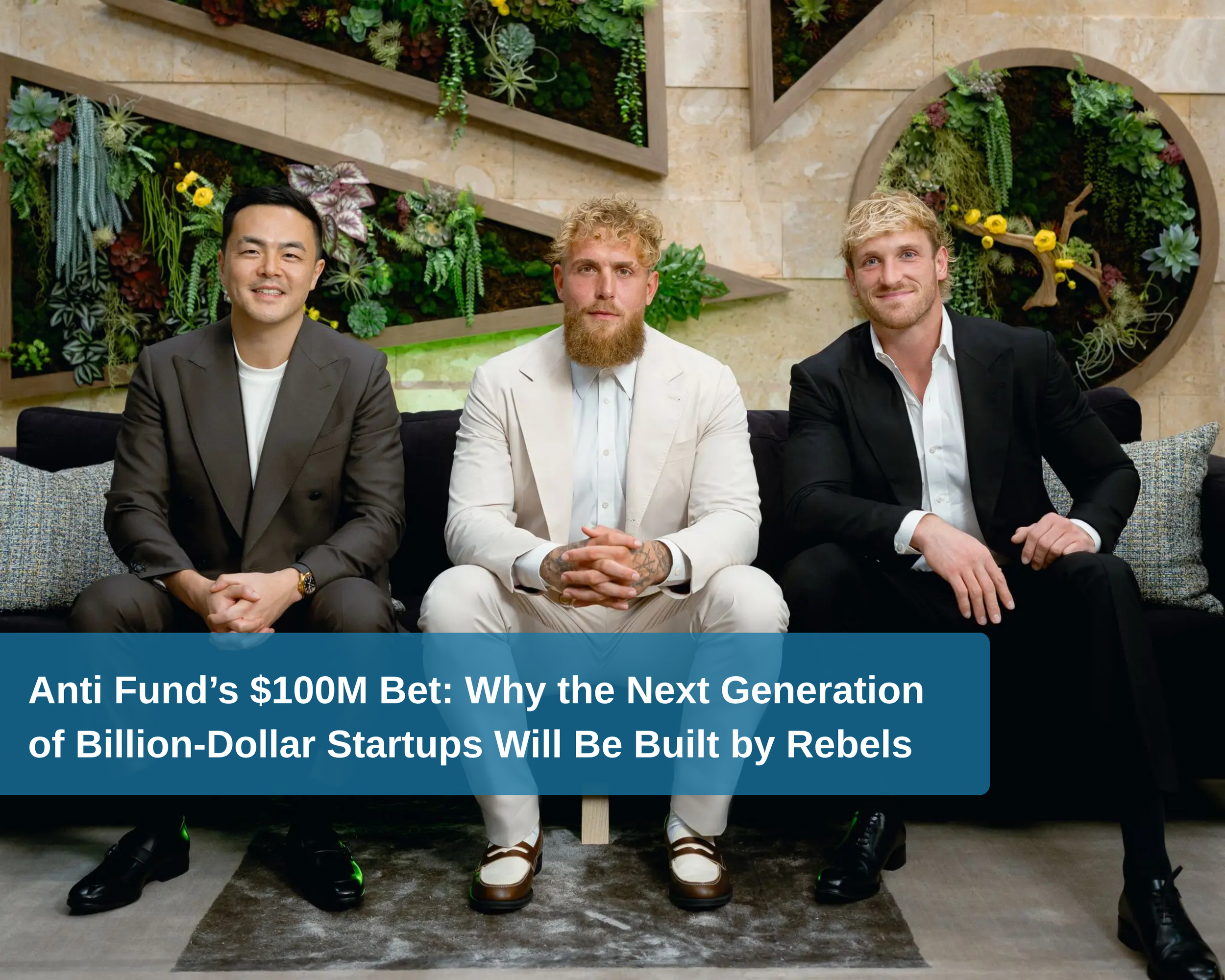
Anti Fund’s $100M Bet: Why the Next Generation of Billion-Dollar Startups Will Be Built by Rebels
The next generation of billion-dollar technology companies may not come from traditional playbooks. They may come from founders willing to challenge industries, rebuild outdated systems, and pursue ideas that initially seem impossible.
That is the thesis behind Anti Fund, a technology investment firm that recently announced the close of its oversubscribed $100 million fundraise to expand its investments in high-growth technology companies, backing the belief that the most transformative companies are often built by founders who refuse to follow the rules. This raise brings the venture firm’s total assets under management to more than $180 million.
The firm’s portfolio includes some of the most closely watched technology companies shaping the future, including OpenAI, Anduril Industries, Ramp, Cognition, Physical Intelligence, Flock Safety, and Chronosphere.
But beyond the capital, Anti Fund is betting on something harder to measure: attention.
The “Anti” Thesis: Capital Is Everywhere. Attention Is Not.
Anti Fund is a technology investment firm and venture platform founded by Geoffrey Woo alongside a group of operators and creators, including high-profile entrepreneurial partners such as Jake Paul and Logan Paul. The firm was built around a non-traditional view of venture capital, one that blends investing with storytelling, distribution, and cultural attention.
At its core, Anti Fund’s thesis argues that startups compete on two critical resources: capital and attention.
While access to funding has become increasingly available across the venture ecosystem, the ability to capture attention, from customers, talent, partners, and the broader market, has become a defining constraint and advantage.
“Anti Fund was built to back exceptional founders before the market fully understands them,” said Geoffrey Woo, managing partner of Anti Fund. “Venture I lets us invest at the earliest stages, when taste and conviction matter most. Growth I lets us keep backing and turbocharging the same kind of founders later, when they are running the companies that define our generation.”
The firm’s philosophy reflects a broader shift in how companies are built today. In an environment where thousands of startups are racing to define categories in artificial intelligence, robotics, defense, and infrastructure, the winners may not only be the best funded or most technically advanced, but also the ones best able to command mindshare.
Anti Fund positions itself as backing those founders early: engineers, scientists, and creators who operate outside conventional expectations, challenge incumbents, and build companies designed to reshape entire industries rather than iterate within them.
This “anti” ethos is not just branding, it is a deliberate investment lens focused on identifying non-consensus founders with the ability to turn technical differentiation into cultural and commercial momentum.
“We are not trying to be just another fund,” said Jake Paul, managing partner of Anti Fund. “Capital is everywhere; attention, trust, and real founder help are not. At the earliest stages, founders need believers. As companies scale, the most successful founders look for partners who can both support and challenge them to go further.”
From AI Models to the Infrastructure Era
Anti Fund’s investment strategy reflects a broader shift happening across venture capital.
The first wave of AI was defined by models and applications. The next wave is increasingly centered on the infrastructure powering the future, autonomous systems, robotics, defense technology, energy innovation, and enterprise transformation. Companies like Anduril Industries and Physical Intelligence represent a future where software is no longer confined to screens, but is deeply connected to the physical world, reshaping industries that have historically been slower to digitize.
Against that backdrop, Anti Fund invests across stages, from first check through late-stage, pre-IPO growth, in high-growth companies spanning AI, robotics, defense, software, fintech, and consumer technology.
The firm looks for what it describes as technical edge, customer urgency, category ambition, and a non-consensus view that can scale into institutional-level value creation.
Investment sizes range from $250,000 to over $30 million, with the flexibility to both lead rounds and participate alongside other institutional investors, depending on where the opportunity sits in the company’s lifecycle.
Why South Florida Fits The Thesis
The Anti Fund story also reflects a broader trend happening in Florida.
Over the past several years, South Florida has evolved from a financial and real estate powerhouse into an increasingly influential technology and founder ecosystem.
The region has attracted:
Venture investors looking beyond traditional Silicon Valley networks
Founders building globally focused companies
AI and emerging technology startups
International entrepreneurs seeking access to U.S. markets
South Florida’s appeal has been driven by more than relocation trends. The region’s growing identity as a hub for entrepreneurship, finance, and global connectivity aligns with the type of founder Anti Fund says it wants to support: ambitious builders who think beyond traditional boundaries.
Florida’s expanding innovation ecosystem, including universities, venture networks, and technology communities across Miami, Tampa and beyond, continues to create an environment where unconventional ideas can find both talent and capital.
The Bigger Question
Anti Fund’s $100 million raise is not simply a bet on startups.
It is a bet on a new generation of founders and people building companies around artificial intelligence, automation, infrastructure, and technologies that could reshape entire industries.
And as South Florida continues to position itself as a gateway for innovation, the question becomes whether the region will emerge as a key hub for the next generation of frontier technology founders.



Palm Beach-based DeLorean Artificial Intelligence has been acquired by healthcare technology company WellStack in a deal combining predictive AI with healthcare data infrastructure. Founded in 2019, DeLorean developed technology designed to identify patient risks, predict disease progression, and support proactive interventions. The company had raised approximately $7.55 million before the acquisition. The transaction adds another healthcare AI exit to South Florida’s growing technology ecosystem.