
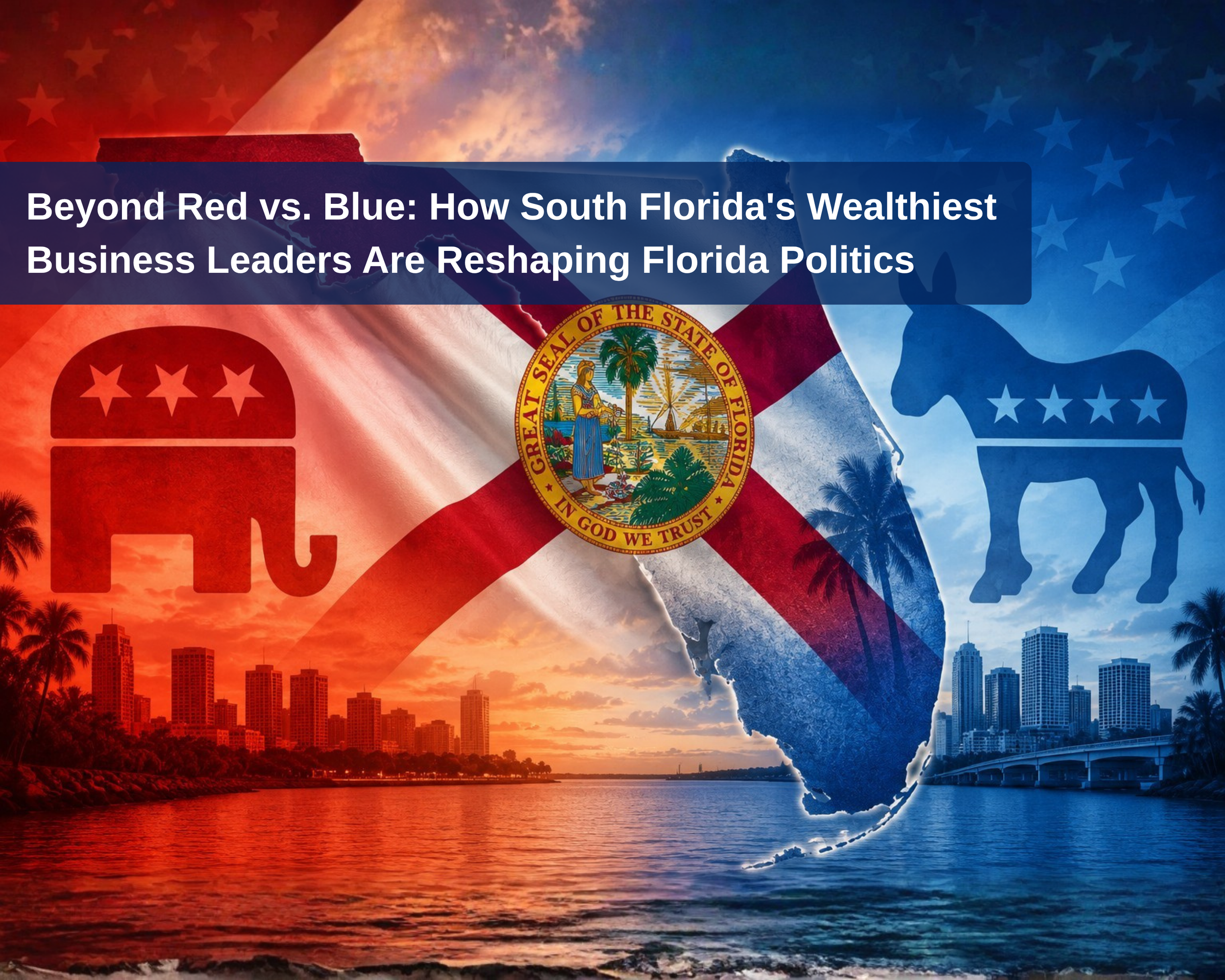
Beyond Red vs. Blue: How South Florida's Wealthiest Business Leaders Are Reshaping Florida Politics
South Florida's most influential executives have never been strangers to politics.
From campaign donations and fundraising dinners to policy advocacy and civic leadership, the region's business community has long played a significant role in shaping Florida's political landscape. But today's power players are no longer aligning themselves along simple Republican-versus-Democrat lines.
Instead, a more nuanced divide has emerged.
Among South Florida's wealthiest executives, three distinct approaches to political engagement are taking shape: business conservatives, centrist builders, and moderate Democrats. While each group supports different candidates and policy priorities, they share one common belief: Florida's future matters, and business leaders have a responsibility to help shape it.
The Republican Business Conservatives
Executives such as Ken Griffin and Norman Braman represent a group that sees Florida's economic competitiveness as inseparable from conservative fiscal policy.
Their political investments have largely favored Republican candidates who advocate for lower taxes, limited regulation, business-friendly policies, and education reform. For these leaders, the goal isn't simply supporting a political party, it's reinforcing an economic environment they believe encourages investment, entrepreneurship, and corporate relocation.
Ken Griffin, Founder and CEO of Citadel, one of the world's largest hedge funds, relocated Citadel's headquarters from Chicago to Miami in 2022, further cementing South Florida's rise as a global financial hub. His contributions have supported Republican candidates at both the state and national levels, including recent backing of gubernatorial candidate Byron Donalds. Griffin has also invested heavily in educational initiatives and philanthropy across South Florida, reflecting a belief that long-term economic growth depends on both policy and talent development.
Norman Braman, Chairman of Braman Motorcars, built one of the nation's largest luxury automotive dealership groups while becoming a respected business leader and philanthropist. He has similarly remained one of Florida's most consistent Republican supporters. His focus has traditionally centered on fiscal responsibility, public safety, and maintaining a business climate that attracts employers and investment.
While these executives don't always agree with every policy advanced by Republican leaders, their financial support generally reflects confidence that conservative economic principles provide the strongest foundation for sustained growth.
The Centrist Builders
A second group approaches politics less as an ideological exercise and more as a tool for regional development.
Leaders like Stephen Ross, Chairman of Related Ross and Owner of the Miami Dolphins, Ross has transformed skylines from New York to West Palm Beach through large-scale real estate development. He is widely recognized for championing economic development, innovation districts, education, and public-private partnerships that drive regional growth.
For Ross, the conversation is often less about party affiliation and more about outcomes.
His investments in downtown West Palm Beach, South Florida real estate, transportation, workforce development, education, and professional sports have required collaboration with officials from both parties.
Rather than becoming identified with one political movement, Ross has maintained relationships across the political spectrum while advocating for policies that encourage business investment and regional competitiveness.
This centrist approach reflects a practical reality of large-scale development: transformational projects rarely succeed without bipartisan cooperation.
For executives operating at this scale, building consensus often becomes more valuable than winning ideological debates.
The Moderate Democrats
A third group of South Florida executives has increasingly positioned itself as advocates for pragmatic Democratic leadership focused on governance rather than political activism.
Developers and entrepreneurs such as Jorge Pérez and healthcare executive Mike Fernandez have become influential voices supporting moderate Democratic candidates while emphasizing issues including immigration reform, affordable housing, healthcare access, democratic institutions, and responsible economic development.
Jorge Pérez, Founder, Chairman, and CEO of The Related Group, Pérez is one of the country's most accomplished real estate developers and has played a defining role in shaping Miami's modern skyline. Known as the "Condo King of Miami," he is also a prominent philanthropist with significant investments in the arts, education, affordable housing, and urban development.
He has consistently argued that South Florida's continued growth depends on addressing housing affordability, resilient infrastructure, and thoughtful urban planning. While firmly aligned with many Democratic priorities, Pérez has also maintained productive relationships with Republican elected officials, recognizing that successful public-private partnerships often transcend party lines.
Miguel “Mike” Fernandez, Founder of MBF Healthcare Partners, Fernandez built one of the country's largest healthcare investment firms and is recognized as one of Florida's leading entrepreneurs and philanthropists. He is an outspoken advocate for immigration reform, healthcare access, civic engagement, and strengthening democratic institutions through pragmatic leadership.
He represents perhaps one of Florida's most notable political evolutions. Once among the state's largest Republican donors, Fernandez gradually shifted his political support after becoming increasingly critical of partisan polarization and what he viewed as growing threats to democratic institutions.
Today, his political giving reflects support for candidates and organizations focused on moderation, institutional stability, healthcare, and immigration reform.
Rather than embracing the most progressive elements of the Democratic Party, both Pérez and Fernandez have generally advocated for pragmatic solutions aimed at balancing economic growth with social responsibility.
Politics as Economic Strategy: A New Era of Business Influence
Although these executives often support different candidates, their political engagement reflects something deeper than party affiliation. Each views Florida's future through an economic lens, but they differ in how they believe that future should be achieved.
Republican Business conservatives focus on maintaining a competitive tax and regulatory environment that attracts investment and encourages entrepreneurship. Centrist builders prioritize public-private partnerships and bipartisan collaboration to fuel large-scale economic development. Moderate Democrats emphasize sustainable growth supported by investments in housing, healthcare, workforce development, and strong democratic institutions.
Despite these differing philosophies, they share a common understanding: Florida's long-term prosperity depends on thoughtful leadership and strategic public policy.
Their influence extends well beyond campaign contributions. Through philanthropy, economic development initiatives, nonprofit leadership, workforce programs, higher education partnerships, and civic engagement, these executives are helping shape the state's future in meaningful ways.
As South Florida continues its rise as one of America's leading centers for finance, technology, healthcare, real estate, and entrepreneurship, its business leaders are playing an increasingly visible role in public policy discussions. Their impact is measured not only by the candidates they support, but by the investments they make in communities, institutions, and the long-term competitiveness of Florida's economy.
Looking Ahead
As Florida prepares for another competitive gubernatorial election, one trend appears increasingly clear: the state's business community is not moving in lockstep.
Instead, its most influential leaders are building distinct coalitions rooted in different philosophies about leadership, governance, and economic opportunity.
Some believe prosperity is best achieved through conservative fiscal policies. Others see bipartisan collaboration as the engine of regional growth. Still others argue that Florida's long-term success depends on balancing economic expansion with investments in housing, healthcare, democratic institutions, and inclusive communities.
Together, these executives are helping shape not only the outcome of elections, but also the broader conversation about what Florida's future should look like. Whether through campaign contributions, philanthropy, civic leadership, or economic investment, their influence extends far beyond the ballot box.
For readers interested in learning more about the candidates seeking to become Florida's next governor, the Florida Division of Elections Candidate List provides the official roster of qualified candidates, while the Florida Candidates & Committees portal offers campaign documents, finance records, and additional election information.



2150 co-founder Christian Hernandez Gallardo is leaving venture capital to become Executive Chair of Boca Raton-based Blue Frontier, helping the climate-tech company scale manufacturing, expand internationally and capitalize on growing demand for energy-efficient cooling as AI and data centers place new pressure on the electrical grid.