
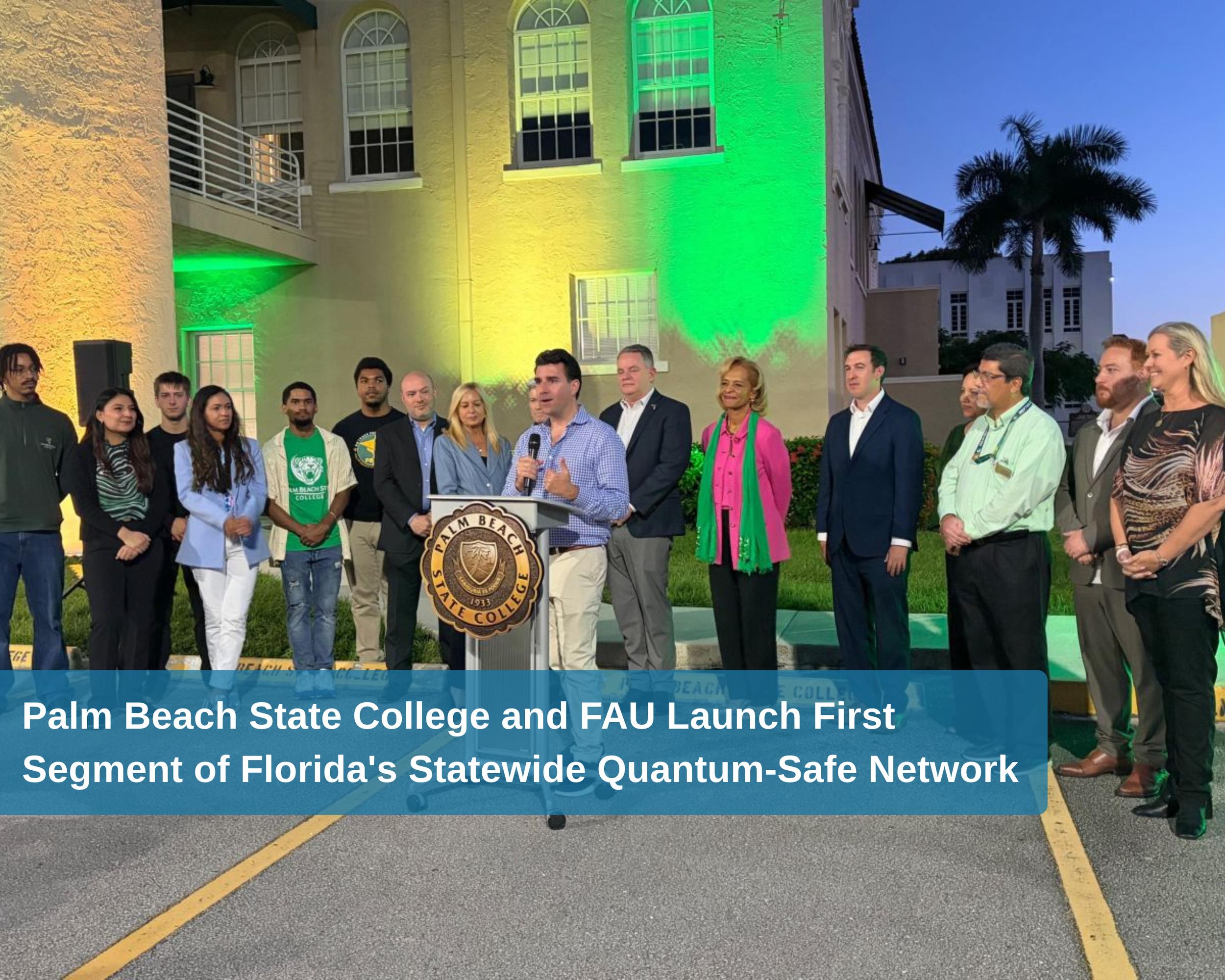
Florida has taken a significant step toward building a statewide quantum-secure communications network, with Palm Beach State College (PBSC) and Florida Atlantic University (FAU) activating the first operational segment of what project partners describe as the nation's first statewide quantum-safe network under development.
The connection, which went live October 2026, links PBSC in West Palm Beach to FAU's Boca Raton campus through Palm Beach County's existing fiber-optic infrastructure. The milestone was announced Oct. 22 by PBSC President Ava L. Parker ahead of the Quantum Beach 2026 conference.
Supported by a $1 million defense infrastructure grant from FloridaCommerce, the initiative brings together PBSC, FAU, Florida LambdaRail, Palm Beach County and quantum technology company IonQ to establish a foundation for secure communications between research institutions, universities and other critical organizations.
While the initial connection represents only the first segment of the proposed statewide network, its activation marks a transition from planning and investment to operational infrastructure.
Building a Quantum-Safe Communications Network
As quantum computing advances, governments, businesses and research institutions face growing concerns about the long-term security of encrypted information. Many of today's widely used public-key encryption systems could become vulnerable to sufficiently powerful future quantum computers. That possibility has accelerated efforts to develop quantum-resistant security technologies and protect sensitive information against emerging threats.
The Florida network incorporates quantum key distribution (QKD) technology from IonQ, allowing participating institutions to establish and share cryptographic keys using quantum-based methods. QKD uses properties of quantum physics to help detect attempts to intercept the key exchange. It is one approach to strengthening communications security, distinct from post-quantum cryptography, which uses quantum-resistant mathematical algorithms.
The initial connection operates over Palm Beach County's existing dark fiber infrastructure, demonstrating how public infrastructure can support advanced cybersecurity capabilities without requiring an entirely new statewide fiber network. The project is being developed in partnership with Florida LambdaRail, a research and education networking organization that operates a 1,540-mile fiber-optic network serving 13 university partners and affiliated organizations across Florida.
That existing infrastructure could eventually support quantum-secure communications among universities, research institutions, health care organizations and government entities throughout the state.
From Palm Beach County to a Statewide Network
The operational connection between PBSC and FAU represents the first milestone in a broader initiative announced in April 2026, when IonQ and Florida LambdaRail entered into an agreement at the eMerge Americas conference in Miami. The initial vision called for a quantum-safe corridor extending nearly 100 miles between Palm Beach County and Miami-Dade County.
Project partners are now planning additional network connections involving Miami Dade College and FAU's John D. MacArthur Campus in Jupiter, with a targeted expansion timeline of approximately three months following the October announcement.
The Jupiter campus is part of a regional research environment that includes the FAU Stiles-Nicholson Brain Institute and neighboring biomedical research institutions such as the Max Planck Florida Institute for Neuroscience and the Herbert Wertheim UF Scripps Institute for Biomedical Innovation & Technology.
Expanding secure communications among these institutions could create new opportunities for collaborative research and the exchange of sensitive scientific information.
A second phase, being planned by Florida LambdaRail and FloridaCommerce, would seek to extend quantum-safe capabilities across Florida LambdaRail's statewide network footprint. That expansion remains dependent on additional funding.
Supporting South Florida's Emerging Quantum Economy
The launch of Florida's first quantum-safe network segment represents more than a cybersecurity milestone. It also supports a broader effort to position South Florida as a center for quantum technology development, investment and innovation.
For Palm Beach State College and Florida Atlantic University, the project complements ongoing investments in quantum research, education and workforce development. PBSC recently secured nearly $5 million in state funding to establish a quantum workforce training initiative, while FAU is expanding its quantum computing capabilities through a partnership with D-Wave Quantum.
The network also creates potential opportunities for businesses in financial services, health care, defense, telecommunications and critical infrastructure, where protecting sensitive information against future quantum computing threats is an increasingly important consideration.
As additional connections are developed, the initiative could strengthen collaboration among academic institutions, technology companies and government agencies while creating new opportunities for research and commercial applications. However, broader industry adoption and statewide availability will depend on continued investment and network expansion.
Together, these developments reflect South Florida's growing momentum in quantum technology, with higher education institutions playing an important role in connecting infrastructure investments with emerging industry needs.
Building the Foundation for Florida's Quantum Future
The PBSC-FAU connection represents an early but tangible result of Florida's growing investment in quantum technologies. Rather than focusing exclusively on quantum computers, the project addresses another essential component of the emerging industry: the infrastructure required to secure communications and support collaboration.
As the network expands, its long-term significance may depend on how effectively academic institutions, government agencies and private companies translate this infrastructure into research partnerships, workforce opportunities and practical applications.
With additional investments in quantum computing, cybersecurity education and technical training already underway across South Florida, the network launch is one part of a larger regional effort to establish the capabilities needed for a quantum-driven economy.




Palm Beach State College and Florida Atlantic University have launched the first segment of Florida's statewide quantum-safe network, marking a major milestone in secure communications, cybersecurity innovation and South Florida's growing quantum technology ecosystem.