

Carrier's Acquisition of 75F Signals the Next Era of Autonomous Buildings
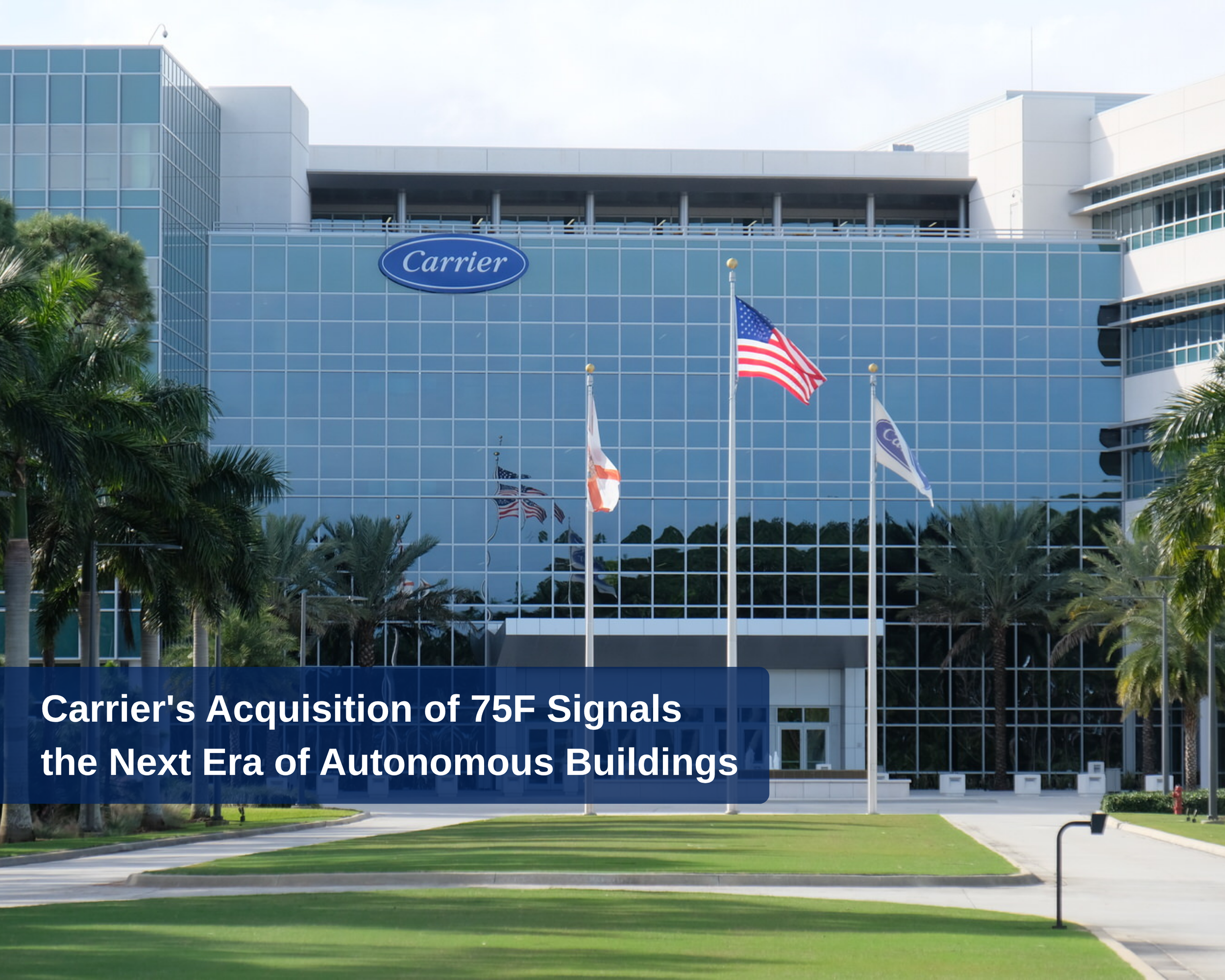
The future of commercial buildings isn't just smarter, it's becoming autonomous.
Carrier Global Corporation's acquisition of 75F, a leading provider of cloud-native, wireless, AI-enabled building automation systems, represents far more than another acquisition in the HVAC industry. It signals a significant shift in how commercial buildings will be designed, managed, and optimized over the coming decade.
As artificial intelligence transforms industries from manufacturing to healthcare, commercial real estate is entering its own intelligent revolution. Carrier's latest move positions the company at the forefront of that evolution.
Beyond HVAC: Building an Intelligent Building Platform
For more than a century, Carrier has been synonymous with heating, ventilation, and air conditioning. Today, the company is expanding well beyond climate equipment to become a comprehensive intelligent building technology provider.
With the acquisition of 75F, Carrier is bringing together an impressive portfolio that spans connected equipment, building controls, predictive analytics, operational intelligence, and artificial intelligence.
The combined ecosystem includes Carrier's WebCTRL® building controls, Abound™ predictive analytics platform, Nlyte® operational intelligence software, Carrier ClimaVision™, and now 75F's cloud-native automation platform and AI capabilities.
Rather than viewing these as individual products, Carrier is building an integrated digital platform where equipment, sensors, software, and artificial intelligence work together to continuously optimize building performance.
The result is an end-to-end intelligent building ecosystem designed to simplify deployment, unify building data, and create more autonomous facilities.
Buildings That Learn, Adapt, and Optimize
"Buildings are becoming intelligent and autonomous systems that continuously learn, adapt and optimize performance," said David Gitlin, Chairman and CEO of Carrier.
"Through Carrier ClimaVision™, we have already seen firsthand the power of 75F's cloud-native, AI-enabled platform. This acquisition accelerates our strategy to create increasingly autonomous and self-optimizing buildings by bringing together connected equipment, intelligent controls and digital solutions in a unified platform that simplifies deployment, connects building data and enables agentic AI."
That vision represents an important evolution in commercial building management.
Historically, building automation systems focused on monitoring equipment and alerting facility managers when something required attention. The next generation of intelligent buildings goes significantly further.
Artificial intelligence can continuously analyze occupancy, weather conditions, equipment performance, utility pricing, indoor air quality, and energy consumption to automatically make operating decisions in real time. Rather than simply notifying operators about potential issues, future buildings will increasingly identify problems, recommend solutions, implement adjustments, and continuously learn from the results.
Why 75F Matters
Founded by Deepinder Singh, 75F has spent years reimagining building automation around modern cloud software rather than legacy control systems.
Its platform combines:
Cloud-native software
Wireless sensors and controllers
AI-enabled automation
Remote commissioning
Energy optimization
Indoor air quality management
Unlike many traditional building automation systems that require extensive wiring, proprietary hardware, and specialized programming, 75F's architecture simplifies installation while making intelligent building management more accessible for both new construction and retrofit projects.
The company has built a reputation for reducing deployment time while delivering meaningful improvements in energy efficiency and occupant comfort.
"75F was founded to fundamentally rethink building automation using cloud-native software, AI and wireless technologies," said Singh. "Joining Carrier enables us to accelerate that vision on a global scale. Together, we can help make intelligent buildings simpler to deploy, easier to operate and more accessible to customers everywhere."
AI Is Moving Beyond Analytics
Perhaps the most significant aspect of the acquisition is Carrier's emphasis on generative AI and agentic AI. While predictive analytics has become increasingly common throughout commercial buildings, agentic AI represents the next stage of intelligent automation.
Instead of simply identifying maintenance concerns or reporting energy usage, agentic AI can evaluate operating conditions, determine the best response, automatically implement changes, and continue learning from operational outcomes.
Imagine a building that detects changing occupancy levels, rising humidity, fluctuating electricity prices, and underperforming HVAC equipment, all while automatically adjusting airflow, cooling, ventilation, and energy consumption before occupants ever notice a problem.
That's the direction Carrier is now pursuing.
Carrier also plans to integrate 75F's generative AI, agentic AI, and auto-commissioning capabilities into its large commercial platforms, including its Carrier QuantumLeap™ thermal management suite.
Auto-commissioning alone has the potential to significantly reduce installation time, lower labor costs, simplify system startup, and improve building performance from day one.
Data Centers Are Driving the Next Wave
One of the clearest themes throughout Carrier's announcement is the growing importance of data centers. As artificial intelligence accelerates demand for high-performance computing, data centers have become one of the fastest-growing markets for advanced cooling technologies.
These facilities require:
Precise thermal management
Continuous uptime
Predictive maintenance
Intelligent energy optimization
Real-time operational visibility
Carrier already provides industry-leading cooling equipment. By combining that hardware with 75F's intelligent controls, Nlyte's operational intelligence platform, and Abound's predictive analytics, the company is positioning itself to deliver a comprehensive thermal management ecosystem for AI-driven infrastructure.
As AI workloads continue expanding globally, intelligent cooling is becoming just as important as computing power itself.
A Global Innovation Strategy with Florida Roots
Carrier's acquisition of 75F represents more than the addition of another software company to its portfolio. It reflects a strategic evolution from manufacturing climate equipment to delivering intelligent building ecosystems powered by software, cloud connectivity, and artificial intelligence.
The buildings of the future won't simply heat, cool, or ventilate themselves. They will continuously learn from their environments, anticipate operational needs, optimize energy usage, improve occupant experiences, and proactively manage their own performance.
For building owners, developers, and facility operators, that means lower operating costs, improved sustainability, enhanced resilience, and greater efficiency.
For Florida, the significance extends even further.
Carrier's global headquarters is located in Palm Beach Gardens, placing one of the world's leading climate and intelligent building technology companies at the heart of South Florida's rapidly growing innovation ecosystem. As Carrier continues investing in artificial intelligence, autonomous building technologies, and next-generation digital infrastructure, the region is uniquely positioned to benefit from the presence of a global company helping define the future of the built environment.
The acquisition also reinforces Palm Beach County's growing reputation as more than a destination for corporate relocations, it is increasingly becoming a place where global innovation strategies are developed and scaled. Combined with the region's expanding technology sector, world-class universities, growing data center investments, and leadership in engineering, life sciences, and climate technologies, Carrier's continued evolution strengthens South Florida's position as a hub for intelligent infrastructure and advanced technologies.
For Florida's commercial real estate market, technology ecosystem, and innovation economy, that makes this acquisition far more than corporate news. It is another indication that the region is playing an increasingly important role in shaping the next generation of intelligent, connected, and sustainable buildings.




2150 co-founder Christian Hernandez Gallardo is leaving venture capital to become Executive Chair of Boca Raton-based Blue Frontier, helping the climate-tech company scale manufacturing, expand internationally and capitalize on growing demand for energy-efficient cooling as AI and data centers place new pressure on the electrical grid.