

Kind Designs Isn't Raising Capital to Prove Its Technology. Mark Cuban Invests Again as It Scales To Meet Demand.
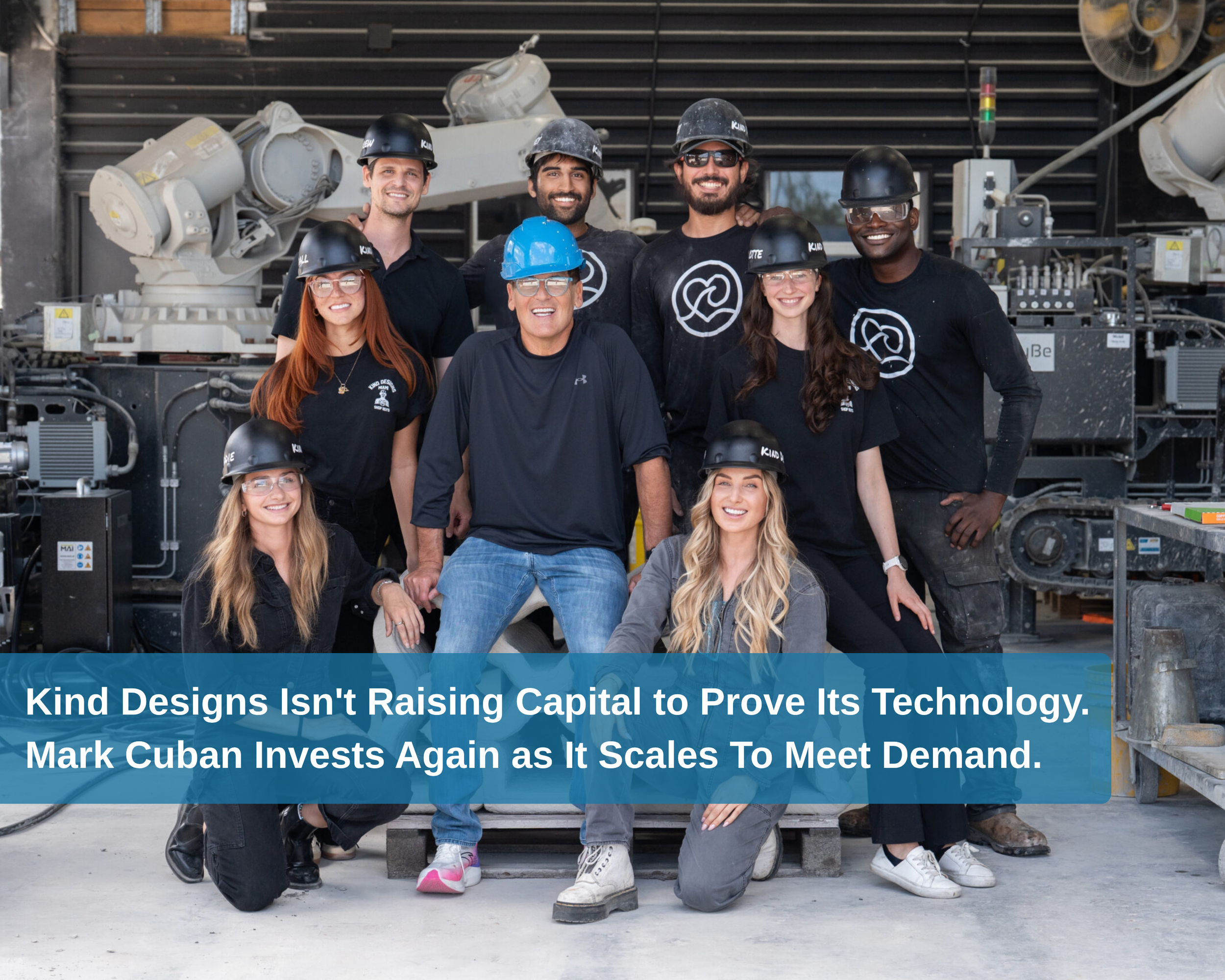
Every startup reaches a defining moment.
It's the point when the question changes from "Can this technology work?" to "How quickly can we build enough of it?"
For Miami-based Kind Designs, that moment has arrived.
The climate resilience company didn't set out to raise $10 million.
It set out to raise $5 million.
But after attracting nearly $20 million in investor interest, Kind Designs doubled the size of its Pre-Series A round, closing $10 million at a $70 million valuation, bringing its total funding to $21.5 million.
While many funding announcements celebrate future potential, this one tells a different story.
Kind Designs isn't raising capital to prove its technology anymore.
It's raising capital because demand has arrived.
Reinventing an Industry That Hasn't Changed in Generations
For decades, seawalls have been built with one objective: keep the water out.
They're functional, but largely unchanged. Kind Designs believes coastal infrastructure should accomplish much more.
Using large-scale 3D printing, robotics, proprietary digital manufacturing, and ecological engineering, the company has created a new generation of Living Seawalls™ that not only protect coastlines from erosion and storm surge but also improve water quality and restore marine ecosystems.
Unlike traditional smooth concrete walls, Living Seawalls are engineered with textured surfaces, natural crevices, and biologically inspired designs that encourage oysters, coral, and other marine organisms to colonize the structure. As these ecosystems develop, they naturally improve water quality, increase biodiversity, and strengthen shoreline resilience, all while delivering the structural protection expected from traditional seawalls.
Instead of asking communities to choose between resilient infrastructure and environmental restoration, Kind Designs is proving they can have both.
What makes the platform especially compelling is that its performance isn't based solely on theory. Kind Designs works closely with researchers at Florida International University and the University of Miami to continuously study, test, and refine its living infrastructure. Those partnerships help ensure every installation is backed by scientific research and delivers measurable benefits for both coastal protection and marine ecosystem restoration.
The company's competitive advantage isn't any single innovation.
The combination of advanced manufacturing, ecological engineering, and university-backed research has helped distinguish Kind Designs from traditional marine construction companies, positioning it as a technology company built around data-driven coastal resilience.
From Startup to Infrastructure Company
The company's growth over the past year illustrates why investors are paying attention.
After generating approximately $1 million in revenue during 2025, Kind Designs has already secured $10 million in contracted revenue, built an active pipeline valued at approximately $175 million, and expanded far beyond its residential beginnings.
From private residences to large-scale commercial contracts, today its customers include luxury hospitality brands, municipalities, commercial developers, and the federal government.
Recent projects include Living Seawalls for the Fontainebleau Miami Beach, Pagani Residences, and Ritz-Carlton Miami Beach, along with completed municipal infrastructure projects in Miami Shores and Longboat Key.
The company has also expanded into New York City, Charleston, and Nassau, while advancing opportunities in California focused on coastal erosion and rail protection infrastructure.
Perhaps most notably, Kind Designs recently secured a $2 million contract with the U.S. Navy, demonstrating that its technology has progressed well beyond pilot projects into mission-critical infrastructure.
That evolution changes the story behind this funding round. This isn't venture capital being invested into an experiment. It's growth capital being deployed to scale a proven business.
The company's momentum has also been recognized well beyond the investment community. Kind Designs and their 3D-printed living seawalls were named one of TIME's Best Inventions of 2025 in the sustainability category.
This is a distinction that recognizes both the innovation behind the technology and its potential to reshape how coastal communities protect and restore their shorelines.
Building the Technology Company the Seawall Industry Never Had
"The seawall industry is a multi-hundred-billion-dollar market that has never had a true technology company," said Anya Freeman, founder and CEO of Kind Designs.
"We're building one of America's most important tech companies to put resiliency on the map as the next great industrial category."
That vision extends well beyond seawalls.
The company's platform now includes Living Seawalls™, Living Seawall Tiles™, and Living Shorelines transforming shorelines into living reefs, serving residential, commercial, hospitality, municipal, and federal applications.
Rather than viewing itself as another construction company, Kind Designs is applying robotics, software-driven manufacturing, digital design, and ecological science to modernize an industry that has remained largely unchanged for generations.
It's a shift from building infrastructure to creating intelligent infrastructure.
The seawall is the product. The platform is the innovation.
Why Investors Doubled the Round
Kind Designs originally planned to raise $5 million. Investor demand approached $20 million, prompting the company to double the size of the financing. That kind of oversubscription typically signals more than enthusiasm, it reflects confidence that a company has reached commercial inflection.
Investors weren't simply buying into a compelling idea. They were responding to measurable traction.
Returning investor Mark Cuban, entrepreneur, billionaire investor, and longtime Shark Tank star, joined the round once again, alongside former Mayor of Washington, D.C. Adrian Fenty, both of whom have backed Kind Designs through multiple funding rounds. NBA forward Kyle Kuzma also joined as a new investor.
"Most climate founders pitch you on saving the planet," Cuban said. "Anya pitched me on an opportunity to disrupt a multi-billion-dollar coastal infrastructure market in a way that's faster, cheaper, and also better for the environment.
"Kind Designs continues to cement itself as a leading innovator in coastal resiliency and is a perfect reminder that you can both 'do well' and 'do good.' This is why I wrote another check into the company."
Perhaps the most important phrase is the last one. Another check.
Repeat investors are often among the strongest indicators of confidence because they've already seen the company's execution firsthand.
Scaling to Meet a Market That's Already Here
Kind Designs isn't just responding to growing demand, it's entering the market at a time when both industry needs and public policy are aligning.
Across the United States, millions of feet of aging seawalls will require replacement or reinforcement over the coming decades as coastal communities confront rising sea levels, stronger storms, aging infrastructure, and increasing environmental expectations. Kind Designs believes that challenge represents one of the nation's largest infrastructure modernization opportunities.
At the same time, government policy is beginning to accelerate the adoption of innovative coastal infrastructure.
Over the past year, Miami-Dade County updated its seawall codes to provide expedited permitting and environmental mitigation exemptions for Kind Designs' systems. At the state level, Governor Ron DeSantis signed SB302 Coastal Resiliency, directing the Florida Department of Environmental Protection to develop incentives supporting Living Seawall adoption throughout Florida.
Those policy changes, combined with growing commercial demand and federal contracts, are helping create momentum for an entirely new category of resilient coastal infrastructure.
The company's new funding will allow Kind Designs to capitalize on that momentum by accelerating expansion into new markets, including New York and California, tripling production capacity through additional robotic manufacturing and expanded production lines, supporting working capital for large-scale municipal and federal infrastructure projects, and growing its engineering and operations teams.
The challenge is no longer proving the technology works. It's scaling quickly enough to meet a market that's already here.
A South Florida Success Story With National Impact
South Florida has become known for attracting technology companies.
Kind Designs represents something different. It's building one here.
By combining advanced manufacturing, robotics, ecological science, and infrastructure engineering, the company is exporting South Florida innovation to communities across the country facing increasingly urgent climate challenges.
As aging seawalls, rising sea levels, stronger storms, and coastal erosion drive billions of dollars in infrastructure investment, Kind Designs is positioning itself as a technology company serving one of America's largest infrastructure modernization opportunities.
"The technology is proven. The demand is here. Now it's about scaling a new generation of coastal infrastructure that protects America while making this country more beautiful,” Freeman said.
Those words capture exactly why this funding round matters. The next chapter for Kind Designs isn't about proving that Living Seawalls work. That chapter has already been written.
The company's next challenge is building enough of them to serve a market that's rapidly embracing a smarter, more resilient vision for the future of coastal infrastructure.
“Resiliency is the next great industrial category, and we're building one of America's most important technology companies inside it. Next stop, quadrupling production and growing a world class team,” Freeman shared in a social media post.
“We're done building at the pace permission allows, we're building at the pace this planet needs.”


2150 co-founder Christian Hernandez Gallardo is leaving venture capital to become Executive Chair of Boca Raton-based Blue Frontier, helping the climate-tech company scale manufacturing, expand internationally and capitalize on growing demand for energy-efficient cooling as AI and data centers place new pressure on the electrical grid.