
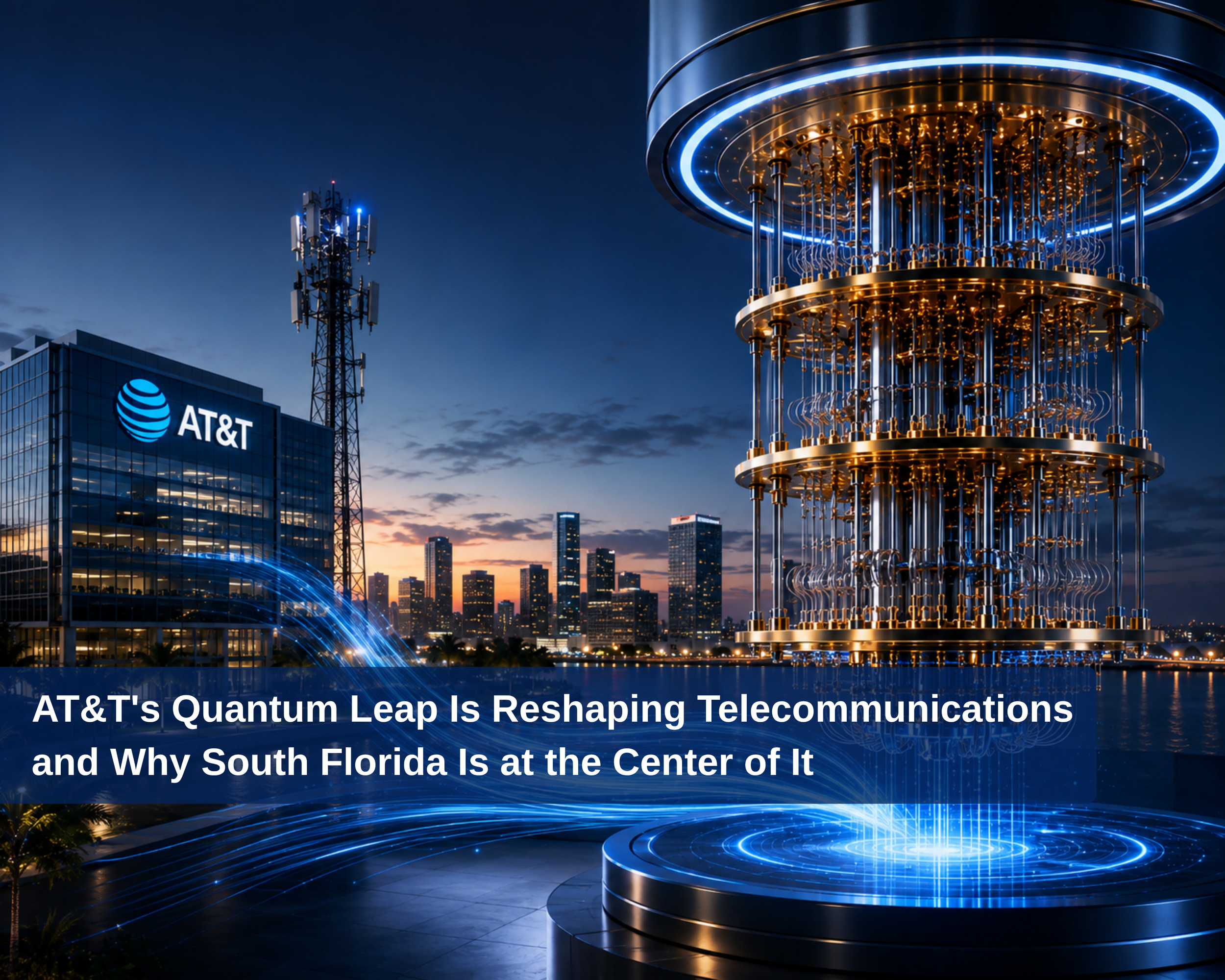
AT&T's Quantum Leap Is Reshaping Telecommunications and Why South Florida Is at the Center of It
For decades, telecommunications companies have relied on increasingly powerful classical computers to manage some of the world's most complex networks. But as artificial intelligence accelerates demand for faster, smarter, and more resilient infrastructure, even today's most advanced computing systems are beginning to reach their limits.
AT&T believes the next leap forward won't come from artificial intelligence or quantum computing alone, but from the convergence of both. By combining agentic AI with D-Wave's quantum optimization technology, the company is helping demonstrate how these once-emerging technologies are becoming practical tools for solving some of the world's most complex operational challenges.
In a landmark announcement, AT&T revealed it has expanded its agreement with D-Wave Quantum to integrate quantum computing into the AI systems that already help manage one of the largest telecommunications networks in the world. The collaboration marks another important milestone in the commercialization of quantum computing and positions Boca Raton at the heart of one of the industry's most exciting transformations.
From Automation to Autonomous Decision-Making
Artificial intelligence has evolved rapidly over the past several years. While many organizations continue adopting generative AI to create content and summarize information, AT&T is investing in a more advanced class of technology known as agentic AI.
Unlike traditional AI systems that respond to prompts, agentic AI can analyze changing conditions, evaluate multiple options, make decisions, and execute complex workflows with minimal human intervention.
Within AT&T's network, these intelligent agents continuously monitor infrastructure, identify service disruptions, prioritize response efforts, and coordinate actions across massive operational environments.
The results are already significant.
According to AT&T, its AI-powered End-to-End Incident Management platform, which now incorporates agentic AI capabilities, reduced customer downtime by more than 12 million hours in 2025 by improving outage detection, predictive maintenance, and incident response. D-Wave's expanded partnership is designed to enhance those AI capabilities further by accelerating the complex optimization decisions that underpin network operations.
Yet even highly capable AI agents face a common challenge: optimization.
Determining the best possible solution among millions, or even billions, of potential combinations is often computationally expensive. That is precisely where quantum computing enters the picture.
Why D-Wave Is Different
Most people associate quantum computing with futuristic machines that could someday replace today's supercomputers.
D-Wave has taken a different approach.
Rather than waiting for fully fault-tolerant universal quantum computers to mature, D-Wave has spent more than two decades commercializing quantum annealing, a specialized form of quantum computing designed specifically to solve optimization problems.
These are the kinds of problems businesses encounter every day:
Finding the fastest route for thousands of technicians
Allocating network resources during peak demand
Optimizing supply chains
Scheduling manufacturing operations
Managing power grids
Reducing transportation costs
These aren't theoretical research challenges. They are operational decisions that directly impact cost, efficiency, and customer experience.
D-Wave's focus on optimization has allowed it to become one of the first quantum computing companies delivering production-ready commercial applications across industries. In early testing with AT&T, one network optimization workload that previously required approximately one hour using conventional approaches was completed in less than 15 seconds using D-Wave's quantum technology.
For an industry managing millions of network events every day, that type of acceleration has enormous implications.
Where AI and Quantum Converge
Rather than replacing artificial intelligence, D-Wave's technology enhances it. AT&T's strategy is to layer quantum optimization into the agentic AI systems already helping operate its network.
The AI determines what needs to happen.
Quantum computing rapidly evaluates an enormous number of possible outcomes to determine the most efficient way to accomplish it.
Together, the technologies have the potential to improve:
Outage detection and response
Technician routing
Fiber deployment planning
5G network expansion
Traffic optimization
Infrastructure planning
As telecommunications networks become increasingly complex, and as AI-driven applications place greater demands on bandwidth and reliability, the ability to optimize decisions in seconds rather than hours could become a significant competitive advantage.
AT&T believes quantum computing is already demonstrating that potential.
"D-Wave's annealing quantum computing technology gives us a new way to approach optimization and high-intensity compute challenges across AT&T's network operations," said Lucus Haugen, Director of Data Science for AT&T's Chief Data Office.
"The speed we're seeing with D-Wave challenges what's currently possible. It has the potential to help us optimize faster, increase efficiency and scale more real-time operations, making quantum a practical tool for advancing how we run and modernize our network."
A New Chapter for Boca Raton
While the announcement highlights AT&T's innovation strategy, it also represents another important milestone for South Florida's rapidly emerging quantum ecosystem.
Earlier this year, D-Wave announced it will relocate its corporate headquarters to Boca Raton, establishing a major U.S. research and development center at the Boca Raton Innovation Campus (BRiC).
Shortly afterward, Florida Atlantic University announced a $20 million investment to purchase an onsite D-Wave Advantage2 quantum computer, making FAU the first university in Florida to host a dedicated, publicly accessible quantum computing system. The initiative includes research partnerships, workforce development, paid student internships, and the creation of a D-Wave Quantum Applications Academy designed to prepare the next generation of quantum professionals.
Together, these investments signal something much larger than a corporate relocation.
For D-Wave, the collaboration with AT&T represents a broader shift taking place across enterprise technology as organizations begin deploying quantum computing to solve practical business problems.
"AT&T's work with D-Wave is a powerful example of how leading enterprises are beginning to turn to quantum computing for solving real business problems," said Alan Baratz, CEO of D-Wave. "AT&T has incredibly complex optimization problems across its network operations, understands where classical computing is challenged, and is moving quickly to explore where quantum can make an impact. We're excited to work with AT&T to help drive speed, efficiency and business value across its operations."
They represent the formation of an ecosystem where industry, academia, government, startups, and investors are building around commercially deployed quantum technologies.
Building the Next Innovation Legacy
For many in the technology community, this story feels familiar.
Boca Raton has been at the center of transformative technology before. In the early 1980s, IBM's Boca Raton campus developed the IBM Personal Computer. This was a breakthrough that helped democratize computing around the world and forever changed the technology industry and established the city as an unexpected center of technological innovation. Today, Boca Raton is once again attracting companies that are redefining the future of computing.
Now, with D-Wave establishing its headquarters in the city and expanding its work with one of the world's largest telecommunications companies, South Florida is emerging as a destination where artificial intelligence and quantum computing are converging to solve real-world business challenges.
That is what makes this announcement so significant.
For years, quantum computing was viewed primarily as a promising research field and an exciting technology that remained years away from meaningful commercial applications. AT&T's expanded agreement with D-Wave signals that the conversation is changing. One of the world's largest communications companies is investing in quantum computing not as a future experiment, but as a practical technology capable of improving network operations today.
For South Florida, that distinction matters.
With D-Wave establishing its headquarters in Boca Raton, Florida Atlantic University building one of the nation's most advanced university quantum programs, and AT&T demonstrating real-world enterprise adoption, the region is no longer simply observing the next generation of computing - it is helping shape it.
The convergence of agentic AI and quantum computing has the potential to become one of the most significant technology shifts since the rise of cloud computing. As enterprises move beyond experimentation toward measurable business outcomes, South Florida is uniquely positioned to become a national leader in commercial quantum innovation, attracting researchers, startups, investment, Fortune 500 partnerships, and the talent that will help define the next era of enterprise technology.


2150 co-founder Christian Hernandez Gallardo is leaving venture capital to become Executive Chair of Boca Raton-based Blue Frontier, helping the climate-tech company scale manufacturing, expand internationally and capitalize on growing demand for energy-efficient cooling as AI and data centers place new pressure on the electrical grid.