
Autonomous Vehicle Conference 2026 Positions South Florida at the Center of the Future of Mobility
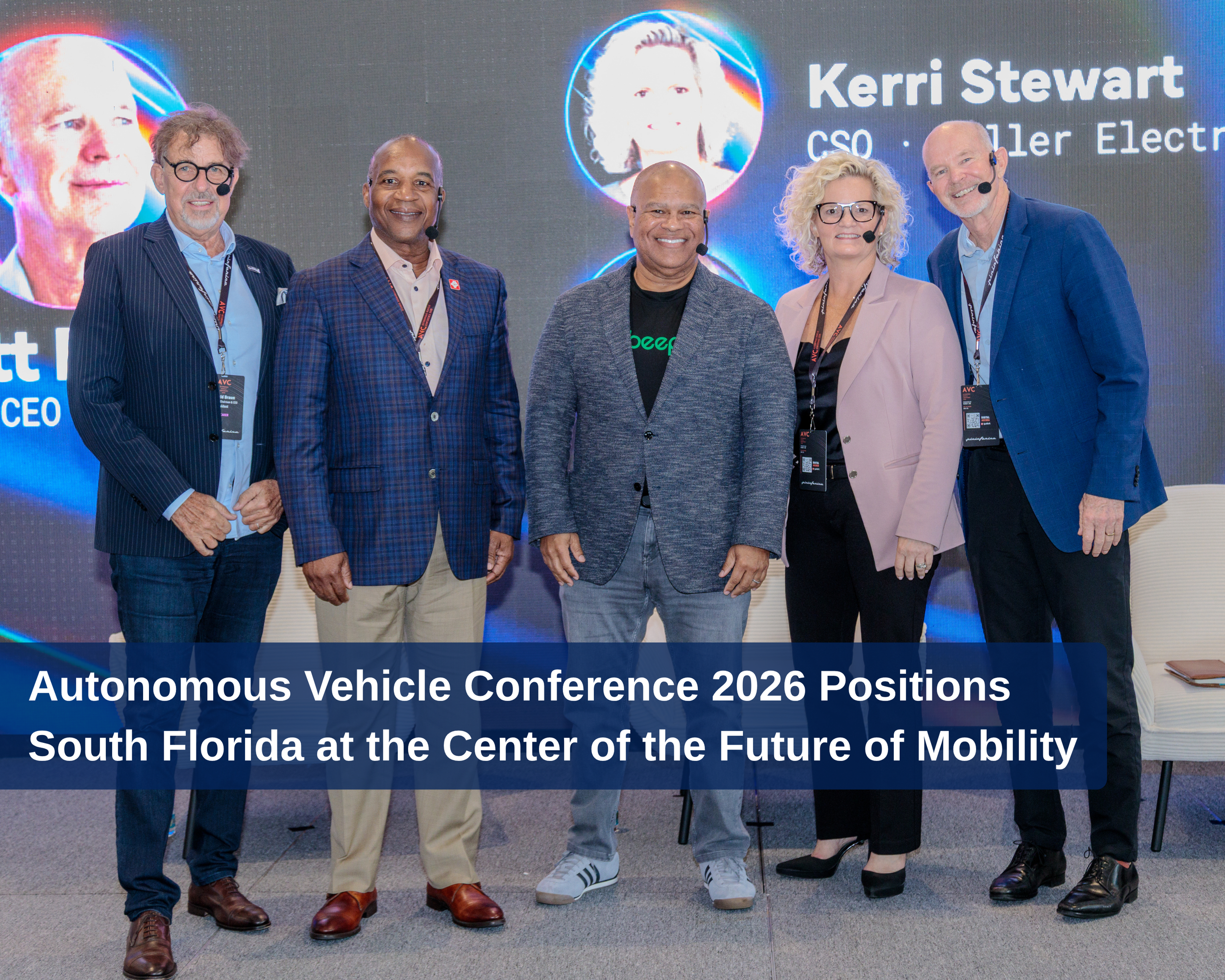
As autonomous transportation moves beyond experimentation and into real-world deployment, the conversations shaping its future are becoming increasingly important. On May 29, 2026, transportation leaders, policymakers, researchers, infrastructure experts, and autonomous technology innovators gathered for the 5th Annual Autonomous Vehicle Conference (AVC 2026)
Hosted by Guident and the Jacksonville Transportation Authority (JTA), AVC 2026 was more than a showcase of emerging technologies. The conference focused on one of the industry's most pressing challenges: how to move autonomous mobility from promising pilot programs to scalable, safe, and sustainable transportation systems that can serve communities across the United States.
The conference which was held at the Boca Raton Innovation Campus (BRiC) brought together leaders from government agencies, municipalities, transportation authorities, universities, infrastructure providers, and autonomous vehicle companies to explore the policies, partnerships, technologies, and workforce strategies needed to make autonomous transportation a reality.
A National Conversation with Local Impact
The conference was elevated by keynote speaker Seval Oz, Assistant Secretary of Transportation for Research and Technology at the U.S. Department of Transportation.
Her keynote, "From Pilot Programs to Scalable, Real-World Deployment: Building the Affordable Autonomy Economy," challenged attendees to think beyond the technology itself and focus on the economic, policy, and infrastructure frameworks necessary to support large-scale deployment.
She began her speech with a short video she helped produce in 2011 in collaboration with Google about a gentleman, Steve Mahan, the now retired CEO and Executive Director of the Santa Clara Valley Blind Center. Steve lost over 95% of his vision to macular degeneration and became one of the first people ever to use autonomous vehicle technology.
“We searched and found a way to restore some of his freedom - to restore some of his dignity - because you can see movement is essential to life. If you do not move, we atrophy. If we cannot visit our loved ones, we isolate. Eventually, we lose our willingness to live,” offered Oz. “It’s critical that we start measuring up to certain technologies that are available to change that coming forward 15 years.”
The message resonated throughout the day: the question is no longer whether autonomous transportation can work. The question is how communities, agencies, and industry leaders can work together to deploy it responsibly, safely, and at scale.
“Seval Oz’s participation elevates the importance of this year’s conference and reflects the growing connection between innovation, public policy, and real-world deployment,” shared Harald Braun, Executive Chairman and CEO at Guident.
Radar to Autonomous Mobility: Boca Raton's Legacy of Innovation
Following the keynote, Mayor Andy Thomson set the stage for the day's panel discussions by highlighting the City of Boca Raton's longstanding legacy of innovation and technological advancement.
He reflected on the city's unique role in shaping transformative technologies throughout history, from the former Army Airfield during World War II, now home to Florida Atlantic University, where military personnel were trained on emerging radar technologies, to the groundbreaking development of the personal computer at the former IBM Research & Development facility, now known as the Boca Raton Innovation Campus (BRiC).
Mayor Thomson also pointed to the recent arrival of D-Wave Quantum and the growing momentum surrounding quantum computing and other emerging technologies in the region. Today, companies such as Guident are continuing that tradition of innovation, helping position Boca Raton and South Florida at the forefront of the next generation of technological advancement.
His remarks served as a reminder that the breakthroughs shaping the future of transportation, computing, communications, and mobility are part of a larger innovation story that has been unfolding in Boca Raton for decades. Together, these milestones have helped establish South Florida as an emerging hub for technology, innovation, and forward-thinking leadership on the national stage.
Session 1: From Pilots to Programs
The conference opened with a discussion on lessons learned from live deployments.
Leaders from Jacksonville Transportation Authority, the City of Boca Raton, the City of Altamonte Springs, and Beep explored what cities are learning as autonomous systems move from controlled demonstrations into operational environments.
The conversation highlighted a critical reality facing the industry. Success depends not only on technology but also on municipal readiness, operational planning, infrastructure investment, and long-term sustainability.
As communities across the country evaluate autonomous transportation solutions, the experiences shared by these leaders provide valuable insights into what it takes to build repeatable and scalable programs.
Session 2: Governance, Regulation, and Public Responsibility
Autonomous mobility introduces important questions around regulation, liability, governance, and public trust.
Session two brought together elected officials, transportation advisors, legal experts, and planning leaders to discuss the frameworks needed to support safe deployment.
The discussion emphasized that innovation and regulation must evolve together. Clear governance structures, thoughtful policies, and collaboration between public and private stakeholders will play a critical role in determining how quickly and effectively autonomous transportation can be adopted.
As deployment expands, these conversations will become increasingly important for cities seeking to balance innovation with public safety and accountability.
Session 3: The Human Side of Autonomous Mobility
While much attention is often placed on vehicles and technology, one of the conference's most important discussions focused on people.
Experts in workforce development, communications, transportation research, and public education explored how autonomous transportation will affect workers, riders, and communities.
Topics included workforce preparedness, public understanding of autonomous systems, rider education, and strategies for building trust.
The consensus was clear: technology alone will not determine the success of autonomous transportation. Public confidence, workforce readiness, and community engagement will be equally important factors in long-term adoption.
Session 4: Learning from Global Leaders
Autonomous mobility is not limited by geography.
Industry leaders from Europe, North America, and other international markets shared lessons learned from deployments around the world.
Their experiences demonstrated that while technologies may be developed globally, successful deployment must always be adapted to local conditions, regulations, infrastructure, and community needs.
This international perspective provided attendees with a broader understanding of how autonomous transportation is evolving and where opportunities exist for U.S. communities to accelerate progress through proven models and partnerships.
Session 5: The Technologies Beyond the Vehicle
The conference concluded with a look at the broader ecosystem that enables autonomous transportation.
Experts in connectivity, intelligent infrastructure, communications networks, accessibility technologies, radar systems, and smart transportation explored the technologies that make autonomous operations possible.
The discussion reinforced a key theme from throughout the conference: autonomous transportation is not simply about vehicles. It is about an interconnected ecosystem of infrastructure, communications, safety systems, and intelligent technologies working together to support reliable operations.
Why South Florida Matters
Hosting this conference in South Florida is significant for several reasons.
The region sits at the intersection of rapid population growth, infrastructure investment, international business activity, and emerging technology adoption. As one of the nation's fastest-growing metropolitan areas, South Florida faces many of the transportation challenges autonomous mobility seeks to address, including congestion, connectivity, workforce mobility, and public transit accessibility.
South Florida is also uniquely positioned as a gateway between North America, Latin America, and the Caribbean. This global connectivity creates opportunities for the region to serve as a testbed for innovation, collaboration, and technology deployment.
In recent years, the region has experienced substantial growth in technology companies, venture capital activity, research initiatives, and smart city investments. Events like AVC 2026 further strengthen South Florida's reputation as a place where important conversations about the future are happening.
Rather than simply observing innovation from afar, South Florida is increasingly helping shape it.
Looking Ahead
The conversations at AVC 2026 made one thing clear: the future of autonomous transportation will require collaboration across sectors, disciplines, and communities.
Success will depend on more than advances in vehicle technology. It will require thoughtful policy, connected infrastructure, workforce development, public trust, and partnerships between government, industry, and academia.
By bringing together many of the leaders actively working to solve these challenges, AVC 2026 demonstrated why South Florida is an ideal location to host these discussions and why the region is becoming an increasingly important voice in the future of mobility.
As autonomous transportation continues its transition from pilot projects to scalable deployment, the ideas, partnerships, and strategies developed through events like AVC will help shape the next generation of transportation across the United States and beyond.
Guident Founder, Harold Braun, announced that the Autonomous Vehicle Conference 2027 will be held in Jacksonville, Florida on June 4th, 2027. Missed AVC 2026? Watch the recording here.





Tri-Rail enters a new era under Executive Director Dave Kubicek as growing ridership, new funding strategies, and regional development opportunities reshape the future of South Florida transit.