Bridging Biosciences and Technology: Florida Atlantic University To Host 2nd Annual CMBB BioTech Bridge Hackathon
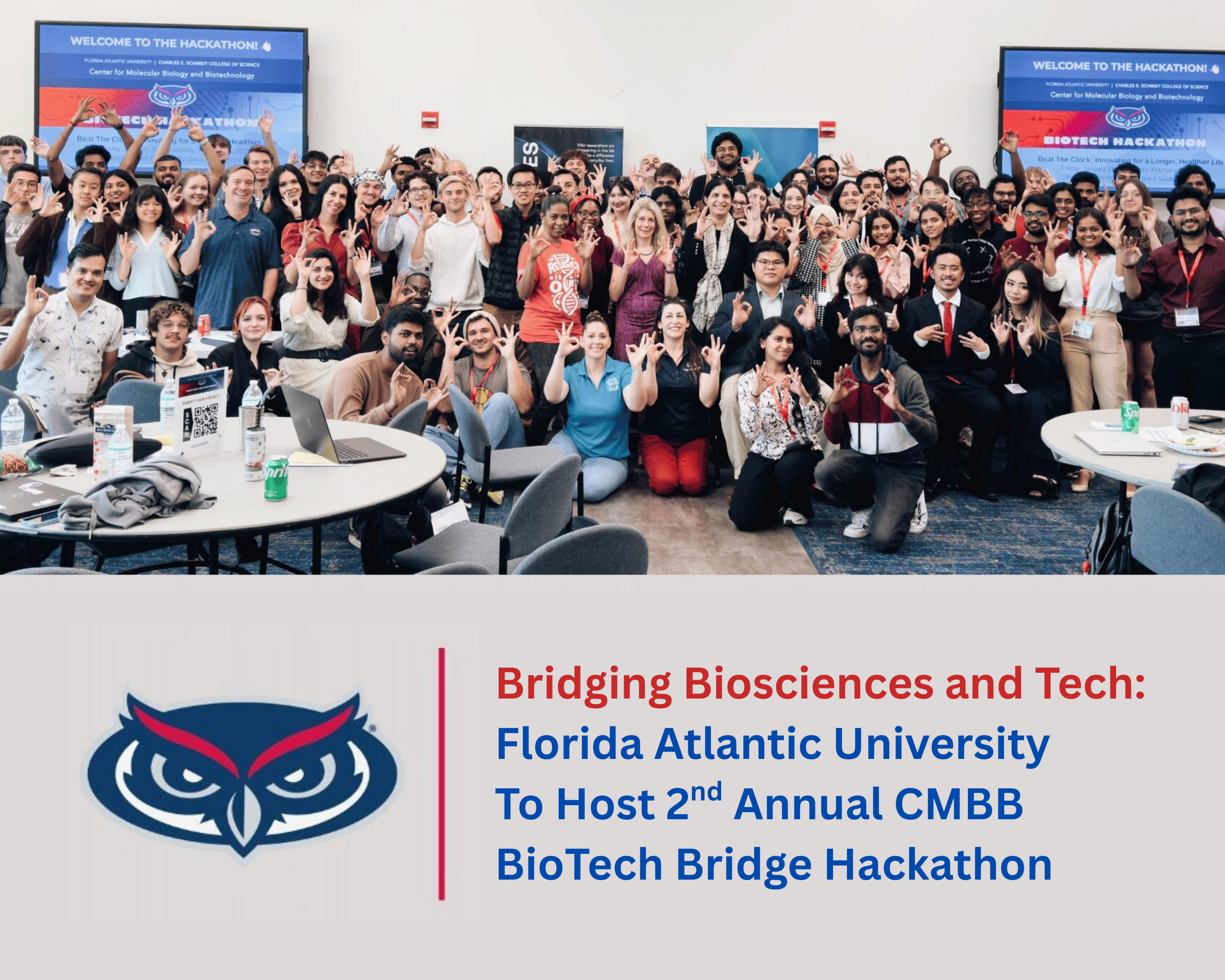
January 30 – February 1, 2026 | Florida Atlantic University, Boca Raton
From the laboratory bench to the world of digital innovation, the FAU CMBB BioTech Bridge Hackathon returns January 30–February 1, 2026, as a dynamic three-day event uniting students, mentors, researchers, and industry leaders to tackle real-world challenges at the intersection of biotechnology and technology. Hosted by Florida Atlantic University’s Center for Molecular Biology and Biotechnology (CMBB), this year’s BioTech Bridge Hackathon builds on the success of its inaugural run and promises to further solidify South Florida’s position as a hub for interdisciplinary bioscience innovation.
The BioTech Bridge Hackathon is designed to bring together undergraduate and graduate students from all majors to collaborate on solutions to pressing life science problems, from improving human health span to developing novel digital tools that support well-being. Participants form teams of 3–6 innovators and work intensively over the weekend to conceive, prototype, and pitch ideas that blend biology, data science, AI, engineering, business, and design.
Unlike traditional hackathons focused solely on software or apps, this event emphasizes biotechnology and bioscience challenges, giving students from biology, chemistry, molecular biology, biomedical engineering, computational science, nutrition, medicine, neuroscience, and even business and the arts an opportunity to contribute their distinctive perspectives. Teams might mine public data sets, design health-focused apps, explore wearable diagnostic technologies, or reimagine how biological insights can be translated into scalable solutions.
Why It Matters
At its core, the BioTech Bridge Hackathon is more than a competition, it is a community builder and a catalyst for cross-disciplinary learning. Events like this break down traditional academic silos, encouraging students who might never ordinarily collaborate to team up and leverage each other’s strengths. By fostering such interdisciplinary connections, the hackathon reflects the reality of the modern biotech landscape where breakthroughs increasingly require expertise in computational modeling, machine learning, engineering design, and market viability as much as they do a grasp of cellular biology or chemistry.
This collaborative model mirrors trends reshaping the life sciences economy: companies are looking for graduates who can not only conduct experiments but also interpret complex datasets, design intuitive user interfaces, and communicate solutions effectively across teams. For students, engaging in a high-energy, mentor-supported environment builds confidence, expands networks, and accelerates professional growth in ways traditional coursework often cannot.
Partnerships Power Success
A key strength of the 2026 hackathon is the growing partnership with Palm Beach State College, bringing community college learners into the fold and strengthening pathways between two-year and four-year STEM education. Palm Beach State’s strong business and computer science programs prepare students for hands-on research and workforce readiness, and integrating these learners into the BioTech Bridge Hackathon expands opportunity, diversity of thought, and the talent pipeline. The collaborative events between FAU and Palm Beach State in engineering and STEM pathways illustrate this shared commitment to student success and workforce development.
By inviting students from Palm Beach State College to participate, the hackathon underscores FAU’s broader mission to build educational bridges across institutions. These partnerships not only support student mobility and academic advancement, but also enhance South Florida’s innovation ecosystem by nurturing early engagement with research, entrepreneurship, and interdisciplinary problem-solving.
Looking Ahead: Expansion and Impact
With strong momentum from its debut in 2025, where more than 85 students participated and interdisciplinary teams produced forward-thinking projects, organizers such as Dr. Shailaja Allani, Director of FAU’s CMBB Program and Nikki Cabus, CEO of Studio Solian and former tech nonprofit executive, are planning strategic growth for the BioTech Bridge Hackathon.
Anticipated expansion includes broader statewide engagement with additional colleges and universities, deeper industry involvement with biotech and health tech companies, and expanded mentorship and sponsorship opportunities. These efforts aim to turn the hackathon into an annual destination event for Florida’s next generation of innovators.
As the life sciences continue to evolve and biotechnology becomes increasingly intertwined with digital solutions, events like the FAU BioTech Bridge Hackathon exemplify how academia and industry can collaborate to prepare talent for tomorrow’s challenges. Whether participants are crafting AI-driven diagnostic tools, building wearable health monitors, or designing platforms to improve patient outcomes, this event represents the future of bioscience innovation, collaborative, interdisciplinary, and impact-driven.
Registration is open and students, mentors, and sponsors are encouraged to join the community shaping the future of biotechnology in Florida and beyond.
Click here for more information or check out this link for sponsorship info.

YouTube sensation IShowSpeed, also known as Darren Watkins Jr., has reportedly invested $10.75 million in a Miami-Dade warehouse to establish a dedicated content creation and production studio. The 26,600-square-foot property represents a major step in the creator's expansion from livestreaming into a larger media enterprise. Miami real estate broker Jordan Karp represented IShowSpeed in the transaction. The investment highlights South Florida's growing role in the creator economy, connecting digital entertainment, technology, commercial real estate, and entrepreneurship.