
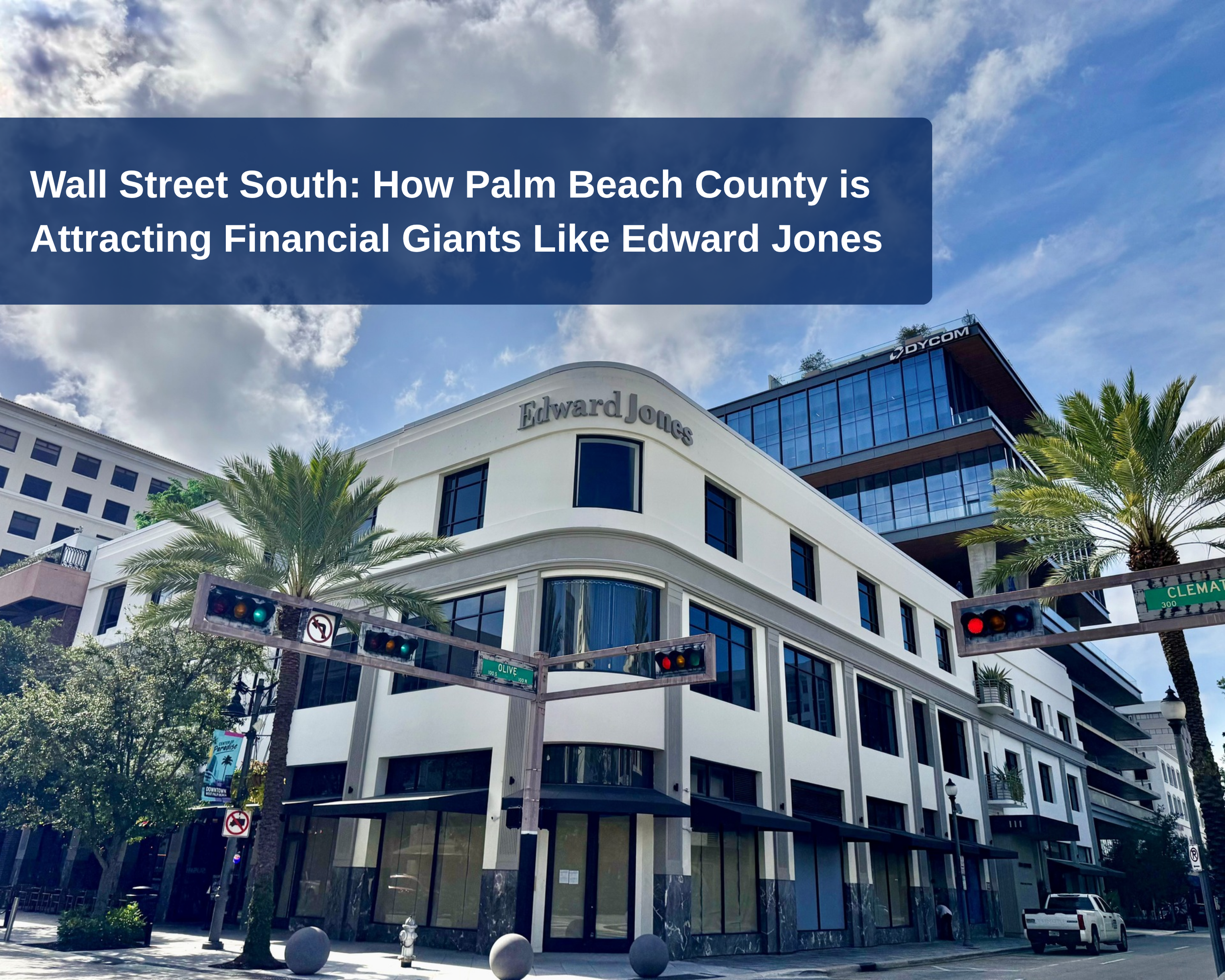
Wall Street South: How Palm Beach County is Attracting Financial Giants Like Edward Jones
For decades, New York City has been synonymous with global finance. Wall Street has long served as the epicenter of banking, investment management, private equity, and wealth advisory services. Today, however, another region is increasingly entering that conversation: Palm Beach County.
Through a strategic economic development initiative known as Wall Street South®, the Business Development Board (BDB) of Palm Beach County has successfully positioned the region as a premier destination for financial services firms, family offices, hedge funds, private equity groups, and wealth management companies seeking growth, talent, and quality of life.
The latest example of that momentum is the expansion of Edward Jones into downtown West Palm Beach, further reinforcing Palm Beach County's growing reputation as one of the nation's most attractive financial centers.
The Rise of Wall Street South Through the Data
The success of Wall Street South is not happening by accident. Palm Beach County has become one of the most attractive destinations in the world for wealth, talent, and business investment.
According to the Business Development Board of Palm Beach County, the county ranks as the fourth-fastest-growing wealth hub in the world and has experienced a remarkable 112% increase in millionaires over the past decade. Today, Palm Beach County is home to approximately 71,000 millionaires and 68 billionaires, creating one of the most concentrated wealth markets in the United States.
The region's appeal extends beyond wealth alone. Palm Beach County boasts the highest average salary in Florida at $74,801, a labor force of nearly 784,000 people, and was recently ranked the No. 2 metro area in the nation for competitive talent attraction. The county has also seen a 10.6% increase in residents ages 25 to 35 over the past decade, signaling continued growth among young professionals and future business leaders.
The area's strong educational pipeline further supports corporate expansion. Palm Beach County is home to the nation's 10th-largest school district, an A-rated system that includes two schools ranked among the top 100 nationwide.
Perhaps most telling is the migration of wealth itself. Of the $39 billion in wealth that moved to Florida in recent years, Palm Beach County captured the largest share at 25%, reinforcing its status as a destination for high-net-worth individuals, entrepreneurs, and investors.
At the same time, the county continues to invest in future growth, with more than 2 million square feet of new commercial and industrial space currently in development, ensuring that companies have room to expand alongside the region's growing economy.
For firms like Edward Jones, these factors create an ideal environment where capital, talent, and opportunity converge, making Palm Beach County a natural choice for long-term investment and expansion.
Edward Jones Chooses Downtown West Palm Beach
One of the newest firms to strengthen its footprint in the region is Edward Jones, one of the largest financial advisory firms in the United States.
Founded in 1922, Edward Jones provides investment management, retirement planning, estate planning, and wealth advisory services to individuals, families, and businesses. The firm serves millions of clients through thousands of financial advisors across North America.
As part of its continued growth strategy, Edward Jones recently leased approximately 10,000 square feet at Banyan & Olive, a premier mixed-use office development in downtown West Palm Beach. The lease occupies nearly an entire floor within the historic 111 Olive building, located at the corner of Olive Avenue and Clematis Street.
The move is particularly noteworthy because it represents one of the firm's most significant downtown Palm Beach County presences to date, positioning Edward Jones closer to the growing concentration of affluent clients, family offices, and financial institutions now calling the region home.
Banyan & Olive: A Symbol of Downtown's Transformation
Edward Jones' new home reflects the broader evolution of West Palm Beach itself.
Banyan & Olive combines the restoration of the historic 111 Olive building, originally constructed in the 1930s, with the development of a modern office tower at 300 Banyan Boulevard. Together, the project creates a next-generation workplace environment featuring hospitality-inspired amenities, wellness facilities, retail spaces, event areas, and waterfront access.
Developers intentionally designed the project to appeal to technology firms, financial services companies, and innovative businesses seeking a workplace that balances productivity, lifestyle, and collaboration. The development has quickly become one of downtown West Palm Beach's most sought-after business addresses.
The arrival of Edward Jones follows a growing list of firms choosing West Palm Beach as a strategic location, helping revitalize the historic Clematis Street corridor and reinforcing downtown's emergence as a center of commerce and innovation.
The Connection Between the Big Apple and Palm Beach County
The “Wall Street South” initiative builds upon the BDB’s New York City campaign, which launched over a decade ago. Business Development Board CEO Kelly Smallridge said the movement peaked during the pandemic and continues to attract more financial giants from the Big Apple to Palm Beach County.
The growth of Wall Street South is not about replacing New York, it is about creating a powerful extension of it.
Many firms establishing offices in Palm Beach County maintain significant operations in Manhattan while expanding executive, wealth management, investment, and client-facing teams into South Florida. The result is a growing corridor between New York and Palm Beach County where talent, capital, and business opportunities move more freely than ever before.
Business leaders frequently travel between the two markets, creating stronger economic ties and opening new opportunities for collaboration. Palm Beach County benefits from access to institutional capital and financial expertise, while firms gain access to an exceptional quality of life, favorable business conditions, and a rapidly expanding base of affluent clients.
The relationship has become so significant that Palm Beach County leaders have actively promoted Wall Street South in New York City, directly engaging financial firms and site selection consultants about expansion opportunities in the region.
More Than a Trend: A Transformation
The arrival of Edward Jones is another indicator that Palm Beach County's emergence as Wall Street South is no longer a prediction - it is a reality.
What began as a branding initiative by the Business Development Board has evolved into a nationally recognized economic development strategy that is attracting some of the world's most influential financial firms and wealth creators. As more companies establish a presence in downtown West Palm Beach, the region continues to deepen its connections with New York's financial ecosystem while creating new opportunities for innovation, entrepreneurship, and economic growth across South Florida.
The result is a powerful bridge between the "Big Apple" and Palm Beach County, one built on talent, capital, and a shared vision for the future of finance.
For South Florida, the implications are significant. As wealth management firms, family offices, investment companies, and financial institutions continue to arrive, they bring with them jobs, investment, innovation, and demand for a broad range of supporting industries. From fintech startups and cybersecurity providers to legal, accounting, and professional services firms, the ripple effects are creating a more diversified and resilient regional economy.
Edward Jones may be the latest firm to plant its flag in downtown West Palm Beach, but it is unlikely to be the last. The momentum behind Wall Street South continues to build, positioning Palm Beach County as one of the most dynamic financial centers in America.
Check out the Wall Street South magazine.




2150 co-founder Christian Hernandez Gallardo is leaving venture capital to become Executive Chair of Boca Raton-based Blue Frontier, helping the climate-tech company scale manufacturing, expand internationally and capitalize on growing demand for energy-efficient cooling as AI and data centers place new pressure on the electrical grid.