
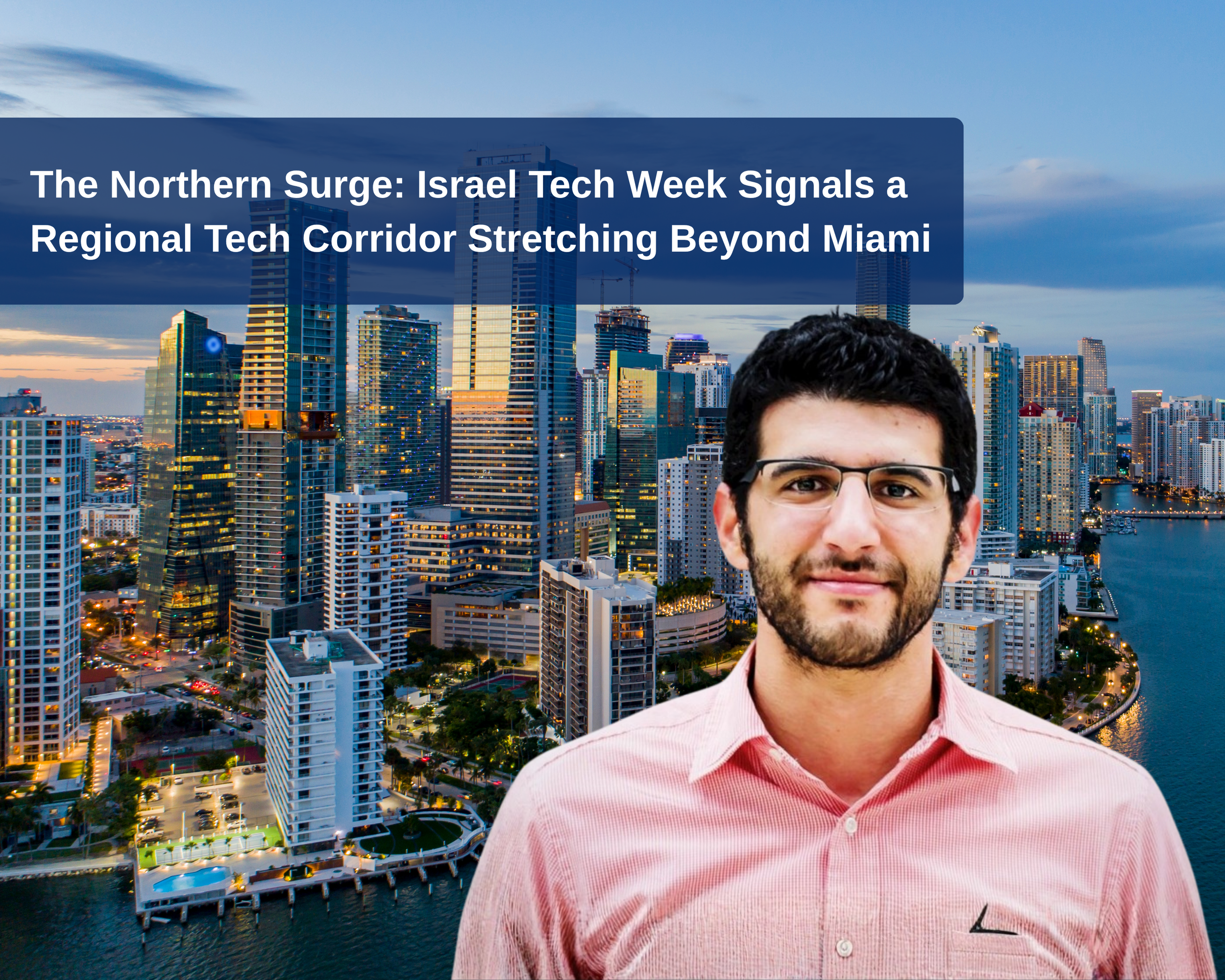
The Northern Surge: Israel Tech Week Signals a Regional Tech Corridor Stretching Beyond Miami
Glaring signs of South Florida’s accelerating innovation economy are no longer confined to Brickell towers or Wynwood coworking hubs. Increasingly, they are farther north, in Palm Beach County boardrooms, Broward innovation initiatives, and the growing connective tissue binding 6 million people into a burgeoning regional economy.
What began as a “Miami tech” narrative rapidly evolved into something much larger. Today’s South Florida innovation corridor encompasses West Palm Beach through Fort Lauderdale and Miami-Dade County.
From Miami Momentum to Regional Movement
Ayal Stern, co-founder of The Lab Miami and Israel Tech Week, said the region fights an external misconception. Many outside South Florida view it as a collection of isolated cities rather than a concentrated economic ecosystem.
“The corridor between Palm Beach, Broward, and Miami-Dade is roughly the same geographical distance as San Jose to San Francisco,” Stern said during a recent interview. “People think of it as just ‘Miami,’ but it really has to be viewed as a regional system.”
That system increasingly attracts international founders, global venture capital firms, family offices, and entrepreneurs. New York and Silicon Valley emigres are now joined by those from Buenos Aires, São Paulo, Bogotá, and Tel Aviv.
Why International Founders Are Choosing South Florida
The appeal extends well beyond taxes, climate, or business regulation. Increasingly, founders describe South Florida as something harder to manufacture: a culturally open environment where ambitious newcomers are welcomed rather than viewed as outsiders.
“Founders want to be where the energy is,” Stern said. “They want proximity to serendipity, where they can meet other founders, meet investors, and meet talent. Florida has that.”
That atmosphere has become especially significant for Israeli founders and investors navigating a changing social climate elsewhere in the United States.
“For Israelis specifically, you’re cheered here in Miami,” Stern said. “In places like New York or Boston, some people feel pressure to hide the fact that they’re Israeli because of safety concerns or anti-Semitism. Here, you can go loud and proud.”
Stern described conversations with Israeli founders who spoke of children concealing their identities in schools in parts of the Northeast and increasingly hostile campus environments following the October 7 attacks. By contrast, many now view South Florida not simply as a lower-tax destination, but as a place where Jewish and Israeli identity can coexist openly with entrepreneurial ambition.
That sense of openness reflects something broader about South Florida itself. Over decades, the region’s identity has been shaped by immigration and international migration, from Latin America, the Caribbean, Europe, and now increasingly Israel. The result is a business culture that often feels globally fluent by default.
Someone arriving from Bogotá or Buenos Aires is not unusual here. Neither is a founder from Tel Aviv. The region’s diversity has evolved into a strategic business asset, creating a uniquely international ecosystem. Cross-border commerce and multicultural networking are uniquely normalized rather than exceptional.
That dynamic was on full display during the latest Israel Tech Week, which grew from roughly 1,500 attendees to more than 2,000 participants this year despite wartime conditions in Israel, international flight disruptions, and severe travel complications.
“A lot of people had to be incredibly creative just to get here,” Stern noted. “And they still came.”
Importantly, the growth is no longer concentrated solely in Miami. Palm Beach County’s expanding concentration of family offices and deployable capital is drawing increasing attention from founders and venture investors, while Broward County is emerging as a connective infrastructure and logistics hub anchored by universities, airports, and port activity.
“We’re seeing increasing participation not just from Miami, but from Palm Beach County and Broward,” Stern said. “The ecosystem is expanding naturally along the corridor.”
The message behind that growth may ultimately matter more than the attendance numbers themselves.
South Florida is no longer simply attracting capital. It is attracting conviction, community, and increasingly, permanence.



Tri-Rail enters a new era under Executive Director Dave Kubicek as growing ridership, new funding strategies, and regional development opportunities reshape the future of South Florida transit.