

CMMC Phase II Suspension Gives South Florida Defense and Tech Companies More Time. But Not a Free Pass.
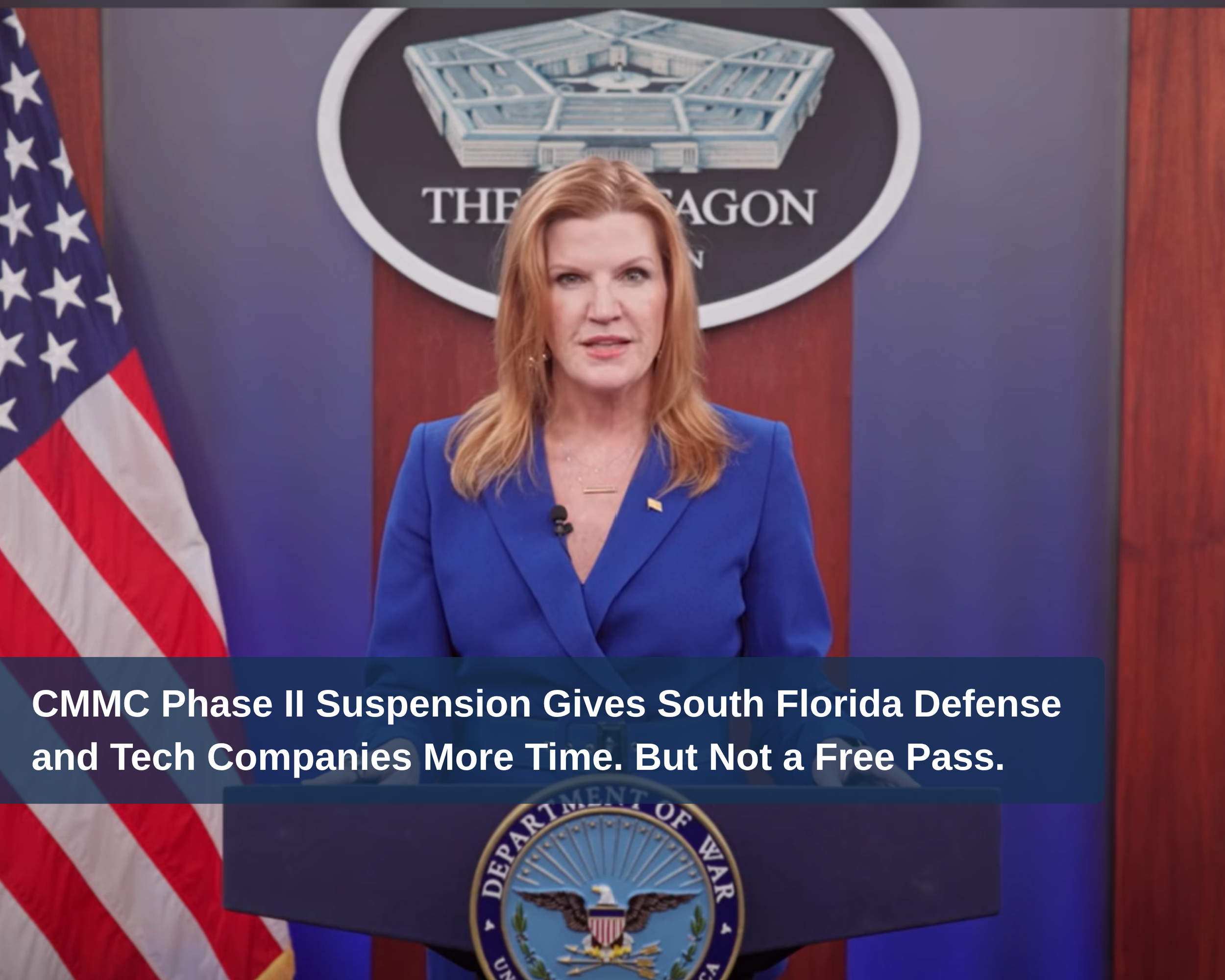
The U.S. Department of War (also known as the Department of Defense) recently announced the immediate suspension of Phase II of the Cybersecurity Maturity Model Certification (CMMC) program, sending ripples across the nation's Defense Industrial Base, and South Florida companies may be among those that stand to benefit.
While the announcement pauses the requirement for many contractors to obtain third-party CMMC Level 2 certification before competing for certain defense contracts, it does not eliminate cybersecurity compliance requirements. Companies handling Controlled Unclassified Information (CUI) must still comply with NIST SP 800-171 security standards, complete required self-assessments, and continue protecting sensitive government information.
For South Florida's rapidly expanding defense technology, aerospace, cybersecurity, and advanced manufacturing sectors, the suspension offers something many companies have been asking for: more time.
A Growing Defense Innovation Hub
South Florida has quietly become an increasingly important hub for defense innovation.
From cybersecurity firms and autonomous systems developers to drone manufacturers, AI startups, marine technology companies, aerospace suppliers, and precision manufacturers, more organizations across the region are pursuing opportunities with the Department of War than ever before.
Companies such as Zulu Pods, which recently secured new investment to expand manufacturing of mission-critical components for military aircraft and unmanned systems, reflect the growing number of South Florida businesses supporting national defense and modernization efforts.
Across Palm Beach, Broward, and Miami-Dade counties, innovators are developing technologies that serve both commercial and defense markets, strengthening Florida's role in the nation's defense industrial base.
Many of these businesses, particularly startups and small manufacturers, had been preparing for the significant cost and complexity of obtaining third-party CMMC certification.
The suspension temporarily removes one of the largest barriers to entry while the Department of War conducts a comprehensive review of the certification program.
Relief for Small and Mid-Sized Businesses
For many smaller contractors, preparing for a CMMC assessment required substantial investments in cybersecurity consultants, documentation, technology upgrades, and third-party audits.
The immediate suspension provides organizations with valuable breathing room to:
Continue strengthening cybersecurity programs at a sustainable pace.
Complete System Security Plans (SSPs) and Plans of Action & Milestones (POA&Ms).
Address security gaps before formal certification requirements return.
Reduce the pressure of meeting previously anticipated certification deadlines.
Rather than viewing the suspension as a reason to slow down, cybersecurity leaders say companies should use the additional time to strengthen both their technology and their workforce.
"Whether certification timelines shift or not, the need for strong cybersecurity governance doesn't," said Ryan Barras, President of ISACA South Florida. "This is an opportunity for organizations to invest in their people as much as their technology. Professional certifications like CISA, CISM, CRISC, and CGEIT help develop the cybersecurity, governance, and risk management expertise companies need to strengthen their security programs and prepare for whatever compliance framework comes next. Compliance should never be viewed as the finish line, but the result of building a resilient security culture."
For organizations willing to continue investing during this pause, the payoff may extend well beyond regulatory compliance, strengthening internal governance, reducing risk, and building the expertise needed to compete for future defense opportunities.
Opening the Door for More Defense Startups
The decision could also benefit South Florida's growing startup ecosystem.
Early-stage companies developing technologies in artificial intelligence, robotics, autonomous systems, cybersecurity, aerospace, maritime technology, advanced manufacturing, and defense software have increasingly looked toward Department of War innovation programs such as SBIR, STTR, AFWERX, NavalX, and the Defense Innovation Unit (DIU) for funding and commercialization opportunities.
For many founders, however, the anticipated cost of CMMC certification represented a significant hurdle.
By temporarily pausing mandatory third-party certification, the Department may make it easier for innovative startups to begin pursuing federal opportunities while continuing to strengthen their cybersecurity posture.
For a region working to establish itself as a national leader in defense innovation, lowering barriers to entry could encourage even more companies to explore government contracting opportunities.
Cybersecurity Still Matters
Despite the suspension, cybersecurity expectations have not changed.
Companies pursuing defense contracts must still maintain compliance with applicable NIST SP 800-171 requirements, complete required self-assessments, and continue protecting Controlled Unclassified Information.
For South Florida cybersecurity firms, that means demand is unlikely to disappear.
Organizations will continue seeking assistance with:
NIST SP 800-171 implementation
Security risk assessments
Security awareness training
Incident response planning
Microsoft 365 and cloud security hardening
Zero Trust architecture
Compliance documentation and governance
Paul Berndt, founder and CEO of NetVPro, believes companies should view the suspension as an opportunity and not a reason to delay their cybersecurity efforts.
"Businesses shouldn't shy away from this or put their cybersecurity plans on hold," Berndt told South Florida VTC. "Some form of formal cybersecurity certification is going to return. The organizations that continue preparing now will be miles ahead of everyone else when the new requirements are introduced."
Berndt said the additional time gives organizations the opportunity to strengthen their cybersecurity posture without the pressure of an immediate certification deadline.
"This is the time to lean into cybersecurity, not away from it," he added. "The companies that invest in building mature security programs today won't be scrambling tomorrow. They'll be ready."
His advice echoes what many cybersecurity professionals are telling defense contractors nationwide: while the certification process may evolve, protecting sensitive information and implementing strong cybersecurity controls will remain fundamental expectations for doing business with the federal government.
Manufacturers Gain Valuable Time, But the Work Isn't Over
South Florida manufacturers supporting aerospace and defense supply chains stand to benefit from the Department of War's decision to suspend Phase II of the CMMC program.
Instead of racing to complete third-party assessments before upcoming procurement deadlines, suppliers now have the opportunity to strengthen internal controls, improve documentation, and implement cybersecurity best practices before certification requirements return in a revised form. For organizations already investing in cybersecurity, the suspension allows those efforts to continue strategically rather than under compressed timelines.
However, companies should not mistake the suspension for the end of CMMC.
Only the mandatory third-party certification component of Phase II has been paused while the Department conducts a comprehensive review of the program. Organizations pursuing defense contracts should continue investing in cybersecurity, documenting compliance efforts, and aligning with NIST SP 800-171 requirements.
Those that use this additional time to strengthen their cybersecurity posture, mature their governance practices, and prepare for future certification requirements will likely be best positioned when the next iteration of the CMMC framework is introduced.
“To ensure we maintain robust security, without the red tape, today we are establishing a CMMC Reform Task Force which will deliver its final recommendations to me within 60 days,” announced the Department’s CIO Kirsten Davies.
A Turning Point for Florida's Defense Economy
South Florida's innovation ecosystem has spent the past several years attracting defense technology companies, cybersecurity firms, dual-use startups, advanced manufacturers, and aerospace innovators.
The temporary suspension of CMMC Phase II may remove an immediate obstacle for many organizations seeking to enter the defense market while preserving the long-term expectation that contractors maintain strong cybersecurity practices.
For companies considering federal contracting, this isn't an invitation to pause cybersecurity investments, it's an opportunity to strengthen them thoughtfully.
If the Department's review results in a more streamlined, cost-effective certification model, South Florida could be well positioned to capitalize. With a growing concentration of defense innovators, research institutions, advanced manufacturers, and cybersecurity expertise, the region is increasingly becoming a destination for companies building technologies that support both economic growth and national security.
The rules may be changing, but the opportunity remains and for many South Florida companies, it may be bigger than ever.
More information can be found here: https://dowcio.war.gov/brilliantbasics






Carnegie Mellon University has named four-time technology founder Jignesh M. Patel as the founding dean and vice president of its new Miami campus. Backed by a $2 billion commitment from Citadel founder Ken Griffin, CMU Miami will focus on artificial intelligence, national security, healthcare, energy, and advanced manufacturing. Patel brings extensive experience in computer science research, startup development, and technology commercialization. Planned for Miami's Wynwood neighborhood, the campus expects to begin enrolling students in 2028, strengthening South Florida's growing innovation and entrepreneurship ecosystem.