
From Boca Raton to Dolby: FAU Video Technology Lands in Global Media Giant’s Portfolio
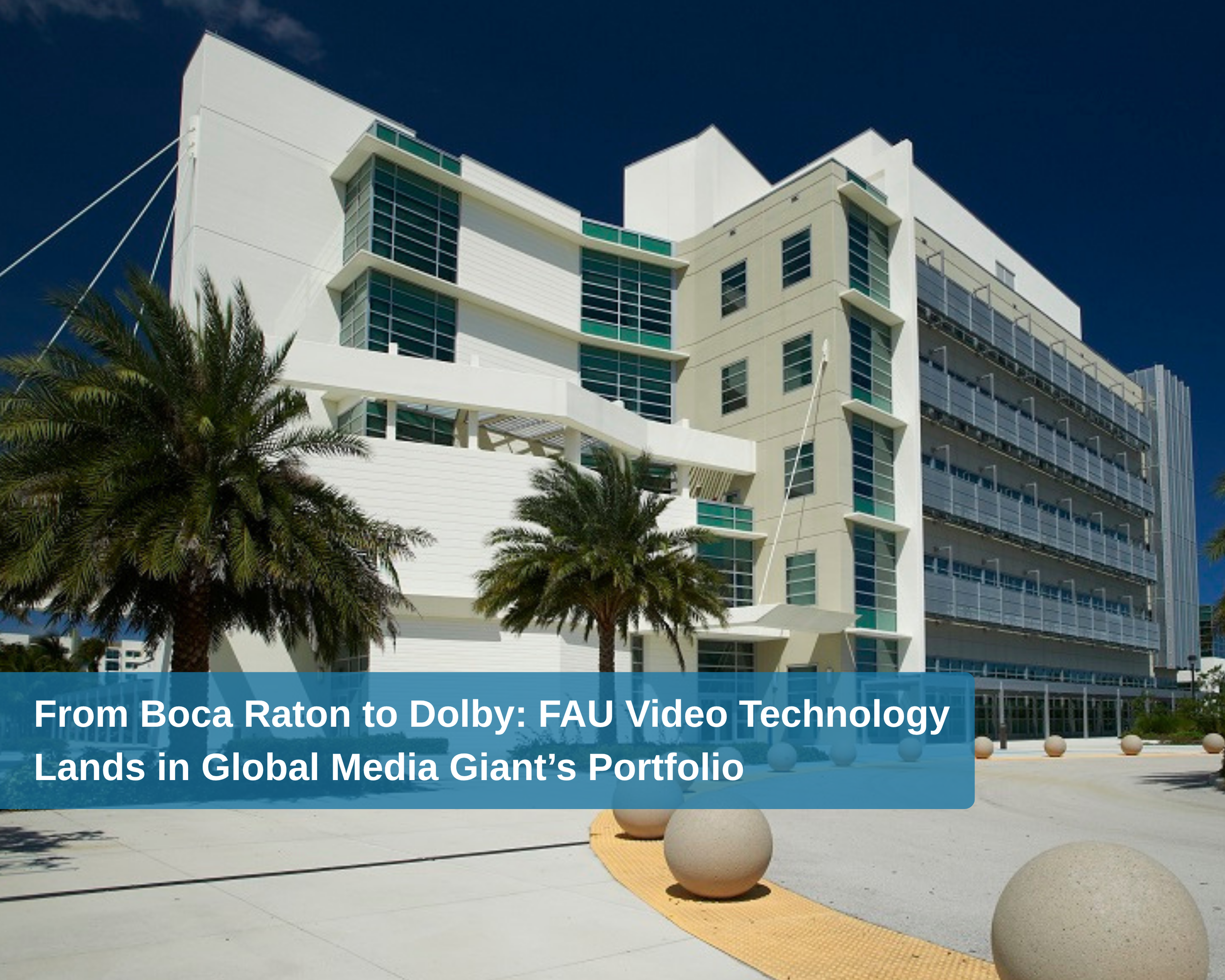
Technology developed inside the laboratories of Florida Atlantic University is heading into the portfolio of one of the world’s best-known media technology companies.
Dolby Laboratories has acquired a major video-compression intellectual property portfolio developed by researchers at FAU’s College of Engineering and Computer Science.
The portfolio includes 683 intellectual property assets, 250 granted patents worldwide and 73 U.S. patents, according to FAU. Sixteen of the U.S. patents have been declared essential to the international Versatile Video Coding standard, better known as VVC or H.266.
While the size of the portfolio is notable, the deal tells a larger story about how research originating at a South Florida university can move from the laboratory to international technology standards, and ultimately into the hands of a global technology company.
Compressing the Future of Video
At the center of the portfolio is technology contributing to VVC/H.266, the international video-compression standard finalized in 2020.
VVC can reduce the amount of data required to transmit video by approximately 50% compared with the previous High Efficiency Video Coding standard while maintaining comparable visual quality, according to FAU. That efficiency becomes increasingly important as the volume and quality of video moving across networks continues to grow. The implications also extend well beyond television and streaming.
Efficient video transmission and processing can play a role in drones, satellites, robotics, autonomous vehicles and defense communications, where systems may need to transmit and analyze large quantities of visual information while operating under bandwidth and storage constraints.And the next frontier may be artificial intelligence.
As cameras increasingly capture video not just for people to watch but for machines to interpret, video coding is beginning to intersect with computer vision and AI. FAU researchers have already been working on technologies related to Video Coding for Machines, including presenting technology during international standards work in Geneva in 2023.
From FAU Research to Global Commercialization
The portfolio represents years of work by researchers within Florida Atlantic University’s Department of Electrical Engineering and Computer Science, and a partnership designed to move that research beyond the university laboratory.
Dr. Hari Kalva, professor and department chair, and Dr. Borko Furht, professor and director of FAU’s NSF Industry/University Cooperative Research Center for Advanced Knowledge Enablement (CAKE), are named inventors on all 250 granted patents included in the portfolio. Dr. Velibor Adzic, an FAU alumnus and assistant professor of teaching, is also a co-inventor across the patent family.
“Every day, millions of people and countless devices rely on video, yet the challenge has always been how to deliver more quality using less bandwidth,” Kalva said in announcing the acquisition.
Much of that work is closely connected to FAU’s MLab, which focuses on visual computing and video compression as well as the growing convergence of artificial intelligence and machine vision. But the path from a Boca Raton research lab to Dolby was not a traditional university technology-transfer story.
FAU developed the technology through a strategic relationship with OP Solutions LLC(OPS), which sponsored the research while providing strategic direction, patent portfolio development and commercialization expertise. FAU contributed the researchers, technical expertise and resources behind the inventions. The patent rights were ultimately assigned to OPS, which sold the portfolio to Dolby, according to FAU.
The partnership, which dates to 2018, connected academic research with intellectual property strategy and commercialization over a period of years, and the Dolby transaction is not its first major commercial outcome.
In 2021, Mitsubishi Electric acquired other FAU-developed video-compression inventions created through the OPS partnership. At the time, FAU said the collaboration had already generated significant revenue for the university and could produce royalty income for decades.
The progression illustrates a broader commercialization pathway: research developed at FAU, supported and commercialized through OPS, has moved into international video standards and attracted global technology companies including Mitsubishi Electric and now Dolby.
Why 16 Patents Could Be Particularly Important
Among the hundreds of assets Dolby acquired, 16 U.S. patents stand out because they have been declared essential to VVC/H.266. Those patents are licensed through the Access Advance VVC patent pool for worldwide commercial implementation. Standard-essential patents can carry significant strategic value because they cover technologies considered necessary to implement an industry standard.
FAU and OPS had already begun establishing their position within the VVC ecosystem before the Dolby transaction. In 2023, FAU announced that seven U.S. patents from the collaboration had entered the VVC patent pool. At that time, the pool included licensors such as Dolby, Mitsubishi, Panasonic, MediaTek, Toshiba and Alibaba.
In other words, Dolby and the FAU-developed intellectual property were already participating in the same broader VVC licensing ecosystem years before the acquisition. Now Dolby owns the OPS portfolio itself.
A Commercialization Story for South Florida
For South Florida’s technology ecosystem, the significance of the transaction may reach beyond video compression.
Universities across the region are increasingly being asked to play a larger role in building companies, producing intellectual property, attracting research capital and moving technologies from academic laboratories into commercial markets. The FAU-OPS-Dolby story offers a tangible example of what that pathway can look like.
“This acquisition exemplifies the power of combining world-class faculty expertise with strong industry partnerships,” FAU President Adam Hasner said. “Technology developed at Florida Atlantic has evolved from groundbreaking university research into an international standard and is now part of the portfolio of one of the world’s leading media technology companies.”
It also arrives as FAU has been expanding its ambitions in other deep-tech fields, including artificial intelligence, autonomous systems and quantum technologies. The university established a Center for Quantum Technologies, has expanded quantum-related programs and research, and continues building research capabilities across AI, robotics, cybersecurity and advanced engineering.
Taken together, those efforts point toward a bigger opportunity for Boca Raton and the broader South Florida region: building an ecosystem where universities don't simply educate technology talent, but create intellectual property capable of competing on a global stage.
The Dolby transaction provides something particularly valuable to that ambition, evidence that the model can work. A technology can begin in a South Florida research lab, enter an international standard, generate hundreds of patents and ultimately become valuable enough to attract one of the world's leading media technology companies.
And FAU and OPS may already be looking toward what comes next. Recent reporting from MLex indicates that following the video-compression portfolio transaction, the partners plan to continue their research relationship with a greater focus on artificial intelligence.
For South Florida, that may make the next chapter of the partnership just as interesting as the Dolby deal itself.




Miami-based Blackstone technology executive Emma Mazzeo has joined Lutheran Services Florida's board of directors alongside two accomplished leaders in education and child welfare, bringing new expertise to the statewide nonprofit.