
From Streets to Skies: West Palm Beach Tackles Traffic Challenges Amid Economic Growth
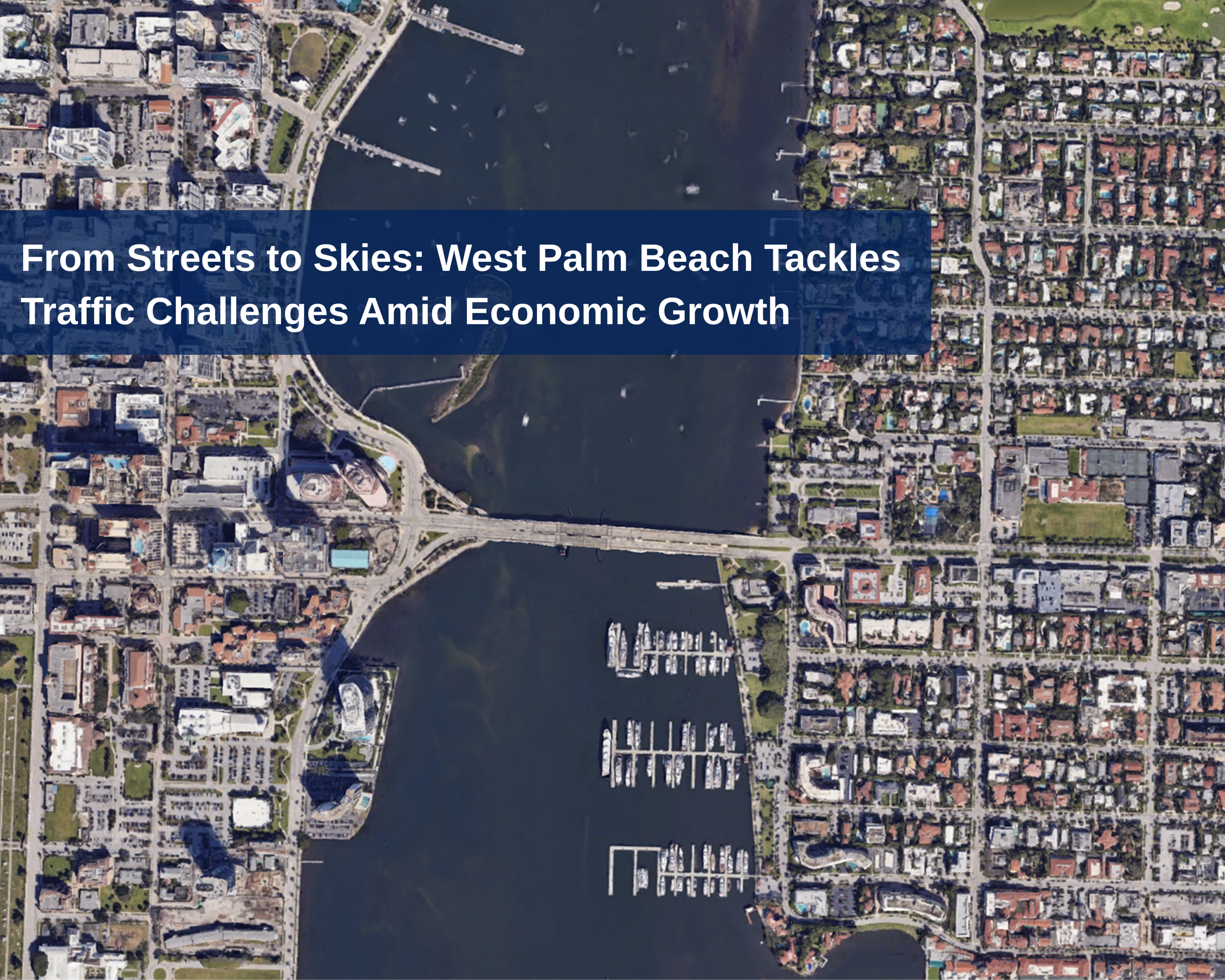
As the City of West Palm Beach continues its transformation into a major South Florida business and financial hub, the city is confronting a growing challenge: how to keep people moving as more companies, residents, employees, and visitors arrive.
New office towers, corporate relocations, residential developments, and expanding commercial districts are fueling economic momentum. But that growth is also placing additional pressure on roads, parking, and transportation infrastructure.
Now, two innovative mobility initiatives are offering different approaches to the challenge.
Real estate developer Related Ross is advancing plans for electric air taxis that could eventually connect West Palm Beach with other major South Florida business centers. Meanwhile, the City of West Palm Beach has launched West Palm Move, a technology-enabled, all-electric transit network designed to make getting around the city easier and more affordable.
Together, these initiatives illustrate how public and private investment in transportation technology could help shape the region's next chapter of economic growth.
Related Ross Looks to the Skies Above CityPlace
Related Ross is taking steps toward establishing an electric air taxi landing facility atop the Hibiscus Garage at CityPlace in downtown West Palm Beach.
In September 2026, the West Palm Beach Planning Board unanimously endorsed a zoning change allowing the proposed facility, known as a vertistop, to advance through the approval process. The project builds on a broader partnership between Related Ross and Archer Aviation, a California-based aerospace company developing electric vertical takeoff and landing (eVTOL) aircraft for regional passenger transportation.
“Our partnership with Archer marks a pivotal step in expanding South Florida's regional connectivity through cutting-edge technology,” said Stephen Ross, CEO and Chairman of Related Ross and owner of the Miami Dolphins.
“We are integrating Archer’s electric vertical takeoff and landing aircraft into our flagship locations across South Florida, including the Hard Rock Stadium in Miami, Related Ross developments in West Palm Beach, and Apogee Club in Hobe Sound. We’re excited to embrace a forward-thinking vision that transforms how people and businesses move across the region.”
Archer's proposed South Florida network would connect major destinations throughout the region, potentially allowing passengers to bypass some of its busiest highways. Its Midnight aircraft is designed to carry four passengers and a pilot, using electric propulsion to take off and land vertically.
The proposed CityPlace facility would include aircraft charging infrastructure and a passenger waiting area, with plans to accommodate multiple air taxi operators rather than operate as an exclusive network. However, the project remains in its early stages. Additional municipal and federal aviation approvals are required before commercial operations can begin.
For Related Ross, which has invested heavily in West Palm Beach's commercial and mixed-use development, the vertistop represents an opportunity to integrate emerging transportation technology directly into its real estate portfolio. The proposed CityPlace facility would include aircraft charging infrastructure and a passenger waiting area, with plans to accommodate multiple air taxi operators rather than operate as an exclusive network.
However, the project remains in its early stages. Additional city approvals and Federal Aviation Administration authorization are required, and commercial air taxi service is likely still years away.
West Palm Move Brings Transportation Innovation to the Streets
While air taxis represent a longer-term vision for regional connectivity, West Palm Beach is already deploying technology to address everyday transportation needs.
On September 8, 2026, the city officially launched the fixed-route portion of West Palm Move, followed by its on-demand service on September 15.
As Venture Tech Chronicle previously reported in West Palm Move Brings Tech-Enabled Transportation to a Growing Business Hub, the initiative combines digital transportation technology with an expanded local transit network to improve mobility throughout the city's growing commercial and residential districts.
Developed in partnership with global mobility technology company Via, West Palm Move replaces the city's earlier RideWPB pilot program with a permanent, fully electric transportation service.
The network offers two options:
Fixed-Route Service: Electric minibuses operating approximately every 8–10 minutes along a north-south corridor connecting the Norton Museum of Art, downtown, and Northwood Village, with fares of $1 per ride.
On-Demand Service: App-based rides that passengers can request within designated service areas for $2 per trip, with free transfers between the two services.
The program is designed to reduce the need for short car trips, ease parking demand, and provide more convenient connections between workplaces, businesses, residential neighborhoods, and other destinations.
For employees commuting into downtown West Palm Beach, the service could also help address the last-mile challenge, connecting regional transportation options such as Brightline and Tri-Rail with nearby employment centers and destinations.
Unlike air taxis, which are expected to serve a limited number of passengers per flight, West Palm Move is designed to provide affordable transportation for a much broader segment of the community.
Economic Growth Is Driving the Need for New Solutions
West Palm Beach's rise as a destination for financial services, technology companies, corporate headquarters, and professional services has created substantial economic opportunities. However, the infrastructure supporting that growth must also keep pace.
As companies establish operations and new developments reshape the downtown landscape, traffic congestion and transportation accessibility become increasingly important considerations for employers, workers, and investors. South Florida operates as an interconnected regional economy, with executives, entrepreneurs, employees, and investors frequently traveling between Palm Beach, Broward, and Miami-Dade counties.
For businesses, improved transportation can mean more accessible talent pools, easier client meetings, and stronger connections between regional markets. For employees and residents, it can mean shorter commutes, reduced transportation expenses, and greater access to employment opportunities.
The two initiatives address different parts of that equation: West Palm Move focuses on local accessibility, while electric air taxis could eventually offer faster connections between regional business centers.
Could Air Taxis Transform Regional Business Travel?
For professionals traveling frequently between West Palm Beach and Miami, electric air taxis present an intriguing possibility. A highway trip that can take well over an hour depending on traffic could potentially be reduced to a much shorter flight, although total travel time would also depend on ground transportation, boarding, and other operational requirements.
Beyond convenience, the emerging advanced air mobility industry could create opportunities for South Florida's technology ecosystem. Electric aviation requires investments in charging infrastructure, battery technology, aviation software, air traffic management, cybersecurity, maintenance, and specialized workforce development.
These needs could create opportunities for technology companies, startups, universities, and investors as the industry develops. Still, significant hurdles remain.
Aircraft certification, infrastructure approvals, operational safety, and pricing will determine whether air taxis become commercially viable. Their limited passenger capacity also raises questions about how much they could realistically reduce overall roadway congestion.
Rather than replacing traditional public transportation, electric aviation may ultimately serve as a complementary option for certain regional trips.
Technology, Infrastructure, and the Future of West Palm Beach
The contrast between West Palm Move and Related Ross's proposed vertistop highlights an important distinction in transportation innovation. One is an operating public transit network designed to serve everyday transportation needs at an affordable price. The other is a longer-term investment in an emerging aviation industry that could change how certain passengers travel between South Florida's business centers.
Both demonstrate how transportation technology is becoming increasingly intertwined with economic development, real estate investment, and urban planning.
For West Palm Beach, the challenge will be ensuring these innovations deliver measurable benefits as the city continues to expand. That means balancing emerging technologies with practical investments in public transit, pedestrian accessibility, regional rail connections, and infrastructure that supports businesses and residents alike.
The bigger story is not simply about flying taxis or electric shuttles. It is about whether West Palm Beach can build a transportation network capable of supporting the economic growth it is working so hard to attract.
As the city continues its evolution into a major South Florida business destination, its ability to connect people, companies, and opportunities may prove just as important as the developments transforming its skyline.


West Palm Beach is exploring innovative transportation solutions as economic growth increases pressure on local infrastructure. Related Ross is advancing plans for an electric air taxi facility at CityPlace in partnership with Archer Aviation, potentially connecting major South Florida business hubs. Meanwhile, the city has launched West Palm Move, an all-electric transit network developed with Via that offers affordable fixed-route and on-demand transportation. Together, these initiatives highlight how emerging mobility technology could support South Florida's expanding business ecosystem.