
Levita Magnetics Expands in Miami as Magnetic-Assisted Robotic Surgery Debuts in Florida
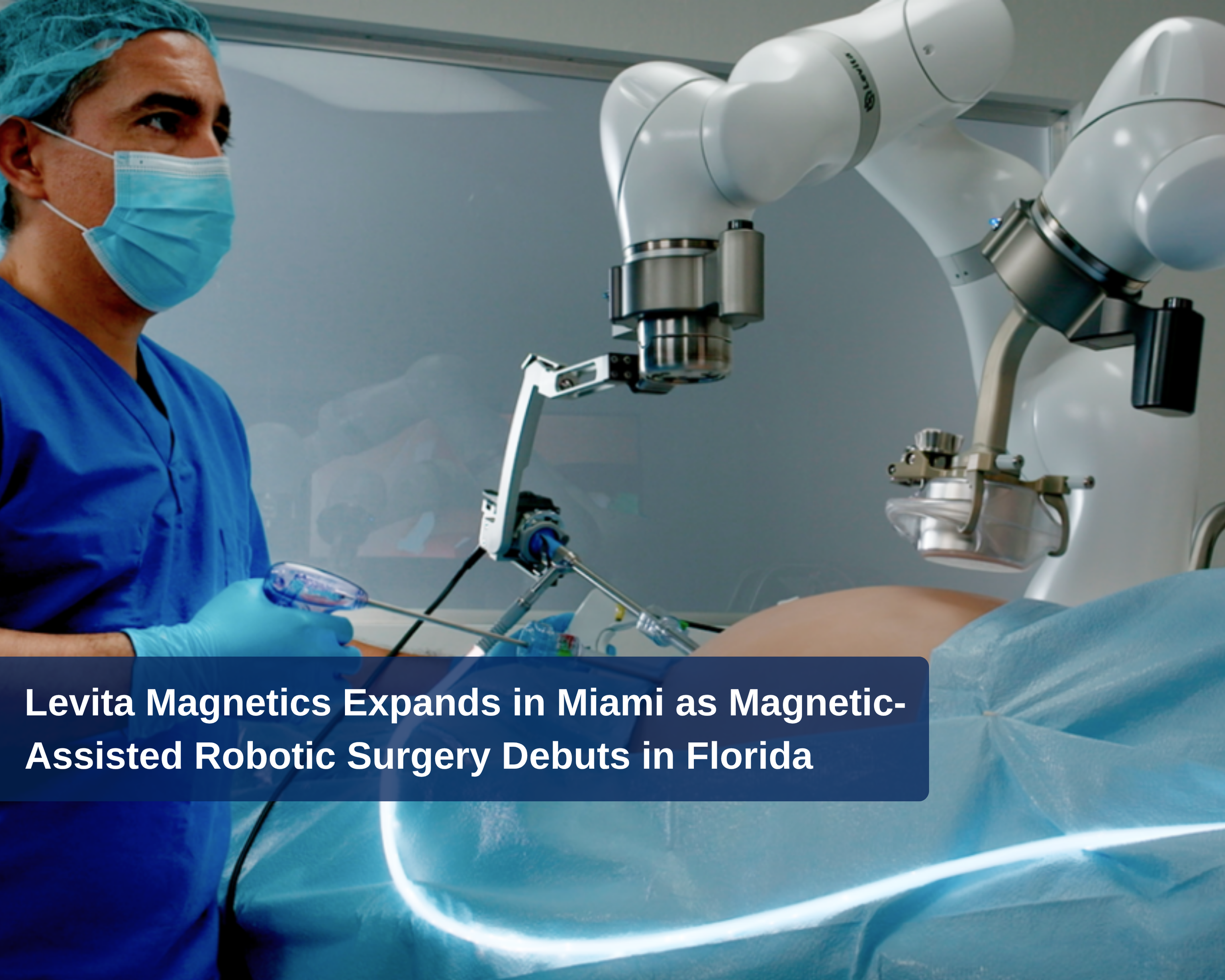
Levita Magnetics has made its move to Miami, bringing with it a surgical robotics platform that uses magnetic technology to reduce the number of incisions needed during minimally invasive procedures. Originally co-founded by Dr. Alberto Rodríguez-Navarro and Nicolás Luksic in Santiago, Chile, and now headquartered in Silicon Valley, Levita recently marked the Florida debut of its MARS platform at HCA Florida Mercy Hospital in Miami.
The hospital is the first in Florida to offer the technology, creating both a clinical foothold for Levita in the state and another connection between South Florida's healthcare institutions and the growing medical technology sector.
Levita describes MARS as a first-of-its-kind surgical platform combining its proprietary Dynamic Magnetic Positioning™ technology with a surgeon-controlled robotic arm. The system works alongside Levita's Magnetic Surgical System to allow surgical instruments inside the body to be controlled magnetically from outside it. By magnetically retracting tissue rather than passing an additional instrument through the abdominal wall, the technology can reduce the number of traditional incisions required during certain minimally invasive procedures.
The concept is similar to moving an object on the inside of aquarium glass by moving a magnet along the outside. The first Florida procedures focused on bariatric surgery and were performed by Dr. Nestor de la Cruz-Muñoz, a bariatric surgeon at HCA Florida Mercy Hospital.
The Florida deployment builds on Levita's growing clinical footprint. As of August, the company reported that its FDA-cleared technology had been used in more than 2,500 surgeries.
For Levita co-founder Dr. Alberto Rodríguez-Navarro, the Florida launch represents both a geographic expansion and an extension of the patient-focused mission behind the technology.
“Bringing MARS® to Florida is a meaningful step in our mission to make surgery less invasive and more human-centered. Every expansion is ultimately about the patient. By reducing the footprint of surgery on the body, we help surgeons deliver care that allows patients to recover faster, and we are proud to bring that to more patients across Florida through our new collaboration with HCA Florida Mercy Hospital,” said Rodríguez-Navarro.
At the same time the technology is entering Miami operating rooms, Levita is establishing a physical presence in South Florida to support its next stage of expansion.
Levita Selects Miami as Its Gateway to the East Coast and Latin America
Levita has opened a new Miami-area location to complement its Silicon Valley headquarters, establishing South Florida as a training and expansion hub as surgeon adoption increases across the East Coast and Latin America.
The company says Miami was selected in part because of the region's growing technology and entrepreneurial ecosystem. That gives Levita's move a significance beyond simply opening another sales office. Miami will serve as a place where hospitals and surgeons can engage with the technology while supporting the company's expansion into additional markets.
It also places Levita within a broader trend of companies using South Florida as a bridge between U.S. and Latin American markets. For example, Brazilian digital banking giant Nu has also established a South Florida presence as part of its expansion into the United States.
For Levita, that geographic advantage is paired with something equally important: proximity to healthcare institutions capable of adopting and demonstrating its technology. HCA Florida Mercy Hospital's deployment means Miami is simultaneously a market where MARS is being used clinically and a base from which Levita intends to support broader adoption.
From a Fish Tank Magnet to a New Approach to Minimally Invasive Surgery
The origins of Levita's technology began with a relatively simple idea: Could magnetic force be used to manipulate surgical instruments from outside the body?
For Rodríguez-Navarro, a minimally invasive surgeon, the question grew out of his firsthand experience with patients and their desire for fewer incisions, less scarring and faster recovery. The concept has often been compared to a magnetic aquarium cleaner, where moving a magnet outside the glass causes another component inside the tank to move with it.
Applied to surgery, that same basic principle allows a magnetic instrument positioned inside the body to be manipulated externally.
Rodríguez-Navarro and Luksic combined clinical innovation with investment and business experience to build Levita around that concept. Since moving to the United States, the company has developed magnetic surgical instruments, secured U.S. patents and worked through the regulatory process to commercialize its technology.
MARS represents the evolution of that original idea from magnetic surgical instruments into a platform combining magnetics, robotics and software.
How MARS Uses Magnets and Robotics to Reduce the Surgical Footprint
MARS is built around Levita's Dynamic Magnetic Positioning technology and works in conjunction with the company's Magnetic Surgical System. One of its defining features is magnetic retraction. Rather than inserting an additional instrument through another incision to move tissue during surgery, a magnetic instrument inside the body can be controlled externally.
The platform also provides surgeon-controlled visualization and retraction, creating potential benefits that extend beyond reducing the number of incisions. According to the surgeon who performed the first Florida procedures, the technology can also change how the surgical team operates in the room.
“The MARS® system was quick to adopt and integrates smoothly into how our team functions, providing stable, consistent visualization. Throughout the procedure, the camera and retraction are surgeon-controlled, which eliminates the need for an additional assistant at the table, minimizing distraction and maintaining optimal efficiency in the operating room,” said NDr. de la Cruz-Muñoz.
The firsthand experience highlights another component of Levita's value proposition: MARS is designed not only to reduce the physical footprint of surgery for patients, but also to give surgeons greater control while potentially improving operating-room workflow and efficiency. Levita has also reported positive results across multiple prospective clinical trials.
From Patient Outcomes to Operating Room Efficiency
The arrival of MARS in Florida also comes as the landscape around weight management continues to evolve. The rapid adoption of GLP-1 medications has introduced new nonsurgical options for patients, while bariatric procedures continue to play a role in long-term weight management.
Rodríguez-Navarro sees that changing landscape as another reason less-invasive approaches to bariatric surgery could become increasingly relevant.
“Bariatric procedures like those performed with Levita's MARS® technology are drawing renewed interest as patients seek durable alternatives for weight management. While pharmaceutical treatments such as GLP-1 medications have drawn significant attention, peer-reviewed research, including studies of semaglutide and tirzepatide, indicates that many patients regain substantial weight after discontinuing treatment. For those seeking a durable, less invasive surgical option, bariatric surgery remains a long-term solution, and the MARS® platform supports these procedures through a reduced-incision approach associated with shorter hospital stays and lower postoperative pain scores,” said Dr. Alberto Rodríguez-Navarro, co-founder of Levita Magnetics.
Beyond patient outcomes, the business case for surgical robotics increasingly includes what the technology can do for the operating room itself. Hospitals must consider how new surgical systems affect staffing, workflows, procedure efficiency, training and patient care. Because MARS gives the surgeon direct control over visualization and magnetic retraction, Levita says the platform can reduce dependence on additional personnel at the operating table while giving surgeons greater control during procedures.
That potential combination, reducing the physical footprint of surgery while improving how surgical teams use technology and personnel, could become an important part of Levita's value proposition as it works to expand adoption.
Capital Behind Levita's Commercial Expansion
Scaling a medical technology company from clinical development into hospital adoption requires significant capital, and Levita has raised substantial funding as it has moved toward commercialization.
In 2022, the company raised $26 million in Series C financing to support development and commercialization of its technology. More recently, an April 2026 SEC Form D filing reported approximately $30.7 million sold in a securities offering, adding another significant source of capital as Levita expands commercialization.
The timing coincides with the company's broader push into new U.S. markets, including its Florida launch and Miami presence. That combination of capital, regulatory clearance, clinical adoption and geographic expansion places Levita at a different stage than an early-stage medical device startup still working toward its first hospital deployments.
The company now faces the challenge of turning technological and clinical validation into wider adoption. Miami will play a role in that next phase.
What Levita's Move Means for South Florida
Levita's expansion adds another internationally oriented medtech company to South Florida's growing technology ecosystem while highlighting a role Miami is increasingly positioned to play in the commercialization of new technologies.
Not every technology company operating in South Florida has to originate here for the region to benefit from its growth. Companies can develop technologies elsewhere and choose Miami as the place from which they reach customers, train users, recruit talent, build partnerships and expand into new markets. Levita's trajectory illustrates that possibility particularly well.
The company traces its origins to Chile, built its U.S. headquarters in Silicon Valley and is now establishing Miami as a bridge to markets across the East Coast and Latin America. Its technology is also not simply being marketed from South Florida. It is already being used inside a Miami hospital.
Hospitals, universities, investors and technology companies all play different roles in building an innovation ecosystem. Healthcare institutions capable of becoming early adopters of emerging technologies can give companies proximity to the surgeons and patients actually using their products while creating opportunities for additional clinical collaboration and commercialization.
Levita's arrival comes as other pieces of South Florida's healthtech ecosystem continue to develop. Miami-based healthtech startup EyeCheq has partnered with Renovio Group's iCare around advanced eye-screening technology, representing another example of healthcare innovation and corporate partnerships emerging from the region.
South Florida is also attracting additional investment organizations and technology companies. Andreessen Horowitz's expansion into West Palm Beach represents another piece of the region's growing capital infrastructure.
Together, these developments contribute to an ecosystem that increasingly includes not just startups, but investors, healthcare systems, universities, corporate partners and internationally focused technology companies.
Miami's relationship with Latin America adds another competitive advantage. For international companies, South Florida can provide access to the U.S. market while maintaining cultural, business and geographic connections throughout Latin America. For U.S.-based technology companies, those same relationships can make Miami a logical launching point for expansion south. Levita now sits at the intersection of both.
Its journey from Chile to Silicon Valley and now Miami illustrates a role South Florida can increasingly play in the global innovation economy. Miami does not necessarily need to be where every technology is invented to participate meaningfully in its growth. It can also become a place where technologies are demonstrated, commercialized and scaled; where companies connect with customers and healthcare institutions; and where U.S. and international markets converge.
Levita’s magnetic-assisted robotic surgery technology is now being used inside a Miami hospital while its new South Florida operation supports broader adoption across the East Coast and Latin America. If that model succeeds, the significance of Levita's Miami expansion could extend beyond one medical technology company. It could provide another example of how South Florida participates in scaling the next generation of healthcare technology.




Levita Magnetics is expanding in Miami as its MARS robotic surgery platform makes its Florida debut at HCA Florida Mercy Hospital. The technology combines magnetics and robotics to reduce incisions during minimally invasive procedures. Miami will also serve as a hub for surgeon training and expansion across the East Coast and Latin America. The move strengthens South Florida’s growing medtech and healthcare innovation ecosystem.