
SoftBank Didn’t Just Buy Boca Raton-Based DigitalBridge. It Bought an Engine for Financing the AI Buildout.
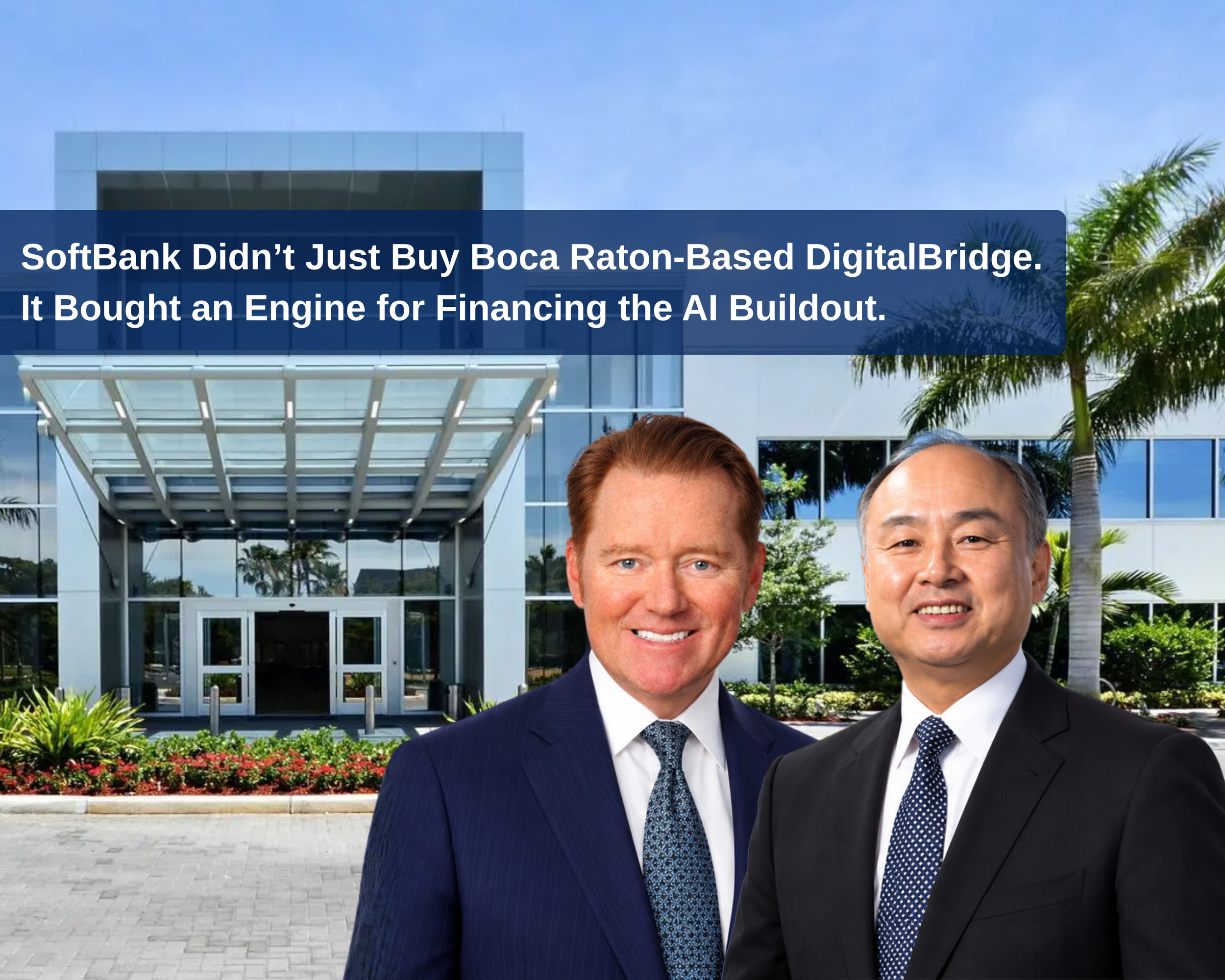
When VTC first reported on SoftBank Group's planned $4 billion acquisition of Boca Raton-based DigitalBridge, the deal pointed to an increasingly important reality in the artificial intelligence race: building better AI models is only part of the equation.
AI at global scale requires an enormous physical backbone, from data centers and fiber networks to power capacity, edge computing and connectivity, and DigitalBridge specializes in precisely that infrastructure.
At the time, the combination promised to strengthen SoftBank's ability to “originate, finance, operate, and scale” digital infrastructure worldwide while putting a Boca Raton-based company at the center of one of the most consequential technology infrastructure buildouts of the coming decade.
Now the deal is complete, and the strategy behind it is becoming even clearer. SoftBank didn't simply acquire exposure to data centers and digital infrastructure. It acquired an investment-management machine capable of helping finance the next generation of AI infrastructure.
SoftBank completed its acquisition of DigitalBridge on September 30, acquiring all outstanding common shares for approximately $3.1 billion in a transaction originally valued at approximately $4 billion on an enterprise-value basis. DigitalBridge is now a controlled subsidiary of SoftBank but will continue operating as a separately managed platform.
That structure matters. DigitalBridge is a global alternative asset manager. Its business is not simply owning infrastructure. It raises capital, structures investments, partners with institutional investors and deploys that capital into the physical infrastructure underpinning the digital economy.
Now that capability sits inside one of the world's most ambitious AI investment strategies.
From Infrastructure Story to Capital Story
When the acquisition was announced, much of the attention naturally centered on DigitalBridge's approximately $108 billion digital infrastructure platform spanning data centers, cell towers, fiber networks, small cells and edge infrastructure, but there's an important distinction behind that $108 billion figure.
SoftBank did not spend roughly $4 billion and suddenly acquire $108 billion worth of infrastructure outright. Much of DigitalBridge's platform is held through funds, investment vehicles and portfolio companies backed by DigitalBridge and its institutional investment partners.
SoftBank acquired the manager, and that may be the more strategically important asset. Asset managers can use third-party capital to pursue investments far larger than their own corporate balance sheets could support. If SoftBank can combine its pipeline of AI opportunities with DigitalBridge's ability to attract institutional infrastructure capital, the investment capacity of the combined ecosystem becomes significantly larger. That matters because the global AI race is rapidly becoming an infrastructure and financial race.
Training and operating increasingly sophisticated AI systems requires advanced chips, hyperscale data centers, high-speed networks and enormous amounts of electricity. All of it requires capital.
SoftBank has spent years assembling pieces of that ecosystem. Through Arm, it has a major position in semiconductor architecture. Through its massive investments in OpenAI, it has positioned itself alongside one of the companies leading the development and commercialization of generative AI.
Just one day after completing the DigitalBridge acquisition, SoftBank announced the third and final $10 billion installment of its previously announced $30 billion follow-on investment in OpenAI. That brought SoftBank's cumulative investment in OpenAI to approximately $64.6 billion, representing an ownership interest of roughly 13%. The timing illustrates the scale of SoftBank's ambitions, and the amount of capital required to pursue them.
SoftBank Bought an Investment-Management Machine
DigitalBridge's potentially greater value to SoftBank is its ability to raise, deploy and manage outside capital.
Marc Ganzi, DigitalBridge CEO, described the company to the Financial Times as becoming SoftBank's “third-party infrastructure arm.” That phrase may provide one of the clearest explanations yet for the acquisition.
Rather than SoftBank funding every data center, energy project or connectivity investment from its own balance sheet, DigitalBridge provides an established platform capable of bringing pension funds, sovereign wealth funds, insurance companies and other institutional investors into those opportunities. DigitalBridge already knows how to operate that model.
DigitalBridge and La Caisse, for example, completed their acquisition of hyperscale data-center developer Yondr Group in 2025, with La Caisse investing alongside DigitalBridge-managed investment vehicles. The structure offers a glimpse of what DigitalBridge could potentially do at a much larger scale inside SoftBank: SoftBank can help create demand and identify strategic AI opportunities, DigitalBridge can structure infrastructure investments around them, and institutional investors can provide additional capital.
SoftBank doesn't necessarily have to finance the AI infrastructure boom alone if it can build an ecosystem capable of financing it alongside others.
Data Centers Meet Power
DigitalBridge has also been moving deeper into another critical piece of the AI infrastructure equation: energy.
In May, DigitalBridge announced an agreement to acquire ArcLight Capital Partners, an investment firm specializing in power and electric infrastructure, in a transaction valued at up to $1.05 billion. DigitalBridge described the combination as creating an alternative asset manager positioned at the convergence of “power, AI, and digital infrastructure.”
AI needs computing power. Computing power needs data centers. Data centers need electricity. And all of those assets require enormous amounts of investment capital.
The ArcLight acquisition potentially expands DigitalBridge beyond traditional digital infrastructure into the energy systems required to support it.
Placed inside SoftBank's broader strategy, the pieces begin to connect: semiconductors, AI, compute, data centers, power, connectivity and capital. DigitalBridge provides the investment platform capable of helping finance many of those pieces.
A Boca Raton Company at the Center of a Global AI Strategy
DigitalBridge remains headquartered in the City of Boca Raton, and SoftBank's closing announcement confirmed that the company will continue operating as a separately managed platform under Ganzi's leadership. That puts a South Florida-based investment platform inside one of the world's most ambitious artificial intelligence strategies.
Much of South Florida's recent technology growth narrative has centered around startups, venture capital, technology companies relocating from other markets and financial firms establishing offices across Miami-Dade, Broward and Palm Beach counties.
DigitalBridge represents another dimension of that ecosystem. From Boca Raton, the company manages investments in infrastructure stretching across global markets and touching some of the most fundamental components of the digital economy.
If DigitalBridge becomes a major vehicle for financing SoftBank's AI infrastructure ambitions, Boca Raton will have an increasingly direct connection to decisions about how billions of dollars are deployed into data centers, energy systems and digital infrastructure around the world.
For South Florida's technology and investment community, that makes the acquisition considerably more than a local company being bought by a global conglomerate. It places one of the region's most significant investment platforms at the intersection of AI, infrastructure, energy and global capital.
The Next AI Race May Be About Capital
For the past several years, much of the competition surrounding artificial intelligence has focused on models, chips and computing power, but another question is becoming increasingly difficult to ignore: Who is going to finance all of this?
The capital required to build the next generation of AI infrastructure is enormous. Technology companies are already turning to debt markets, private capital, infrastructure funds and new financing structures to fund the expansion.
DigitalBridge gives SoftBank another way to approach that challenge. Instead of relying exclusively on its own balance sheet, SoftBank now controls an investment platform designed to bring together infrastructure opportunities and long-term institutional capital.
When VTC first covered the proposed deal, the story was about how DigitalBridge could help SoftBank build the physical infrastructure required for AI. Now that the transaction has closed, the bigger picture is coming into focus. SoftBank isn't simply betting that artificial intelligence will require more infrastructure. It is assembling an ecosystem spanning technology, infrastructure and capital to participate across multiple layers of the AI economy.
And with DigitalBridge, SoftBank hasn't just acquired another piece of that infrastructure. It may have acquired the engine capable of helping finance it.

SoftBank’s $4 billion acquisition of Boca Raton-based DigitalBridge is about more than data centers. The deal gives SoftBank an investment-management platform capable of mobilizing institutional capital to help finance the next generation of AI infrastructure.