
FIU Lands IonQ Quantum Computer, Bringing Advanced Quantum Computing to Miami
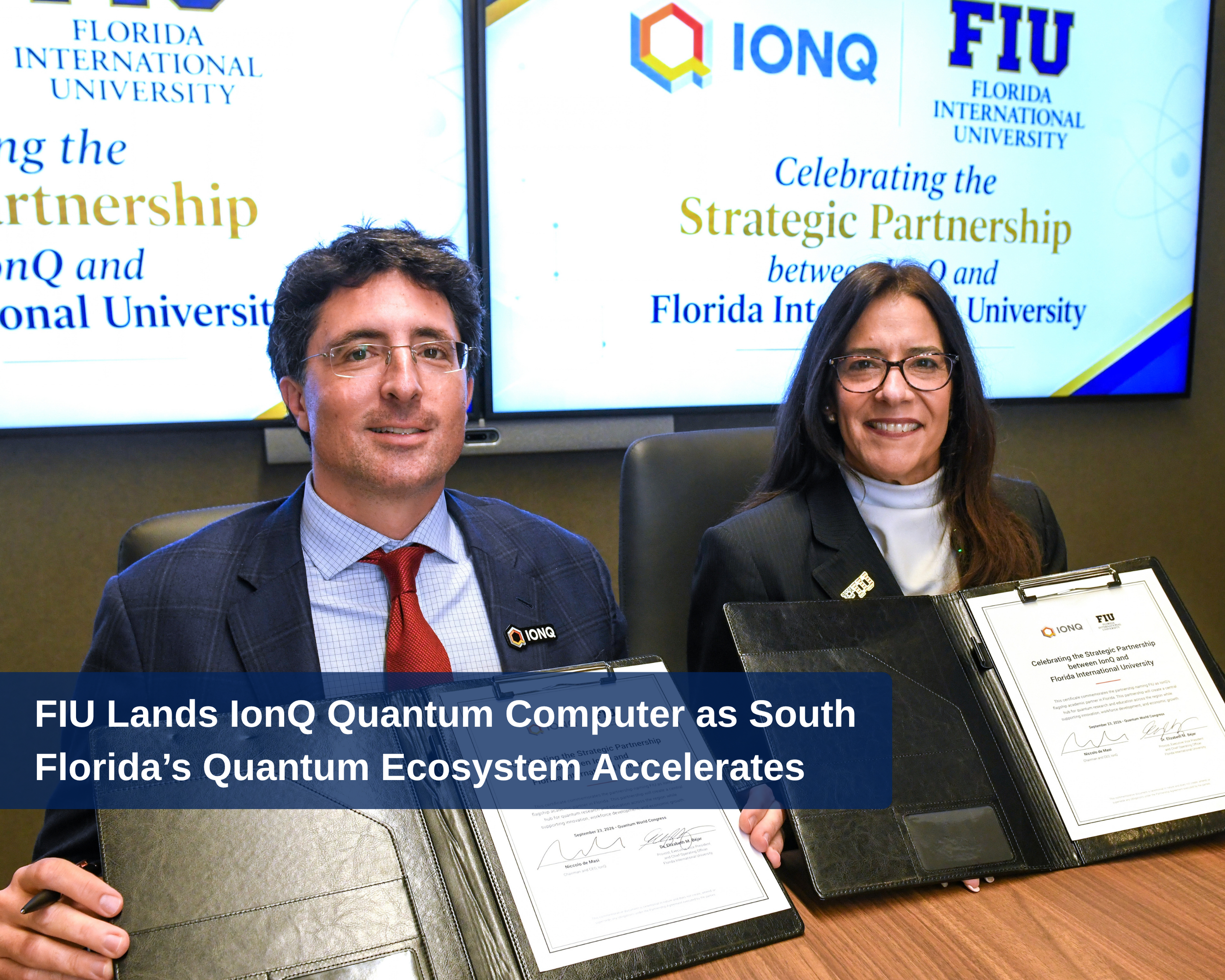
South Florida’s growing quantum technology landscape is getting a major new piece of computing infrastructure. Florida International University (FIU) has signed an agreement with quantum computing company IonQ to install a Superion 256 trapped-ion quantum computer on its Miami campus, giving FIU researchers and students direct access to advanced quantum computing hardware.
The system is expected to arrive in late 2027 and will make FIU the first university in Florida to acquire a full-stack trapped-ion quantum computer. The agreement also establishes FIU as IonQ’s flagship academic partner in Florida.
For FIU, however, the significance goes beyond acquiring a powerful new computer. University researchers say having a quantum system physically on campus will create opportunities to experiment directly with the technology, investigate where quantum computing could provide meaningful advantages over conventional computing, and train students to work with a technology that is still rapidly developing.
What Changes When the Quantum Computer Is on Campus?
Researchers can already access quantum computers remotely through cloud-based platforms. FIU’s agreement with IonQ takes a different approach by bringing the physical system directly to Miami.
IonQ’s Superion 256 is the company’s sixth-generation quantum computing platform and features 256 physical trapped-ion qubits. Trapped-ion quantum computers use electrically charged atoms, or ions, as qubits, the basic units of quantum information, and manipulate them to perform computations.
The system will be housed in a specialized secure facility connected to FIU’s new on-campus data center, with installation currently expected in late 2027. Students, faculty, visiting scholars and affiliated research centers are expected to have direct access.
For Dr. Arif Sarwat, Chair of FIU’s Department of Electrical & Computer Engineering, that proximity could fundamentally change how frequently and deeply researchers interact with quantum hardware. “Cloud access has been an important way for researchers to begin exploring quantum computing, but having a dedicated 256-physical-qubit IonQ system on campus fundamentally changes the depth and frequency of that access,” Sarwat told Venture Tech Chronicle.
According to Sarwat, researchers will be able to conduct more frequent and iterative experiments, benchmark the hardware, test and refine quantum algorithms, and study how the system performs under different conditions. It will also give researchers an opportunity to investigate one of the biggest questions surrounding the rapidly developing technology: Where does quantum computing actually outperform classical approaches?
“We should not assume that simply having more qubits automatically translates into quantum advantage,” Sarwat said. “The value of this investment is that it gives our researchers the infrastructure to test those boundaries, develop the algorithms and applications needed to take advantage of quantum systems, and help determine which problems are genuinely suited to quantum computing.”
FIU President Jeanette M. Nuñez described the acquisition as an investment in research, students and U.S. competitiveness. “Bringing this extraordinary research tool to Miami is an investment in discovery, in our students, and in our country’s ability to compete in a rapidly developing field,” Nuñez said. “This partnership provides our more than 1,800 faculty members, 55,000 students, and countless industry partners with direct access to one of the most advanced computing architectures in the world.”
Nuñez shared that the system also puts FIU in a position to work with federal agencies on emerging quantum initiatives involving sensing, cryptography, commercialization and workforce development.
Putting Quantum Computing to Work on Florida Problems
FIU expects researchers to initially explore applications across three broad areas: environment and energy sustainability, national security and cybersecurity, and health and drug development.
For Sarwat, whose research spans energy systems, grid resiliency, cybersecurity and quantum technologies, Florida itself presents a particularly relevant environment for exploring where quantum computing could eventually make a difference.
“Florida provides an especially compelling environment for this research because our critical infrastructure faces complex, interconnected challenges, from hurricanes and extreme weather to a rapidly evolving energy system and the growing cybersecurity threats facing essential services,” Sarwat shared.
In the energy sector, researchers could investigate whether quantum computing can eventually help address complex optimization problems involving power-grid operations, energy forecasting, grid monitoring and the restoration of critical infrastructure following major disruptions.
Sarwat also sees potential for quantum machine learning in areas including forecasting, anomaly detection and decision-making within increasingly complex energy systems. Other research could examine transportation and routing, supply-chain optimization, advanced materials and energy technologies, as well as environmental and infrastructure resilience.
“For Florida, these are not abstract challenges,” Sarwat said. “They directly affect how we move people and goods, manage energy, respond to extreme weather and protect the systems communities depend on.”
Cybersecurity represents another major area of interest. As quantum technologies advance, researchers and organizations are preparing for the possibility that sufficiently capable future quantum computers could undermine some cryptographic systems currently used to secure digital communications and critical infrastructure.
FIU researchers are already examining quantum-safe approaches, including post-quantum security and crypto-agility, the ability of systems to adapt as cryptographic standards and threats evolve. Health and drug development represent another potential area for research, including exploring whether quantum approaches can eventually improve the modeling of complex molecules and materials.
Ultimately, Sarwat sees the system as a platform that can bring together researchers across multiple disciplines. “The goal is not simply to have access to a quantum computer,” he said. “It is to use that access to solve problems that matter to Florida and beyond.”
Research Infrastructure and a Training Ground
The Superion 256 will also serve as a training environment for students entering fields that could increasingly intersect with quantum technologies. FIU plans to develop new quantum computing curricula, degree programs and professional certificates while expanding collaborations with companies, government agencies and other research institutions.
“Quantum computing is still developing, and that is precisely why access now is so important,” said Andres G. Gil, FIU senior vice president for research and economic development. “Having this system on campus will allow our researchers to determine where quantum computing can make a meaningful difference, while preparing students for jobs and fields that are only beginning to emerge.”
FIU expects the computer to become the centerpiece of a broader university quantum initiative aimed at attracting research funding and industry partnerships. IonQ Chairman and CEO Niccolo de Masi called the agreement a milestone in expanding direct physical access to the company’s quantum hardware. “By housing our Superion 256 system directly on campus, FIU will lead the region in quantum research and training,” de Masi said.
Another Piece of South Florida’s Quantum Infrastructure
FIU’s announcement comes as other major quantum initiatives are taking shape across South Florida. Earlier this year, Florida Atlantic University announced a $20 million agreement with D-Wave Quantum to purchase and install an Advantage2 quantum computer in Boca Raton. D-Wave also announced plans to relocate its corporate headquarters to the Boca Raton Innovation Campus.
The two university systems use fundamentally different approaches to quantum computing. D-Wave’s Advantage2 uses quantum annealing, an approach designed particularly for optimization and related problems, while IonQ’s Superion uses a gate-based trapped-ion architecture.
Meanwhile, IonQ and Florida LambdaRail have announced plans to develop a nearly 100-mile quantum-safe network corridor stretching from Palm Beach County to Miami-Dade County and initially connecting three research and education institutions.
Taken together, the projects are putting different pieces of quantum infrastructure, from computing hardware to secure communications, into place across South Florida.
For Matt Cimaglia, founder and managing partner of Quantum Coast Capital and a founding member of Florida Quantum, the significance of the recent investments lies less in any single project and more in what they could collectively enable.
“South Florida is a quantum hub for the country,” Cimaglia told Venture Tech Chronicle. “The work now is making sure the rest of the world sees what is being built here and wants to be part of it.”
That next phase will depend on moving beyond infrastructure and putting the region’s new capabilities to work. “Infrastructure is only valuable when people use it,” he continued. “The next step is putting these systems to work on real problems in health, energy, logistics, and cybersecurity.”
FIU’s new system will provide researchers with another platform to begin doing exactly that, testing where quantum computing can deliver meaningful results, developing applications around those discoveries and building expertise with the technology.
As South Florida’s quantum infrastructure continues to take shape, the focus is beginning to shift from what is being built to what researchers, students and industry can build with it.

Florida International University is bringing advanced quantum computing directly to Miami through a new partnership with IonQ. The university plans to install a Superion 256 trapped-ion quantum computer on campus in late 2027, becoming the first Florida university to acquire a full-stack trapped-ion system. Researchers and students will use the technology to explore applications across energy, cybersecurity, healthcare, and other fields. The investment adds another major piece of infrastructure to South Florida’s rapidly developing quantum technology ecosystem.