
From Wrenches to Software: Palm Beach State College Invests $5.2M in the Future of Automotive Technology
The automotive technician of the future may spend as much time interpreting data as turning a wrench. Electric drivetrains, high-voltage batteries, regenerative braking, computerized diagnostics and advanced driver-assistance systems are changing what's inside today's vehicles, and the skills required of the people who keep them running.
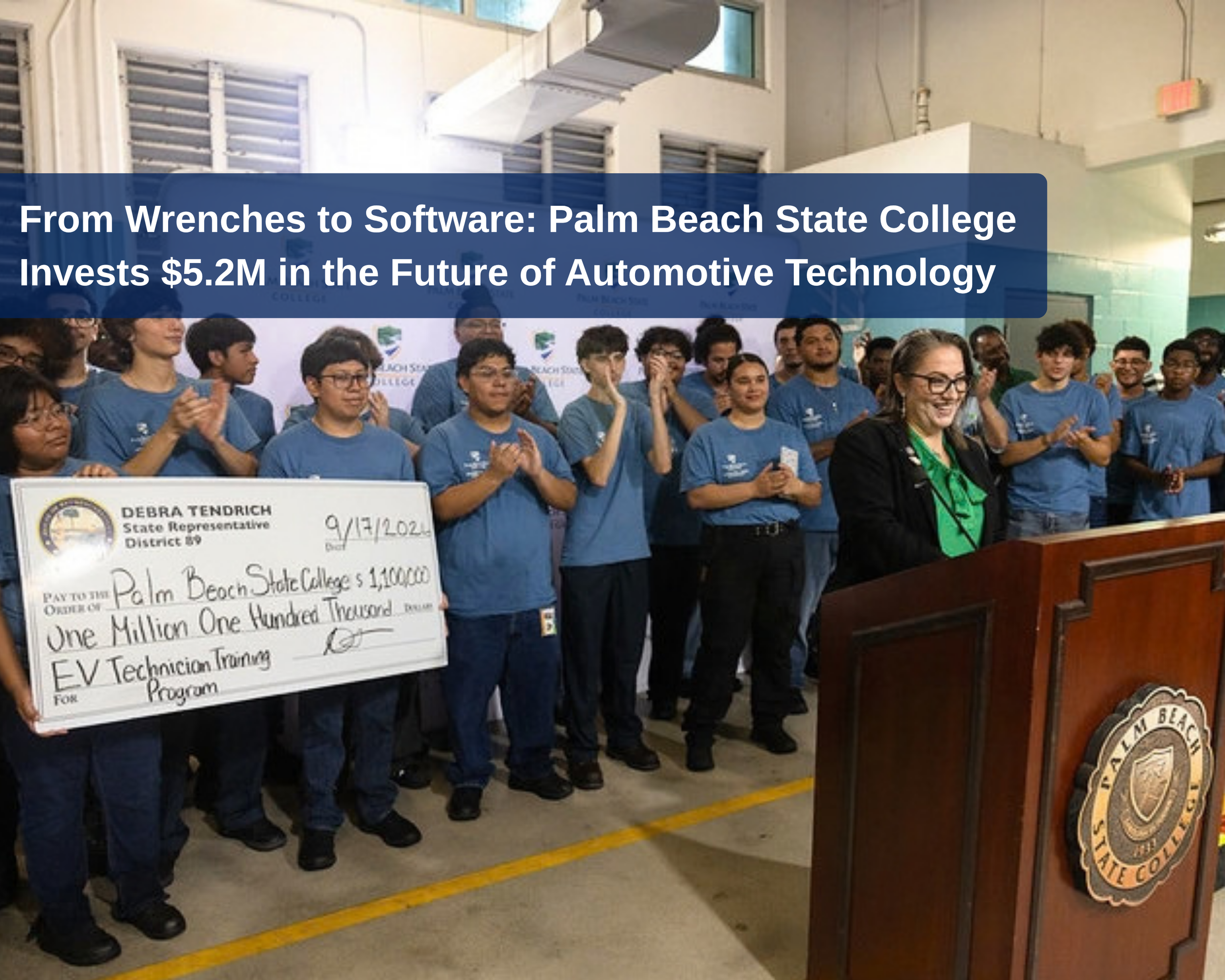
Palm Beach State College (PBSC) is preparing for that shift with a major investment in automotive technology education at its Lake Worth campus. The college recently received $1.1 million in state funding to support its new Electric, Hybrid and Alternative Fuels Vehicle Technician program. Combined with $4.1 million in federal funding, PBSC says the project's projected investment now totals approximately $5.2 million.
The latest funding, secured by Florida Rep. Debra Tendrich through the state's 2026–27 budget, will support specialized diagnostic and training equipment for electric, hybrid, alternative-fuel and diesel vehicle systems. But the investment represents something larger than the launch of another automotive certificate program.
It reflects a transformation taking place across the transportation industry as vehicles increasingly combine traditional mechanical engineering with electronics, software, sensors, data and high-voltage electrical systems.
Building a New Kind of Automotive Workforce
Scheduled to launch in February 2027, PBSC's new 850-hour program will combine classroom instruction with hands-on training in high-voltage safety, batteries and electrical storage systems, electric motors and generators, power inverters, regenerative braking, steering and suspension, cooling systems and engine performance and emissions diagnostics.
Students will also be introduced to alternative-fuel technologies, including compressed natural gas and hydrogen-related systems. The training environment itself is undergoing a transformation.
PBSC is renovating an automotive technology facility with six service bays where students will be able to diagnose, maintain and repair vehicles using specialized equipment. Students are expected to train on electric and hybrid vehicles from major manufacturers including Toyota and Tesla.
They will also use a Switch Lab, a small, fully electric educational vehicle that exposes its components and systems, allowing students to see how the technology works together rather than encountering it hidden beneath the body of a production vehicle.
The hands-on training comes with new safety requirements as well. PBSC instructor Greg Paczkowski, who will teach in the new program, said students will be required to complete high-voltage safety training before beginning hands-on work. "They're electric vehicles, so they are going to be working with 400 volts," Paczkowski told PBSC.
More Than $5 Million in Public Investment
The program has been several years in the making and is being supported through a combination of federal and state investment.
PBSC received approximately $4.1 million to support renovation and infrastructure for the program. The additional $1.1 million state appropriation announced in September will help equip the facility with the specialized diagnostic and training technology students will use. Together, PBSC now puts the project's projected investment at $5.2 million.
The investment is designed not only to build a program, but also to create a workforce pipeline for an automotive industry that is becoming increasingly technology-driven.
"When I looked at the request, I didn't just see equipment," Tendrich said when presenting the funding. "I saw job opportunities, local career paths and students gaining skills that employers will need more and more every single year moving forward."
When the Mechanic Becomes a Technologist
For generations, automotive repair has been associated with mechanical expertise. Those skills aren't disappearing, but they are increasingly being supplemented by an entirely different skill set.
Modern vehicles contain interconnected electronic systems, computers, sensors and software. Electric and hybrid vehicles add high-voltage batteries, electric motors, power electronics and regenerative braking to that equation. In many cases, diagnosing the problem begins before a technician ever picks up a wrench.
"In many cases, the first step in fixing a vehicle isn't turning a wrench," PBSC transportation technologies director Doreen Singer said. "It's connecting diagnostic equipment, interpreting data and figuring out what the technology is telling you."
That evolution is creating an opportunity for students who may not traditionally have thought of automotive repair as a technology career.
A Workforce Need Already Showing Up in South Florida
The connection between PBSC and the automotive industry isn't hypothetical. In 2025, representatives from Ford Motor Company and Grieco Ford of Delray Beach visited PBSC's automotive students to discuss careers and changes taking place across the industry.
Ford Technical Placement Specialist Eduardo Tautiva specifically encouraged students to strengthen their electrical skills and take advantage of training opportunities as electric vehicles become more important to the industry. The relationship has already translated into employment.
PBSC highlighted 2022 Automotive Repair Technician graduate Jessica Foreman, who went on to become a technician at Grieco Ford of Delray Beach. Foreman said working extensively on Ford vehicles during her PBSC training meant she was already familiar with many of the models she encountered when she entered the dealership.
“In an increasingly technical world, the demand for people who can work on mechanical engines cant be overstated and will be for years to come,” shared Marc Adler, Senior Vice President of Craig Zinn Automotive Group.
As electric, hybrid and digitally connected vehicles make up a larger portion of the vehicles entering service departments, the question becomes whether the supply of technicians with the necessary electrical and diagnostic skills can keep pace.
Training for What's on the Road Today and What's Coming Next
One important distinction about PBSC's program is that it isn't abandoning conventional vehicles in favor of an EV-only future. The curriculum encompasses electric, hybrid, alternative-fuel and traditional vehicle technologies. That reflects the reality technicians will encounter in the workforce: gasoline-powered vehicles, hybrids and fully electric vehicles will coexist on South Florida roads for years.
PBSC President Ava L. Parker emphasized that balance when the latest funding was announced. "What's important to me is that I want to make sure that our students know how to fix cars that are going to be on the road forever, but also that they're prepared to fix newer vehicles," Parker said.
The evening format of the new program also opens the training to more than first-time students. PBSC says it is intended to provide a pathway for working adults and current automotive technicians who need to expand their skills as vehicle technology evolves.
That could become increasingly important as the transformation of transportation creates not only a need for new workers, but a need to reskill the existing automotive workforce.
A Skilled Trade for the Technology Economy
The broader story unfolding at Palm Beach State College isn't simply about electric vehicles. It's about what happens when technology transforms a skilled trade.
PBSC has increasingly positioned workforce education around that intersection. Its programs span fields including construction, manufacturing, cybersecurity and other technical careers, while recent investments have also expanded training in areas such as quantum technology and advanced skilled trades. Automotive technology now sits squarely within that conversation.
Tomorrow's technician may still need to understand engines, brakes, steering and suspension. But that same worker may also need to safely navigate a 400-volt battery system, interpret data from a vehicle's computer, troubleshoot sensors and diagnose sophisticated electronic systems.
For students entering the industry, and technicians already working in it, the definition of being "good with cars" is changing. Palm Beach State College's $5.2 million bet is that the workforce will need to change with it. And beginning in 2027, a new generation of South Florida automotive technicians will begin training for what comes next.





Driftwood Capital has named David Resnick and David Steiner co-chief investment officers as the Coral Gables-based investment firm expands across equity, credit, hospitality, and mixed-use development. Resnick brings experience leading major real estate investments, while Steiner helped build Driftwood’s credit platform. The leadership changes come as Driftwood expands its Coral Gables headquarters and launches new investment vehicles. The appointments position the two executives to jointly oversee strategy, capital allocation, origination, underwriting, and portfolio management.