
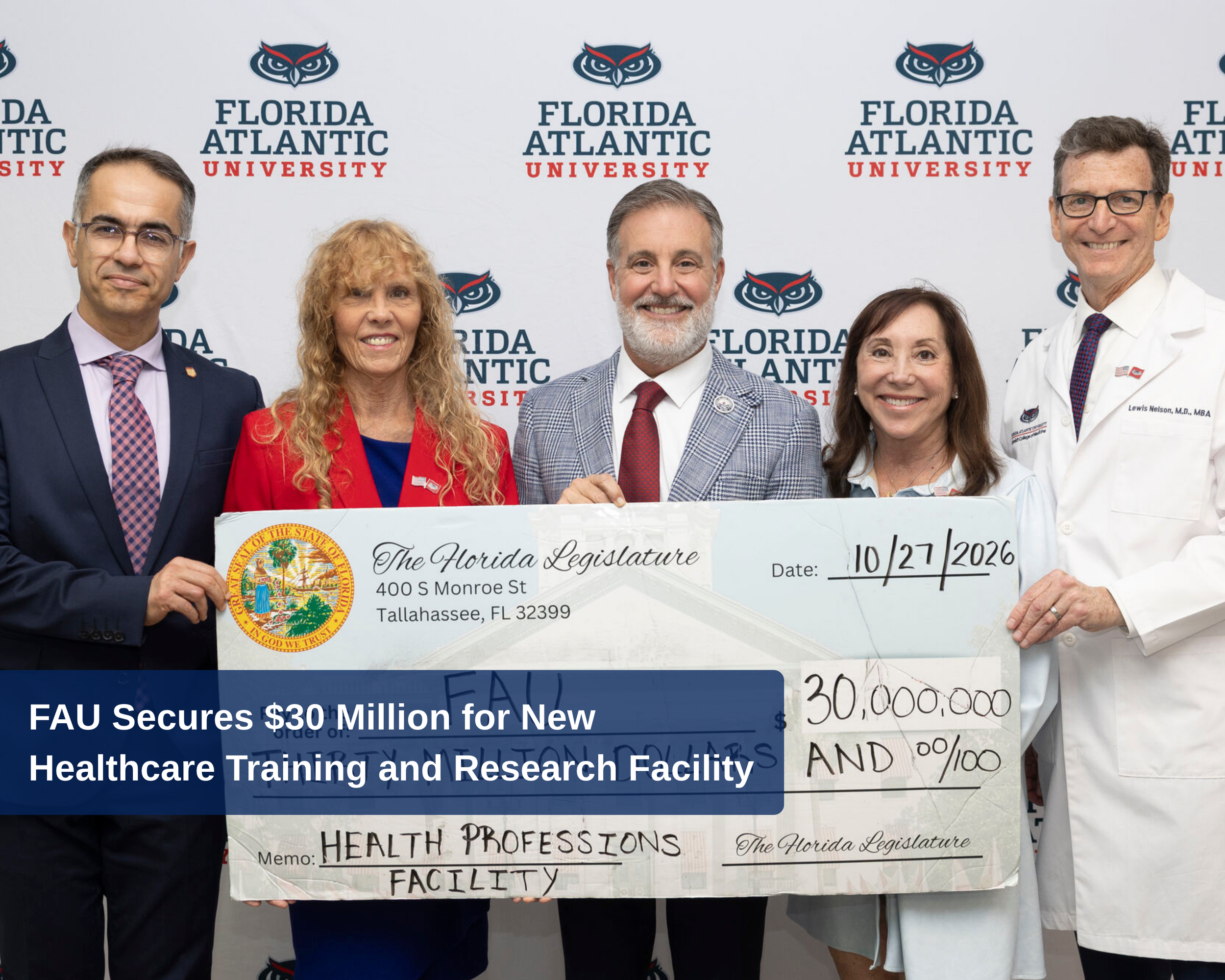
Florida Atlantic University (FAU) has secured $30 million in state funding to advance plans for a new Health Professions Clinical Training and Research Facility on its Boca Raton campus, marking a significant investment in South Florida's healthcare workforce and innovation ecosystem.
The proposed 150,000-square-foot facility will bring together FAU's Charles E. Schmidt College of Medicine, Christine E. Lynn College of Nursing, and College of Social Work and Criminal Justice under one roof. The goal is to prepare future healthcare professionals through shared clinical training, research, and hands-on learning that reflects the realities of modern patient care.
The Florida Legislature allocated $10 million toward the project in 2025, followed by an additional $20 million in 2026. According to FAU, completion is projected for early 2030, depending on additional funding and development progress.
Beyond expanding academic infrastructure, the project could strengthen connections among universities, healthcare providers, researchers, and businesses throughout South Florida.
Building a New Model for Healthcare Education
Modern healthcare relies on physicians, nurses, social workers, and other specialists working together to address increasingly complex patient needs. FAU's proposed facility is designed to reflect that environment by allowing students from different disciplines to train and collaborate throughout their education. Shared clinical experiences and research opportunities could help students develop the communication, problem-solving, and teamwork skills needed in hospitals and other healthcare settings.
The university also envisions involving students and faculty from disciplines beyond healthcare, including engineering, business, and technology. This broader approach would allow future healthcare professionals to work alongside individuals bringing different perspectives and expertise to clinical challenges.
By connecting these fields earlier in the educational process, FAU aims to better prepare graduates for a healthcare industry where collaboration and technological advancement are increasingly intertwined.
Advancing Research, Technology, and Clinical Innovation
The facility will also support FAU's research capabilities as a Carnegie R1 research university, a designation recognizing institutions with very high levels of research activity. Bringing together faculty, researchers, and healthcare professionals from multiple specialties could encourage new approaches to clinical research and patient care.
For South Florida's technology community, the project's potential to connect medical research with emerging technologies is particularly significant. Collaboration with FAU's College of Engineering and Computer Science and other academic programs could support research involving artificial intelligence, digital health, medical devices, and healthcare data analytics.
The facility may also create opportunities for hospitals, healthcare organizations, technology companies, and startups to work more closely with university researchers. Such partnerships could help translate academic discoveries into practical applications and support future commercialization efforts.
While specific technology initiatives and industry partnerships have not been announced as part of the project, the facility's collaborative approach could help bridge the gap between academic research and real-world healthcare innovation.
Strengthening South Florida's Healthcare Workforce
Healthcare remains a major employment sector in South Florida, with demand for qualified professionals across clinical, technical, and patient support roles. According to the U.S. Bureau of Labor Statistics, healthcare practitioners, technical workers, and healthcare support professionals collectively account for approximately 9.9% of employment in the Miami metropolitan area, which includes Broward, Miami-Dade, and Palm Beach counties.
As the region's healthcare needs evolve, building a sustainable pipeline of skilled professionals will remain essential. FAU's investment is intended to strengthen the university's ability to educate and train future physicians, nurses, and social workers while providing greater exposure to clinical research and practical experience.
Expanded training and research opportunities could also help attract faculty and healthcare professionals to the region, contributing to a stronger talent base for hospitals, healthcare providers, and related industries.
Connecting Higher Education, Industry, and Economic Development
Universities across South Florida are taking on a greater role in regional economic development by preparing specialized talent, advancing research, and building relationships with industry. FAU's proposed facility reflects that shift, positioning healthcare education and research as potential drivers of innovation and economic growth.
For startups and established companies developing healthcare solutions, stronger connections with universities and clinical researchers could provide opportunities to test new technologies, better understand industry needs, and pursue research partnerships. The project also highlights the importance of sustained public investment in research infrastructure as South Florida competes to attract talent, businesses, and innovation-driven industries.
Looking Beyond the Classroom
As South Florida's healthcare, technology, and life sciences sectors continue to evolve, investments that connect education, research, and industry will play an important role in the region's long-term competitiveness.
FAU's planned Health Professions Clinical Training and Research Facility represents more than a new academic building. It is an investment in the talent, research capabilities, and infrastructure needed to support the next generation of healthcare innovation. Although its full impact will depend on future funding, development, and industry engagement, the project reflects the expanding role universities can play in shaping regional economies.
For South Florida, the opportunity extends well beyond the classroom, connecting future healthcare professionals with the research, technologies, and partnerships that could help shape the future of care.




Florida Atlantic University has received $30 million in state funding to advance plans for a new Health Professions Clinical Training and Research Facility on its Boca Raton campus. The proposed 150,000-square-foot building will bring together FAU's medical, nursing, and social work programs to expand collaborative clinical training and research. The facility could also create opportunities for partnerships involving healthcare providers, technology companies, and academic researchers. With completion projected for early 2030, the project represents a significant investment in South Florida's healthcare workforce, research infrastructure, and innovation ecosystem.