

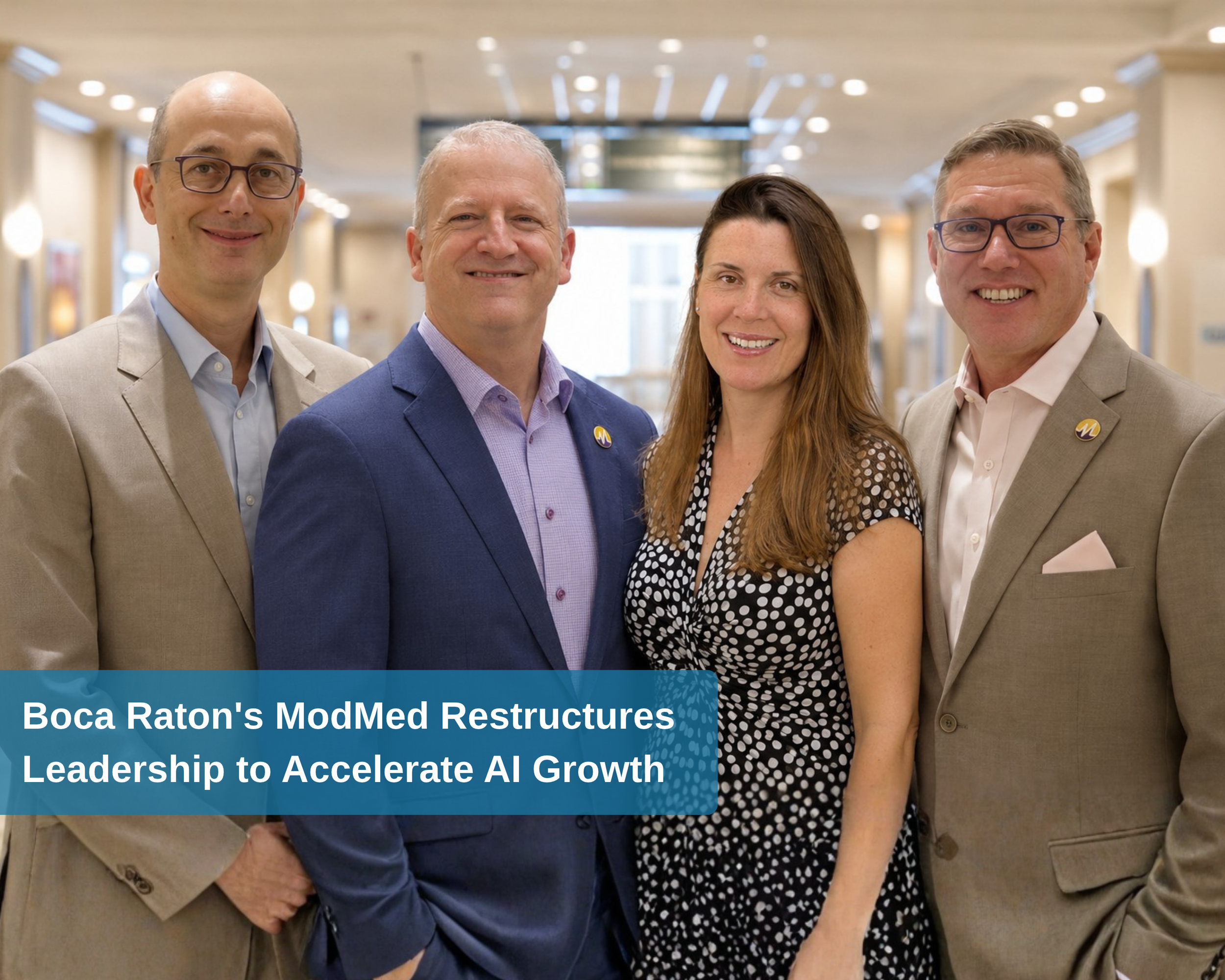
Boca Raton-based healthcare technology company ModMed is reshaping its executive leadership as it accelerates its investment in artificial intelligence across clinical care, revenue cycle management, and patient engagement.
On October 28, 2026, the company announced a leadership restructuring that transitions co-founder Dan Cane from Co-Chief Executive Officer to the newly created position of Chief AI Officer. Joe Harpaz, who has served alongside Cane as Co-CEO for the past three years, will assume sole responsibility as Chief Executive Officer.
The changes also include the promotion of Celine Kaiser to Chief Operating Officer, while co-founder Dr. Michael Sherling continues as Chief Medical and Strategy Officer.
The restructuring comes amid a series of AI product launches and strategic investments by ModMed, which provides specialty-specific healthcare software trusted by nearly 50,000 medical providers nationwide.
For the Boca Raton-founded company, the changes represent more than a shift in executive titles. They reflect a broader effort to integrate AI throughout medical practice operations while establishing clearer accountability for innovation, product development, customer adoption, and business growth.
ModMed Restructures Executive Leadership
The new leadership structure establishes distinct responsibilities across ModMed's business operations and expanding AI portfolio.
Joe Harpaz, Chief Executive Officer - As sole CEO, Harpaz will oversee ModMed's broader business strategy, organizational growth, and execution. His responsibilities include scaling the company while ensuring that AI innovation translates into practical solutions for healthcare providers.
Harpaz brings more than two decades of experience building and leading business-to-business software companies operating in complex and highly regulated industries.
Dan Cane, Chief AI Officer - Cane will lead ModMed's AI strategy across its products and internal operations, with direct executive responsibility for the company's recently launched Revenue Cycle Management (RCM) AI Platform.
His responsibilities include advancing AI-powered solutions that address insurance claim denials, accelerate reimbursement workflows, and reduce administrative burdens for medical practices. Cane will also continue leading ModMed's internal AI transformation, working with technology and product teams to incorporate AI into how the company develops and delivers its solutions.
Celine Kaiser, Chief Operating Officer - Kaiser will oversee product management, customer success, and the company's revenue cycle management business, bringing these functions into closer operational alignment.
Since joining ModMed in 2019, Kaiser has held several leadership positions, most recently serving as Chief Customer Officer. She helped build and scale the company's payments business and led its expansion into obstetrics and gynecology software.
Her expanded responsibilities will focus on improving coordination across business functions, strengthening customer experiences, and supporting medical practices as they adopt new AI technologies.
Dr. Michael Sherling, Chief Medical and Strategy Officer - Sherling will continue overseeing ModMed's clinical and strategic initiatives, with particular emphasis on specialty-specific clinical AI solutions.
His responsibilities include expanding the company's clinical AI portfolio, including ModMed Scribe, and developing technologies designed to reduce physician documentation burdens and support more efficient patient care.
Both Cane and Sherling will remain members of ModMed's Board of Directors, maintaining their involvement in the company's long-term strategic direction.
The leadership changes establish a clearer division of responsibilities between business growth, AI innovation, clinical development, and operational execution.
From Boca Raton Startup to National Healthtech Provider
Founded in Boca Raton in 2010 by Cane and Sherling, ModMed began with a vision of using technology to improve how physicians practice medicine and manage their businesses.
The company initially focused on specialty-specific electronic health records before expanding into practice management, revenue cycle management, payment processing, patient engagement, and other healthcare technology solutions. Today, ModMed serves nearly 50,000 healthcare providers and is backed by private equity firm Clearlake Capital.
The company's growth has increasingly centered on integrating AI into the clinical, financial, and administrative workflows of specialty medical practices. In April 2026, ModMed acquired Bonsai Health, expanding its capabilities in AI-powered patient engagement and adding technology designed to simplify interactions between patients and medical practices.
The acquisition complemented ModMed's growing investment in clinical documentation and revenue cycle automation.
Rather than developing isolated AI applications, ModMed is pursuing a more integrated approach in which AI supports multiple aspects of medical practice operations.
Its latest executive restructuring is intended to coordinate the development, delivery, and adoption of these technologies as the company continues to expand.
Three AI Priorities Driving ModMed's Next Chapter
ModMed is organizing its AI strategy around three major areas of medical practice operations: revenue cycle management, clinical care, and patient engagement.
Revenue Cycle Management AI
Under Cane's leadership, ModMed will continue developing its RCM AI Platform, announced in August 2026. The platform uses agentic AI technology to address administrative challenges associated with medical billing, insurance claim denials, and reimbursement processes.
The goal is to reduce repetitive tasks, improve claim resolution, and help medical practices manage the financial complexities of delivering healthcare services.
By placing the platform under Cane's direct executive responsibility, ModMed is making revenue cycle automation a central component of its broader AI strategy.
Clinical AI and ModMed Scribe
Sherling will oversee the expansion of ModMed's clinical AI capabilities, building on the company's experience developing specialty-specific medical software. One of its most significant developments is ModMed Scribe, an AI-powered clinical documentation solution designed to reduce the time physicians spend documenting patient encounters.
According to ModMed, Scribe supported nearly 3 million patient visits during its first 11 months and became the fastest-growing product in the company's history.
The company plans to build on that adoption by developing additional specialty-specific clinical AI solutions that support physicians throughout their workflows.
"We believe the value of clinical AI comes down to what it enables a physician to do for a patient," said Sherling in the company's October 28 announcement.
The company's clinical AI strategy focuses on reducing administrative demands while allowing physicians to devote more attention to patient care.
Patient Engagement AI
ModMed's third major AI priority builds on its acquisition of Bonsai Health earlier this year. Bonsai co-founder Luke Kervin will lead patient engagement product development within ModMed's Chief Technology Officer organization, working alongside fellow co-founder Travis Schneider, who now serves as General Manager of Patient Engagement.
Together, they will lead the planned 2027 rollout of a new agentic AI platform designed to create a more automated front-office experience.
The platform is intended to simplify patient interactions, streamline administrative workflows, and reduce the responsibilities associated with managing patient communications and other front-office operations.
The planned launch represents another step toward ModMed's vision of an AI-powered medical practice, connecting patient engagement with clinical and financial workflows.
What ModMed's Next Chapter Means for South Florida's Healthtech Ecosystem
ModMed's continued evolution highlights the growth of a Boca Raton-founded technology company into a national provider of specialized healthcare software. Since its founding, the company has expanded its product portfolio, completed strategic acquisitions, and invested in technologies designed to address longstanding operational challenges within medical practices.
Its latest leadership changes illustrate how an established technology company is adapting its organizational structure to support a more AI-focused business strategy.
For South Florida's innovation ecosystem, ModMed represents an example of a locally founded company continuing to develop advanced technologies while serving customers across the country.
The company's expansion also reflects the increasing importance of artificial intelligence within healthcare technology, where providers are seeking solutions that improve efficiency without adding complexity to clinical operations.
ModMed's strategy is particularly notable because it extends AI beyond individual products and into multiple connected functions of a medical practice. The company is pursuing a model in which clinical documentation, insurance reimbursement, and patient engagement can increasingly benefit from AI-powered automation. Whether that approach delivers its intended results will depend on continued product development, customer adoption, and operational execution.
With Harpaz overseeing business growth and Cane, Sherling, and Kaiser leading distinct areas of innovation and operations, ModMed is establishing a leadership structure designed to advance several major initiatives simultaneously.
For a company that began in Boca Raton with a vision of modernizing medical software, the transition marks another stage in its evolution from an electronic health records provider toward a more comprehensive AI-powered healthcare technology platform.
As ModMed moves toward its planned 2027 patient engagement launch and continues expanding its clinical and financial AI capabilities, its next chapter will be defined not only by the technologies it develops, but by how effectively those innovations are adopted across the medical practices it serves.






Boca Raton-based healthcare technology company ModMed has restructured its executive leadership to accelerate artificial intelligence development across its platform. Co-founder Dan Cane will transition to Chief AI Officer, while Joe Harpaz assumes the role of sole CEO and Celine Kaiser becomes Chief Operating Officer. Co-founder Dr. Michael Sherling will continue leading clinical and strategic initiatives, including the expansion of ModMed Scribe. The changes support the company's broader AI strategy, which also includes revenue cycle automation and a planned 2027 patient engagement platform. ModMed's next chapter highlights South Florida's growing influence in healthcare technology and AI innovation.