
South Florida's growing investment in quantum computing is beginning to reveal what the technology could mean beyond research laboratories, advanced computing infrastructure, and economic development. At Florida Atlantic University (FAU), researchers are exploring how quantum computing could help address one of healthcare's most pressing challenges: detecting cancer earlier and more accurately.
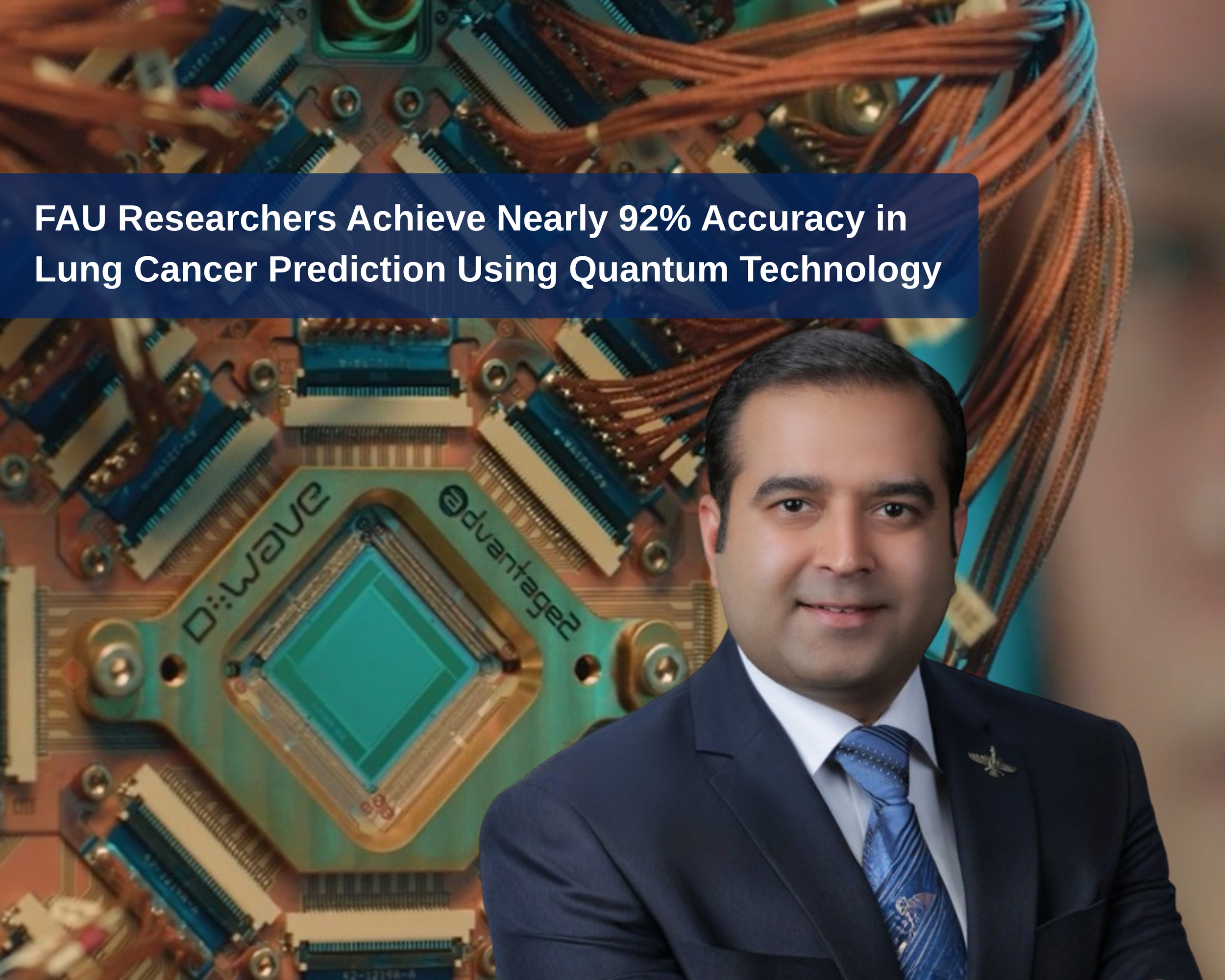
In research highlighted by FAU in November 2026, scientists demonstrated that quantum machine learning techniques could predict lung cancer using limited patient data, achieving 91.9% classification accuracy on actual quantum computing hardware and up to 94.31% accuracy in simulation.
While the findings remain experimental, they offer an important glimpse into how quantum computing could eventually support medical diagnostics, personalized treatment, and healthcare decision-making.
For South Florida, the research also represents something bigger: a potential transition from investing in quantum computing infrastructure to exploring applications that could directly impact industries, businesses, and human lives.
FAU Researchers Put Quantum Computing to the Test
Led by Dr. Arslan Munir, a professor in FAU's Department of Electrical Engineering and Computer Science, the research team investigated whether quantum machine learning could identify patterns associated with lung cancer using relatively small amounts of patient information.
Rather than relying on medical imaging or invasive testing, the researchers examined patient characteristics and reported symptoms, including smoking history, coughing, wheezing, fatigue, and chest pain. The study, published in Discover Quantum Science, used an initial dataset of 309 patient records, expanded through synthetic data generation to support experimental testing. Researchers evaluated multiple quantum computing approaches, including gate-based and quantum annealing techniques.
“Our goal was to examine how different quantum learning approaches perform when the amount of training data is deliberately constrained,” said Munir. “By evaluating multiple methods within a common experimental framework, we can better understand their capabilities and limitations and identify directions that warrant further investigation.”
One of the strongest results came from a quantum support vector machine approach implemented using D-Wave quantum computing technology. The findings suggest that quantum-enhanced machine learning may have potential for identifying complex patterns even when relatively limited training data is available.
That capability could be particularly valuable in healthcare, where high-quality datasets are often difficult to obtain because of patient privacy requirements, limited access to specialized medical records, and the costs associated with collecting and labeling clinical information. However, the researchers emphasize that the technology is not yet ready for clinical diagnosis. Larger, independently validated studies will be necessary to determine whether these approaches can perform reliably in real-world medical settings.
Why Quantum Computing Could Change Healthcare
Healthcare generates extraordinary volumes of complex information, from electronic medical records and diagnostic imaging to genomic sequencing and pharmaceutical research. Traditional computing and artificial intelligence have already transformed how researchers analyze that information. Quantum computing introduces another potential tool for addressing certain computational challenges.
Unlike conventional computers, which process information using bits, quantum computers use quantum bits, or qubits, that can represent information through quantum mechanical states. Although quantum computers are not inherently faster at every task, researchers are investigating whether specific quantum algorithms can improve certain types of optimization, simulation, and machine learning problems.
In healthcare, those possibilities extend across several important areas.
Earlier Disease Detection and Risk Prediction - Quantum machine learning could potentially help researchers identify complex relationships among patient symptoms, risk factors, biomarkers, and other clinical information. FAU's lung cancer study provides an early example of how these methods might contribute to future diagnostic support tools, particularly when researchers have limited datasets.
Drug Discovery and Molecular Simulation - One of quantum computing's most promising long-term healthcare applications involves simulating molecular interactions. Understanding how molecules behave is essential to developing new medications, but accurately modeling complex chemical systems can be computationally demanding.
Future fault-tolerant quantum computers may help researchers simulate molecular properties more effectively, potentially supporting drug discovery and pharmaceutical development.
Personalized Medicine - As healthcare becomes increasingly data-driven, treatment decisions may involve analyzing genetics, medical histories, environmental factors, and responses to previous therapies. Quantum algorithms could eventually complement conventional AI in analyzing certain complex datasets and optimizing treatment strategies.
Healthcare Operations and Optimization - Beyond medical research, quantum and quantum-inspired optimization techniques are being explored for challenges such as hospital scheduling, resource allocation, supply chain management, and treatment planning.
These applications could offer nearer-term opportunities for healthcare organizations to experiment with quantum technologies. Together, these possibilities illustrate why healthcare is becoming an important area of quantum research, even as the technology's practical advantages continue to be tested.
South Florida's Quantum Investment Is Creating New Possibilities
FAU's latest research arrives during a period of significant quantum technology investment across South Florida. The region has been strengthening its position in quantum computing through university research, corporate partnerships, workforce development initiatives, and investments in advanced computing infrastructure.
A major milestone has been the growing relationship between FAU and D-Wave Quantum, including plans to bring a D-Wave Advantage2 quantum computer to FAU's Boca Raton campus. The initiative has the potential to expand access to advanced quantum computing resources for researchers, students, and industry partners while supporting the development of a specialized regional workforce.
“FAU’s research highlights how D-Wave’s annealing quantum computers can be used to advance AI and machine learning,” said Catherine Potts, Ph.D., manager of technical account management at D-Wave Quantum Inc. “By applying our technology to a challenging healthcare use case, the researchers demonstrate its potential to extract valuable insights in data-constrained environments, opening new possibilities for quantum-powered AI across healthcare and other data-intensive industries.”
At the same time, institutions including Florida International University (FIU) and Palm Beach State College are contributing to the region's emerging quantum talent and research ecosystem. They are helping establish the foundations for a quantum economy in which universities generate research, technology companies develop commercial capabilities, employers identify business applications, and students prepare for emerging career opportunities.
The next challenge is demonstrating how those investments translate into measurable value. FAU's lung cancer research offers one example of that progression. Rather than focusing exclusively on the computational power of quantum systems, researchers are applying quantum methods to a problem with clear societal importance. That shift, from what quantum computers can do to what they might help solve, is an important step in the technology's evolution.
From Research Infrastructure to Real-World Applications
For years, much of the conversation surrounding quantum computing has focused on infrastructure, investment, technical milestones, and the race to develop more powerful systems. Those investments remain essential, but the next phase of quantum innovation will increasingly depend on identifying applications that justify the technology's cost and complexity.
“This study reflects Florida Atlantic’s efforts to connect quantum computing research with meaningful application questions,” said Stella Batalama, Ph.D., dean of FAU’s College of Engineering and Computer Science. “Careful comparisons and testing on quantum hardware help build the evidence needed to assess where these technologies may be useful and what challenges remain.”
Healthcare presents a compelling opportunity because the challenges are significant, the datasets are complex, and even incremental improvements in certain processes could create meaningful benefits. Universities bring scientific expertise, access to interdisciplinary research, and the ability to investigate emerging approaches. Technology companies provide computing platforms, specialized tools, and pathways toward commercial development.
Healthcare organizations, in turn, can help determine whether promising research addresses genuine clinical needs. Building connections among these groups will be critical to moving quantum technologies beyond laboratory experiments.
It is equally important to recognize that research demonstrating technical feasibility is not the same as demonstrating clinical effectiveness or commercial readiness. For quantum healthcare applications to become practical, researchers will need to validate their findings against established computing methods, test larger and more diverse patient populations, address privacy and regulatory requirements, and demonstrate consistent performance in clinical environments.
The most meaningful breakthroughs will not simply be those that use quantum computing. They will be those that prove quantum methods deliver advantages over existing solutions.
The Region’s Next Innovation Economy: From Investment to Impact
FAU's research extends beyond lung cancer prediction, highlighting how South Florida's growing quantum ecosystem could drive innovation across healthcare, life sciences, cybersecurity, financial services, and other industries.
With major research universities, healthcare institutions, and increasing private-sector investment, the region has a strong foundation for quantum innovation. The next step is turning those investments into practical applications through research commercialization, industry partnerships, entrepreneurship, and workforce development.
While FAU's findings remain experimental, they offer an encouraging example of how quantum computing could help address real-world healthcare challenges. Ultimately, the success of quantum technology will not be measured by the sophistication of its hardware or the dollars invested, but by the problems it solves and the impact it creates.


Florida Atlantic University researchers achieved nearly 92% accuracy in lung cancer prediction using quantum computing technology, highlighting how South Florida's growing quantum investments could lead to real-world healthcare breakthroughs.