
FAU Leads $5.7 Million Initiative to Improve Literacy and Prepare South Florida Educators for AI
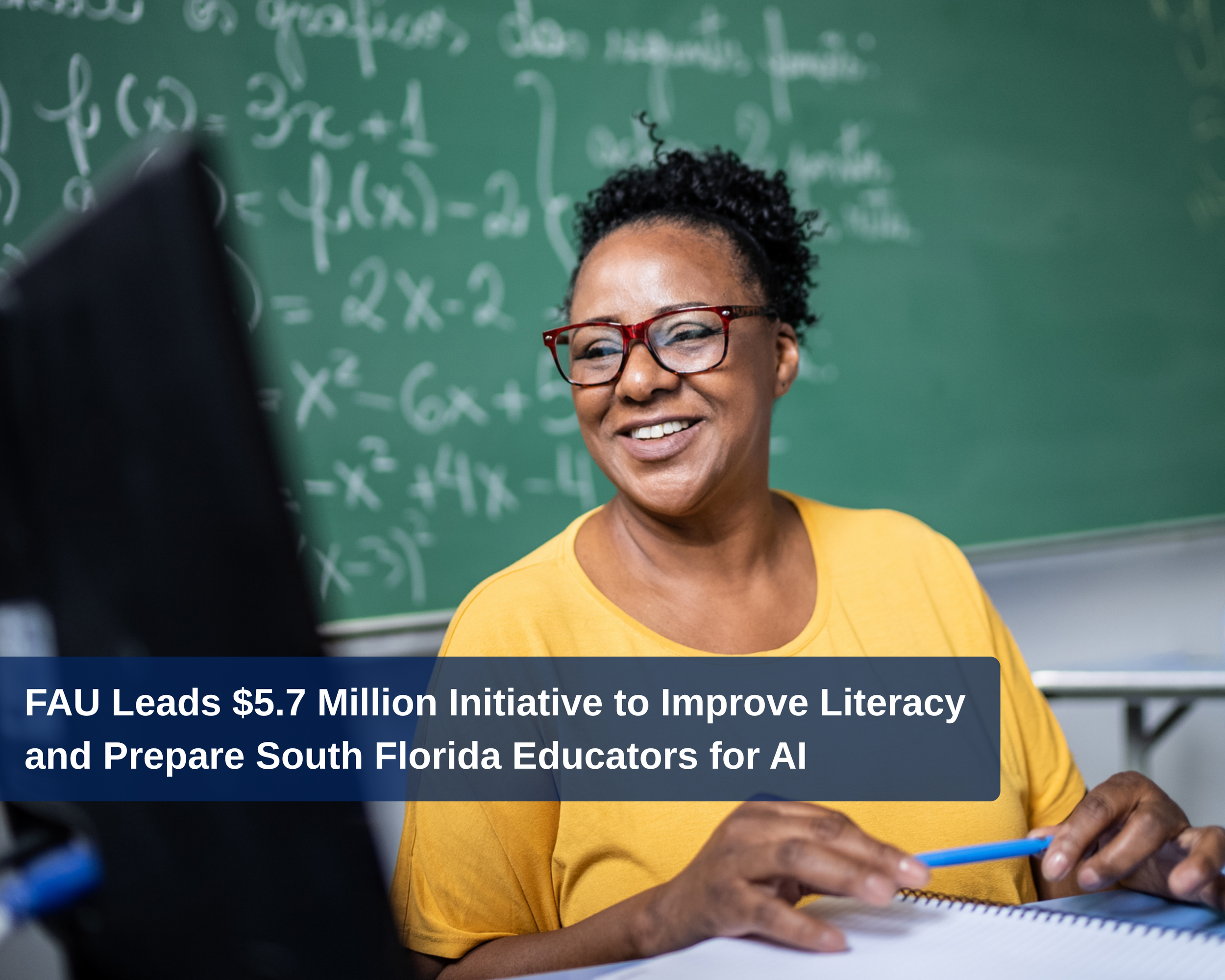
As artificial intelligence continues to reshape industries, workplaces, and classrooms, Florida Atlantic University (FAU) is leading a $5.7 million initiative designed to address two increasingly interconnected challenges: improving student literacy and preparing educators to effectively integrate AI into teaching and school leadership.
The three-year initiative, known as LEAP-AI (Literacy Education for Augmented Praxis by Artificial Intelligence), brings together FAU, the Florida Department of Education, Broward County Public Schools, and Miami Dade College to strengthen reading and mathematics instruction, expand educator training, and develop new pathways into the teaching profession.
Supported by federal funding through the U.S. Department of Education's Supporting Effective Educator Development (SEED) program, the initiative will initially focus on 18 high-need schools in Broward County, with the potential to serve as a model for other school districts across Florida and beyond.
“Great teachers and strong school leaders drive student success,” said Florida Commissioner of Education Henry Mack. “LEAP-AI puts the right partners on the same page: stronger literacy instruction, clearer career pathways into the classroom, and a practical way for schools to use new technology. Florida is investing in educators, so students get better opportunities.”
Bringing Artificial Intelligence Into Teacher Development
While much of the national conversation surrounding AI in education has focused on how students use emerging technologies, FAU's initiative places significant emphasis on preparing the educators and administrators responsible for guiding them.
At least 100 teachers are expected to participate in professional development opportunities that combine AI literacy, instructional coaching, and specialized micro-credentials designed to strengthen classroom instruction. The initiative also includes a two-year leadership development pathway for 18 assistant principals, providing coaching, professional learning, and support toward Florida Level 2 Principal Certification.
“Teachers cannot improve what they are not equipped to teach,” said Daniel Reyes-Guerra, Ph.D., FAU professor of educational leadership and LEAP-AI principal investigator. “We are strengthening evidence-based literacy now and training the next generation of educators to use AI responsibly. That is how you raise results today and build the workforce Florida will need tomorrow.”
Miami Dade College (MDC) will play a central role in the initiative, leading AI and literacy microcredentials, providing educator coaching, and developing AI-supported instructional resources. Under the leadership of Dr. Carmen S. Concepción, MDC's School of Education has already trained more than 300 educators in AI education and innovative teaching practices through microcredentials and its Post-Baccalaureate Certificate, Future-Ready Teaching: AI Applications in the Classroom.
This existing experience provides a foundation for MDC's involvement in LEAP-AI as the initiative seeks to expand educators' ability to integrate emerging technologies into classroom instruction responsibly and effectively.
Together, these efforts aim to equip educators with the knowledge and practical skills necessary to navigate a rapidly evolving technological environment while maintaining a focus on student learning outcomes.
The program arrives as schools and universities across the country continue exploring how AI can support personalized learning, reduce administrative burdens, improve instructional planning, and help educators identify students who may need additional academic support.
However, the effectiveness of these technologies depends heavily on how they are implemented, how educators are trained, and how institutions address concerns surrounding accuracy, privacy, and responsible AI use.
Addressing Literacy Challenges in Broward County
The investment also targets a longstanding challenge facing public education: ensuring students develop the foundational reading and mathematics skills necessary for academic achievement and future career opportunities.
According to information released by FAU, approximately 64% of Broward County third-grade students performed at or above grade level in English Language Arts on Florida's 2026 FAST assessment, compared with approximately 60% statewide. Although Broward County exceeded the state average, the results highlight the continued need to address learning gaps, particularly in schools serving students with greater educational needs.
By focusing on 18 high-need schools, LEAP-AI seeks to strengthen instructional practices while providing educators and school administrators with additional training, resources, and leadership development.
“At Broward County Public Schools, investing in our educators is one of the most powerful investments we can make in our students,” said Superintendent Dr. Howard Hepburn. “This partnership will give our teachers and school leaders innovative tools and opportunities to grow while keeping the focus where it belongs — improving student achievement and preparing our students for the future.”
The initiative's combination of literacy improvement and AI preparation represents an effort to address immediate classroom challenges while investing in the long-term capabilities of the region's education workforce.
Creating New Pathways Into the Teaching Profession
Beyond technology adoption, the initiative also addresses educator recruitment and workforce development.
Through a Registered Educator Apprenticeship program, 18 aspiring teachers and paraprofessionals will have opportunities to pursue teaching credentials while continuing to work in educational settings. The apprenticeship pathway will emphasize high-need instructional areas, including reading, mathematics, and English for Speakers of Other Languages (ESOL).
The initiative aligns with broader efforts across Florida to create alternative pathways into the teaching profession. The Florida Department of Education's Teacher Apprenticeship Program provides eligible paraprofessionals with an opportunity to pursue bachelor's degrees and teaching credentials while gaining hands-on classroom experience under the guidance of experienced educators.
“LEAP-AI brings K-12 and higher education together to strengthen the educator pipeline and prepare teachers to use AI effectively and responsibly,” said Miami Dade College President Madeline Pumariega. “At Miami Dade College, we believe technology is most powerful when it strengthens human talent, expands opportunity and helps every student succeed.”
While the relationship between FAU's LEAP-AI apprenticeship component and the state's existing Teacher Apprenticeship Program has not yet been clarified, both approaches reflect efforts to expand access to teaching careers while addressing educator workforce needs.
For South Florida, where employers across industries are increasingly focused on developing and retaining skilled workers, the initiative highlights the important role educational institutions play in building a sustainable regional talent pipeline.
Connecting AI Innovation, Education, and Workforce Readiness
As artificial intelligence becomes more deeply integrated into business operations, healthcare, financial services, cybersecurity, and other sectors, educational institutions face growing pressure to prepare both current and future workers for an increasingly technology-driven economy. Developing AI literacy among educators could represent an important early step in that process.
“Florida Atlantic prepares students for a rapidly changing world, and LEAP-AI extends that mission by providing our region’s educators with the emerging tools and training needed to ensure Broward’s K-12 students achieve lasting success,” said FAU President Adam Hasner. “We are proud to shape what comes next for Florida while strengthening its talent pipelines and expanding opportunity for both students and educators.”
Teachers and school administrators who understand the capabilities, limitations, and responsible applications of AI may be better positioned to introduce students to emerging technologies while strengthening critical thinking, problem-solving, and digital literacy.
For South Florida's expanding technology and innovation ecosystem, initiatives such as LEAP-AI also raise opportunities for collaboration among universities, school districts, technology companies, and workforce development organizations.
Potential areas of collaboration could include AI training resources, educational technology pilots, research partnerships, and professional development programs. Whether private-sector technology companies will participate directly in LEAP-AI has not yet been detailed publicly.
Building a Model for South Florida's Future Workforce
Although LEAP-AI will initially focus on participating Broward County schools, its potential impact could extend well beyond the classroom and the region. FAU plans to develop a replication toolkit designed to help other school districts and educator preparation programs adopt similar approaches, creating opportunities to scale the initiative across Florida and beyond.
By combining educator professional development, school leadership preparation, apprenticeship pathways, and AI literacy, the initiative could provide a framework for strengthening educational outcomes while preparing the next generation of teachers and students for an increasingly technology-driven economy.
Questions remain about which AI technologies will be incorporated, how funding will be allocated, and what benchmarks will determine success. The answers will be critical in evaluating whether LEAP-AI can deliver measurable improvements and serve as a model for other communities.
As South Florida's technology and innovation ecosystem continues to grow, initiatives like LEAP-AI highlight the connection between education, workforce readiness, and regional economic competitiveness. While its immediate mission is to improve literacy and equip educators with emerging skills, its longer-term significance may lie in how it helps prepare the region's future workforce.
For South Florida, the investment represents more than an effort to improve today's classrooms. It's an opportunity to strengthen the educational foundation that will support tomorrow's innovators, entrepreneurs, and technology leaders.




Florida Atlantic University is leading a $5.7 million initiative to improve literacy in Broward County schools while preparing educators to use artificial intelligence responsibly. Through LEAP-AI, FAU and its partners aim to strengthen teacher training, expand career pathways, and build South Florida's future workforce.