

Why the Miami–Palm Beach Corridor Could Be an Early eVTOL Launch Market
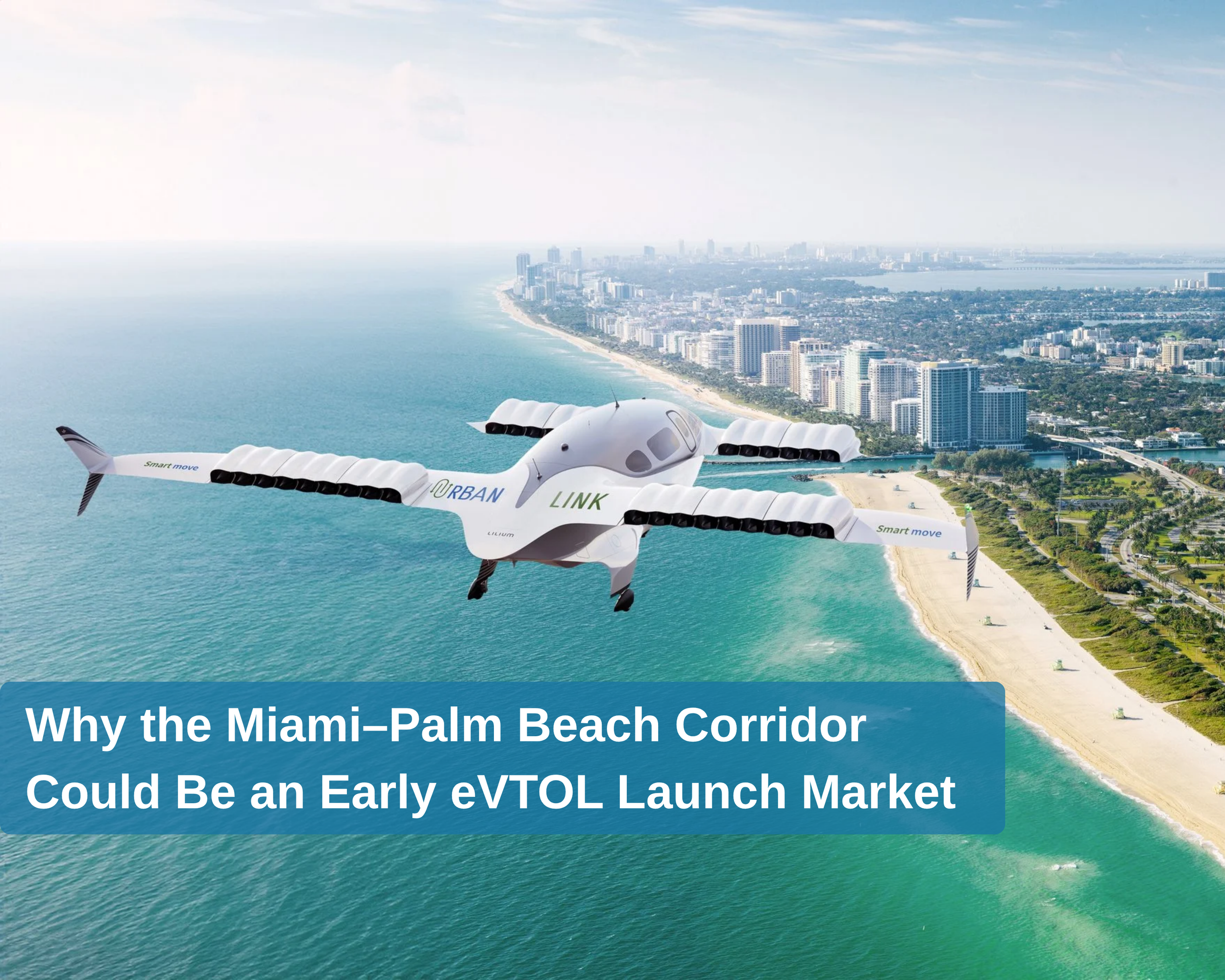
Electric air taxis promise to transform how people move across cities, but where the first large-scale networks will launch remains an open question.
Many industry experts believe the South Florida corridor from Miami to West Palm Beach could become one of the earliest real-world deployments of eVTOL transportation in the United States. The reasons go far beyond technology.
Geography Built for Air Mobility
The distance between South Florida’s major cities aligns perfectly with the capabilities of current eVTOL aircraft.
Typical distances include:
Miami to Fort Lauderdale: ~25 miles
Fort Lauderdale to Boca Raton: ~20 miles
Boca Raton to West Palm Beach: ~30 miles
Most eVTOL aircraft are optimized for short regional flights between 20 and 100 miles, making the corridor an ideal testing ground. Companies like Doroni Aerospace plan to connect these cities with 10–20 minute electric flights, dramatically reducing travel times compared to driving.
The South Florida megaregion is one of North America’s congested corridors facing severe traffic congestion, particularly along Interstate 95. Trips that can take 90 minutes or more by car could be reduced to short air taxi flights using electric aircraft.
Reducing congestion is a major driver behind investment in advanced air mobility solutions.
Real Estate Developers Are Driving the Ecosystem
Unlike many emerging tech industries, Florida’s eVTOL ecosystem is not being driven primarily by Silicon Valley venture capital. Instead, the sector is being shaped by real estate developers, aviation operators, and infrastructure investors.
These stakeholders see air taxis as a way to unlock new mobility corridors and increase property value across major developments.
For example, developer Stephen Ross has partnered with Archer Aviation to integrate vertiports into properties including Hard Rock Stadium and major developments in West Palm Beach.
The concept is simple: better connectivity increases real estate value.
Airports, Infrastructure, and a New Transportation Layer
The Miami–Palm Beach corridor is poised to become a real-world demonstration of integrated advanced air mobility. Rather than replacing roads, eVTOLs will layer on top of existing infrastructure, connecting urban hubs, airports, and developments in minutes.
South Florida already has one of the densest aviation infrastructures in the United States with three international airports, including Miami International Airport, Fort Lauderdale-Hollywood International Airport, and Palm Beach International Airport.
The Miami–Palm Beach corridor may soon become a real-world demonstration of how advanced air mobility integrates with existing transportation systems. Existing heliports and private aviation facilities could be converted into vertiports, dramatically lowering infrastructure costs. Rather than replacing roads, air taxis could become a new transportation layer, connecting urban hubs, airports, and major developments in minutes.
Multiple South Florida eVTOL companies are already developing the aircraft and networks that could make this a reality. For a rapidly growing region where mobility is increasingly valuable, the sky may soon be the fastest route between cities.




Palm Beach State College is investing $5.2 million in its automotive technology program at the Lake Worth campus. The investment combines $1.1 million in state funding with $4.1 million in federal funding to expand training in electric, hybrid, alternative-fuel, and diesel vehicle systems. A new 850-hour program is scheduled to launch in February 2027 with hands-on training in high-voltage systems, batteries, diagnostics, and advanced vehicle technology. The initiative reflects the growing intersection of skilled trades, software, electronics, and transportation technology.