

Project Tango: Palm Beach County's AI Data Center Decision Could Shape Florida's Digital Future
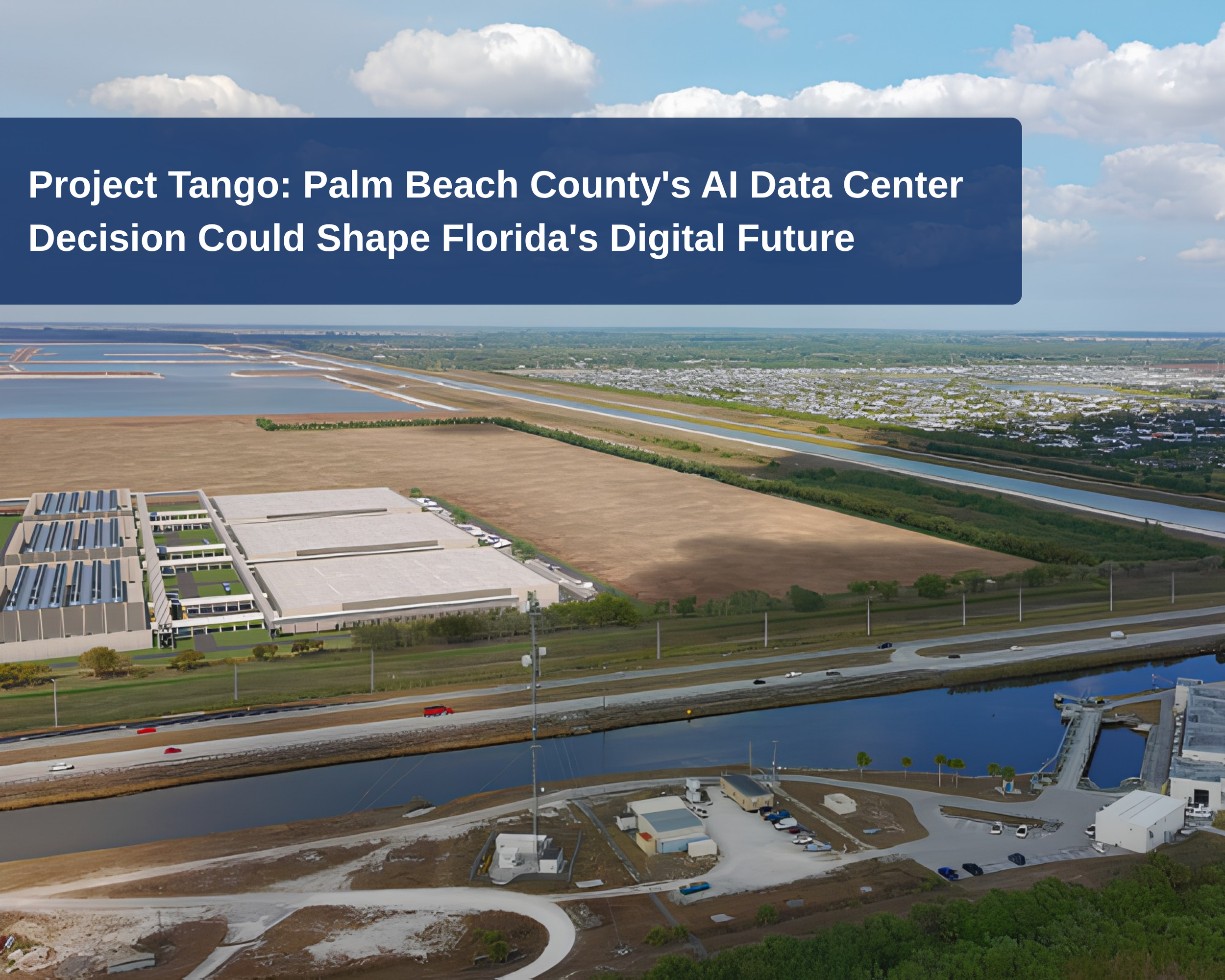
When Palm Beach County commissioners voted to deny the proposed Project Tango AI data center on July 16, the decision reached far beyond the future of a single development.
It became one of Florida's first major public tests of how communities will balance the explosive growth of artificial intelligence infrastructure with the concerns of the neighborhoods where that infrastructure is built.
The more than 12-hour hearing drew passionate testimony from residents, developers, engineers, business leaders, and environmental advocates. At its conclusion, the Palm Beach County Board of County Commissioners voted 5-1 to deny the application without prejudice, meaning the developer may return with a revised proposal in the future.
While the vote marked a victory for opponents of the project, it also underscored a much larger conversation that communities across Florida, and the nation, are only beginning to have.
The Rise of AI Infrastructure
Artificial intelligence doesn't simply exist in software.
Behind every AI application, large language model, autonomous system, medical breakthrough, or financial algorithm are massive computing facilities processing enormous amounts of data every second.
These hyperscale data centers require:
Significant electrical capacity
Extensive fiber connectivity
Robust cooling systems
Reliable water and utility infrastructure
Large land footprints capable of supporting future expansion
As AI adoption accelerates globally, demand for this type of digital infrastructure is growing at an unprecedented pace.
Florida has increasingly become part of that conversation.
With growing technology sectors, expanding fiber networks, available land, and strong population growth, the state has become an attractive destination for next-generation data center investment.
Project Tango represented one of the most ambitious examples proposed in South Florida.
The Promise of Project Tango
Supporters viewed the project as more than another industrial development.
They saw it as critical infrastructure capable of helping position Palm Beach County as a destination for advanced technology investment.
Among the potential benefits frequently cited were:
Hundreds of millions (potentially billions) of dollars in private investment
Significant increases in local property tax revenues
High-paying engineering, IT, cybersecurity, operations, and facility management jobs
Additional construction employment over multiple phases
Expanded digital infrastructure supporting AI, cloud computing, healthcare, finance, and research
Greater competitiveness for attracting technology companies and innovation-focused employers
Supporters also argued that hyperscale data centers increasingly serve as the backbone of modern economies, much like airports, seaports, or interstate highways.
Without sufficient digital infrastructure, regions risk losing future economic opportunities to competing states.
Community Concerns
Residents living near the proposed site saw the project very differently.
Throughout months of public meetings and ultimately during the County Commission hearing, nearby homeowners expressed concerns about the project's scale and long-term impacts on their quality of life.
Among the issues raised were:
Energy Consumption: Modern AI data centers require extraordinary amounts of electricity. Residents questioned whether the regional electrical grid could support a facility estimated to require hundreds of megawatts of power while maintaining long-term reliability for surrounding communities.
Water Usage: Although developers proposed modern cooling technologies designed to reduce water consumption, many residents remained concerned about long-term impacts on local water resources.
Noise: Large cooling equipment, backup generators, and mechanical systems operate continuously inside hyperscale facilities. Neighbors questioned whether these systems could truly operate without creating ongoing noise impacts.
Traffic and Infrastructure: Construction traffic, employee vehicles, utility improvements, and future expansion all raised concerns about increased congestion and infrastructure demands.
Compatibility: Perhaps the largest issue centered on compatibility. Residents argued that a facility of this magnitude simply did not belong adjacent to established residential neighborhoods and schools, regardless of mitigation efforts.
For many, the discussion became less about technology and more about preserving the character of western Palm Beach County.
After hearing testimony from all sides, commissioners ultimately concluded that the proposed development did not sufficiently demonstrate compatibility with surrounding land uses. The application was denied without prejudice, leaving the door open for a revised proposal that could address many of the issues raised during the hearing.
A Precedent for Florida
While Project Tango itself may return in another form, its lasting impact may be much larger.
This case is likely to become one of Florida's first major precedents for evaluating AI-focused data center developments.
Communities across the state are increasingly receiving proposals for facilities designed to support artificial intelligence, cloud computing, quantum computing, autonomous systems, and advanced digital services.
Local governments now face questions they have rarely had to answer before:
How much energy demand is appropriate?
How should water usage be evaluated?
What constitutes compatibility between hyperscale infrastructure and nearby communities?
What standards should govern noise, setbacks, landscaping, and buffering?
How should local economic benefits be weighed against neighborhood impacts?
Many counties currently lack zoning standards specifically written for AI-era data centers. Project Tango exposed those gaps. In response, Palm Beach County has already begun considering new policies and regulations specifically addressing future data center development. Other Florida counties will likely watch closely.
Finding the Balance
The debate surrounding Project Tango illustrates a broader challenge facing communities nationwide. Artificial intelligence is expected to become foundational infrastructure for healthcare, financial services, manufacturing, logistics, education, government, and scientific research.
Those systems require physical facilities.
At the same time, residents understandably want confidence that large-scale infrastructure projects can coexist responsibly with the communities they call home.
Finding that balance will require thoughtful planning, transparent engagement, modern zoning policies, and collaboration between government, industry, and residents.
Project Tango may have been denied, but the underlying issue isn't going away.
If anything, this hearing marked the beginning of a new chapter, one in which Florida must determine not whether AI infrastructure will be built, but how, where, and under what conditions it can become part of the state's future.
As artificial intelligence continues to reshape the global economy, the communities that successfully balance innovation with responsible growth may ultimately become the ones best positioned to lead it.


West Palm Beach-based Ondas is rapidly building a global defense technology platform through acquisitions, investments, and strategic leadership appointments. The company’s $33 million acquisition of Aran Defense adds manufacturing capabilities to its growing autonomous systems portfolio. Former Mossad Director David Barnea is also joining Ondas to lead its global defense strategy. Meanwhile, investments in companies such as FPF Defense and major military contracts are expanding Ondas’ footprint. The company’s growth is further positioning South Florida as an emerging hub for defense and autonomous technology.