
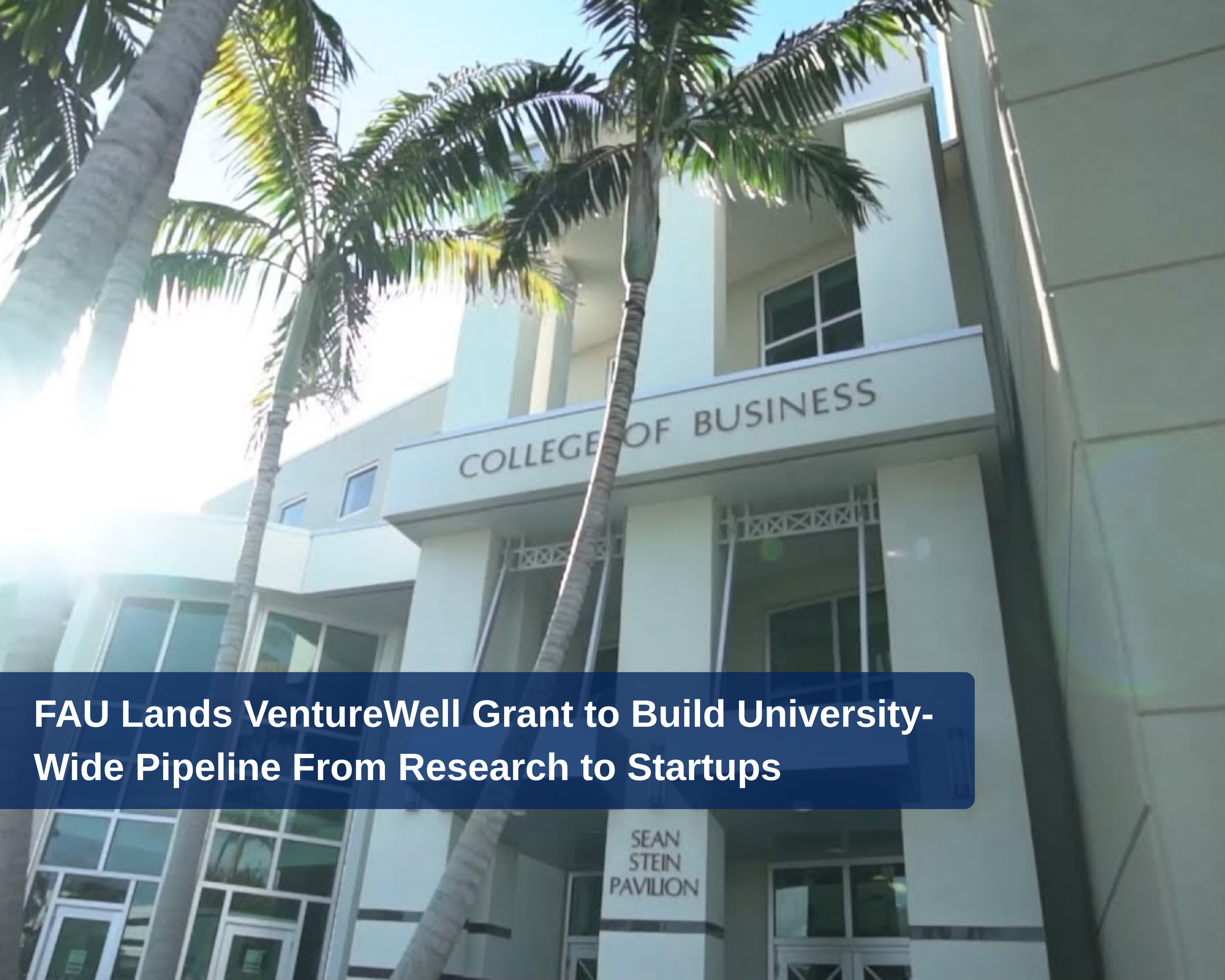
FAU Lands VentureWell Grant to Build University-Wide Pipeline From Research to Startups
Florida Atlantic University (FAU) doesn’t have a shortage of research, intellectual property or entrepreneurial resources. The challenge is consistently connecting them.
Now, the university is building a new interdisciplinary venture-development pipeline designed to create a clearer path from research and ideas to validation, commercialization, startup formation and industry impact.
The effort is being supported by an $85,000, two-year Ecosystem Futures Catalyst Grant from VentureWell, with FAU among just seven academic teams representing 11 institutions selected for the inaugural national cohort.
Led by Dr. Kevin Cox and Regina Thompson, FAU’s initiative, “Building the Future of Interdisciplinary Innovation at FAU through the Ocean Economy and Beyond,” will initially focus on areas including marine and environmental science, coastal resilience, sustainability, clean energy and engineering.
“The gap we are trying to solve is creating a consistent bridge between research and commercialization,” Cox said. “FAU has strong researchers, talented students, intellectual property, entrepreneurship programs, mentors and external partners. But historically, those resources have not always operated as a single, clearly defined pipeline.”
Closing the Commercialization Gap
FAU already has many of the pieces required to produce new ventures: researchers, students, intellectual property, entrepreneurship programs, mentors and external partners. Its entrepreneurial ecosystem includes the Florida Atlantic Entrepreneurship Institute (FAEI) and programs such as FAU Wave, the Business Pitch Competition and The Runway.
The challenge is that those resources have not always operated as a single, clearly defined pipeline. Silos between individual disciplines can also make it more difficult for research innovations to progress toward commercialization. The new initiative is intended to address that disconnect, not by replacing existing commercialization programs, but by making it easier for innovators to find and navigate them.
FAU plans to create what it describes as a repeatable “front door” into commercialization, where promising ideas can be identified earlier, interdisciplinary teams can form around them and innovators can be connected with the university resources appropriate for their stage of development. In other words, the university is creating connective tissue between research and entrepreneurship.
“We’re not trying to replace the commercialization resources FAU already has,” Thompson said. “We’re enhancing our network to help more people find them.”
Building a Network Across FAU
A central component will be the creation of a distributed network of 10 faculty and student ambassadors embedded across FAU colleges and campuses.
The ambassadors will actively identify researchers, students, technologies and ideas with commercial potential and connect those innovators with FAEI. They will also help bring together people from different disciplines to form teams around promising technologies.
The initial initiative will involve the College of Engineering and Computer Science, College of Science, College of Business and Office of Technology Development across multiple campuses.
That interdisciplinary component is important because moving a technology into the marketplace can require expertise well beyond the discipline where the original research occurred.
Creating a Clearer Path From Research to Market
Once innovations enter the ecosystem, FAU plans to establish a more defined progression toward commercialization. The pathway looks something like this:
Research → Interdisciplinary Team → Validation → Venture Development → Commercialization
Teams will begin with educational programming through FAEI, including ideation and market validation, before moving into venture development and testing, mentorship and commercialization.
One of the underlying goals is to eliminate a common question for university innovators: What comes next?
Rather than asking faculty members or students to independently identify programs, collaborators and commercialization resources, the new system is intended to provide a more visible pathway for moving an idea forward.
Starting With South Florida’s Ocean Economy
FAU will initially use the ocean economy as a focal point for testing the model. The university has substantial expertise in marine and environmental sciences, engineering, sustainability and coastal systems. It also hosts Florida’s statewide Office of Ocean Economy, which works to advance economic development through the sustainable use and stewardship of Florida’s ocean and coastal resources.
South Florida itself provides another advantage. The region functions as a living laboratory for challenges involving coastal resilience, marine ecosystems, water, climate, infrastructure, energy and economic development, creating opportunities to move university research beyond academic publication and toward technologies, companies and scalable solutions.
“We are excited to receive support from VentureWell to strengthen our entrepreneurial ecosystem with a focus on marine-based technologies and look forward to expanding this effort into medtech and biotech in the near future,” said Regina Thompson, assistant director of strategic initiatives.
While marine-based technologies provide the initial focus, FAU ultimately wants to apply the commercialization framework to other areas of university research, with medtech and biotech among the next sectors being considered.
What Success Looks Like
FAU has established several measurable goals for the two-year grant period.
The university is targeting at least five FAU teams reaching early commercialization milestones, which could include securing external funding, launching pilot projects or generating revenue.
FAEI also plans to incorporate a dedicated thematic innovation track into at least three major FAU entrepreneurship programs and engage at least five external partners annually as mentors, judges, sponsors, industry collaborators or other contributors.
Those partners could become particularly important as university innovations move closer to the market and require connections with experienced entrepreneurs, corporations, investors and potential customers. The longer-term ambitions go further.
FAU wants to increase the rate at which university research produces startups, licenses, sponsored research, industry collaborations, pilots, follow-on grants, outside investment and revenue-generating ventures.
Many of those outcomes can take considerably longer than the grant’s two-year window to materialize. The Catalyst Grant is instead intended to build the infrastructure that can generate those outcomes repeatedly over time.
If the model works, its biggest outcome may not be a single company or technology.
It could be a system that makes it easier for the next promising idea developed inside an FAU laboratory or classroom to find the people, resources and pathway it needs to make the leap into the marketplace.

Carnegie Mellon University has named four-time technology founder Jignesh M. Patel as the founding dean and vice president of its new Miami campus. Backed by a $2 billion commitment from Citadel founder Ken Griffin, CMU Miami will focus on artificial intelligence, national security, healthcare, energy, and advanced manufacturing. Patel brings extensive experience in computer science research, startup development, and technology commercialization. Planned for Miami's Wynwood neighborhood, the campus expects to begin enrolling students in 2028, strengthening South Florida's growing innovation and entrepreneurship ecosystem.