

Carnegie Mellon Names Four-Time Tech Founder Jignesh Patel to Lead New Miami Campus
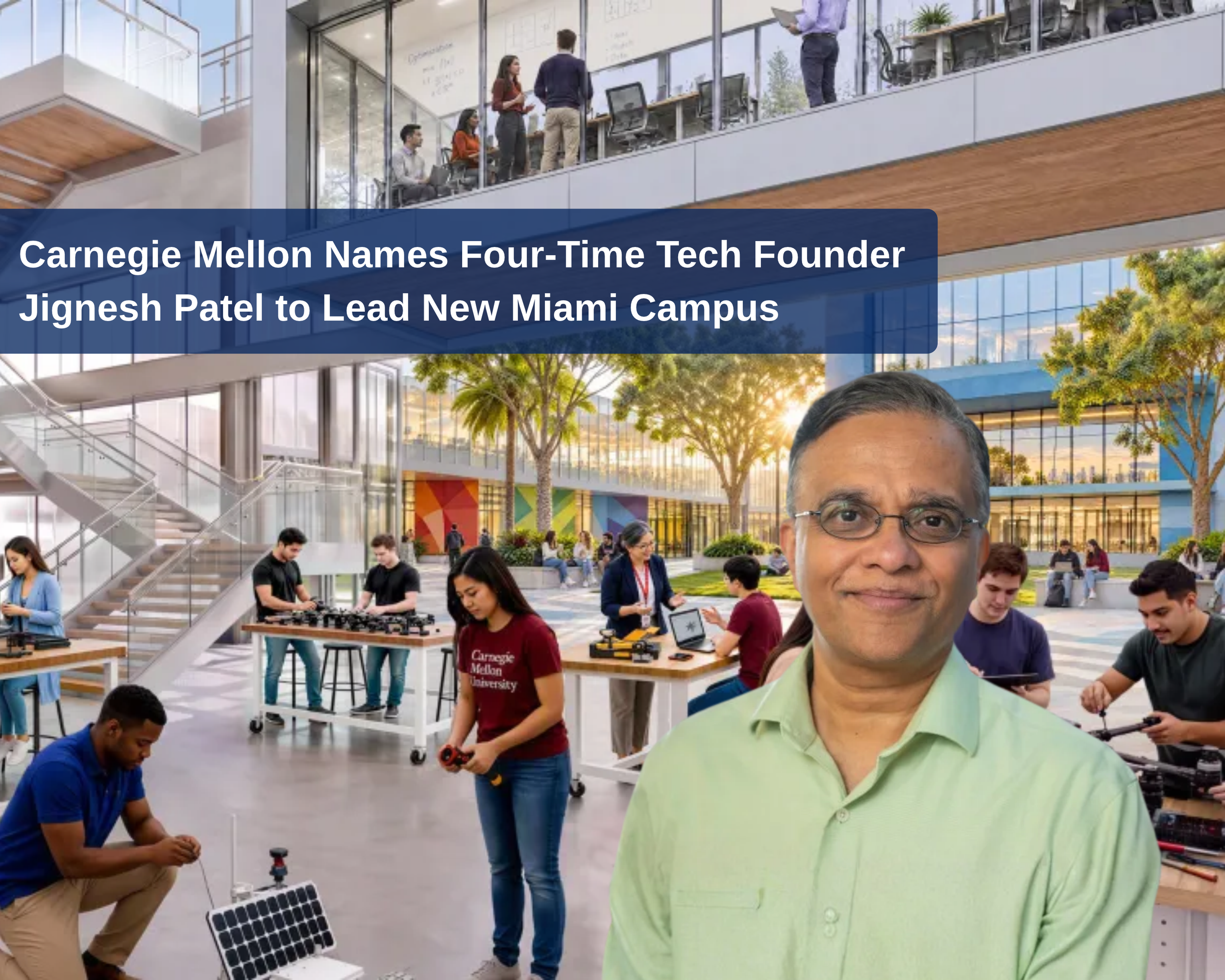
Carnegie Mellon University (CMU) has named Jignesh M. Patel as the founding dean and vice president of CMU Miami, placing a seasoned technology entrepreneur and computer scientist at the helm of its ambitious new campus in Miami's Wynwood neighborhood.
Announced October 20, 2026, the appointment follows the university's September announcement of a historic investment of more than $3 billion from Citadel founder and CEO Ken Griffin, including $2 billion dedicated to establishing CMU Miami.
Patel's selection signals an emphasis on connecting academic research with entrepreneurship, industry partnerships and real-world innovation as Carnegie Mellon prepares to expand its presence into South Florida.
A faculty member in CMU's Kenneth C. Griffin School of Computer Science, Patel has served as interim head of the university's Computer Science Department since 2025. He joined Carnegie Mellon in 2023 following academic appointments at the University of Wisconsin–Madison and the University of Michigan.
In his new leadership role, Patel will oversee the development of CMU Miami's academic and research programs, recruit faculty and students, and establish partnerships across the public and private sectors.
“Dr. Patel embodies the CMU spirit, combining a forward-thinking approach to education with an exceptional mind for research and an entrepreneurial lens. His proven track record of aligning academic discovery with real-world impact makes him uniquely qualified to lead CMU Miami,” said Provost and Chief Academic Officer James H. Garrett Jr. “The vision, energy and enthusiasm he brings to this effort make him precisely the right leader to shape this new campus and guide an exciting chapter for CMU.”
From Research Labs to Startup Exits
What distinguishes Patel's appointment is his extensive experience on both sides of the innovation equation: developing advanced technologies in academic research environments and translating those discoveries into commercially successful businesses.
Throughout his career, Patel has co-founded four technology companies, all of which were subsequently acquired. Among them was Locomatix, a company specializing in real-time location data that was acquired by Twitter in 2013. Its technology was integrated into Twitter's global real-time streaming platform.
His entrepreneurial background extends beyond launching companies. While at the University of Wisconsin–Madison, Patel helped develop the university's entrepreneurial ecosystem, co-founding and co-leading a statewide venture accelerator for science- and technology-based startups in collaboration with the Wisconsin School of Business.
He also established a computer science entrepreneurship competition and served on the Wisconsin Economic Development Corporation's Entrepreneurship and Innovation Committee.
These experiences could prove particularly valuable in South Florida, where a growing community of technology founders, venture capital firms, investors and corporate innovation leaders is working to strengthen the region's position as a global technology hub.
A Leader at the Intersection of AI, Data and Innovation
Patel's research focuses on scalable algorithms, high-performance data systems and natural-language interfaces for data analysis, technologies increasingly central to artificial intelligence and modern enterprise computing.
His research has received support from federal agencies including the National Science Foundation, National Institutes of Health, Defense Advanced Research Projects Agency and Department of Homeland Security, as well as major technology companies including Google, IBM, Microsoft, Oracle, Samsung and Snowflake.
He is a Fellow of the American Association for the Advancement of Science (AAAS), Association for Computing Machinery (ACM) and Institute of Electrical and Electronics Engineers (IEEE).
Beyond his research achievements, Patel has championed changes in computing education. At Carnegie Mellon, he helped modernize the undergraduate curriculum to emphasize foundational problem-solving skills and the responsible use of artificial intelligence.
His academic credentials include a bachelor's degree from the Indian Institute of Technology (BHU), Varanasi, and master's and doctoral degrees in computer science from the University of Wisconsin–Madison.
Building a New Model for Higher Education in Miami
CMU Miami is being designed around an interdisciplinary approach to education, research and innovation. Rather than organizing its work primarily around traditional academic departments, the university plans to address four major societal challenges: national security and strategic capabilities; human health and biological discovery; energy and climate resilience; and advanced manufacturing and industrial transformation.
The model is intended to bring together researchers, students, industry partners and entrepreneurs to develop solutions that move beyond academic discovery and into practical application.
“CMU Miami is an opportunity to start with the challenges facing society and figure out how to solve them in the most effective way. That has been a theme throughout my teaching and research career: turning ideas into results that make a difference,” Patel said. “From the foundational research all the way to real-world implementation — that’s what CMU does. That’s what we want to build in Miami. And that is what society needs too — now more than ever.”
Patel has already played an important role in shaping that vision, contributing to the campus's academic mission, research priorities and educational direction before his formal appointment.
Carnegie Mellon President Farnam Jahanian emphasized Patel's ability to bridge academic excellence and entrepreneurship, describing him as a leader who understands how to move ideas from discovery to impact.
The new campus, planned for a 35-acre site in Wynwood, expects to begin enrolling students in 2028, pending necessary regulatory approvals.
What Patel's Appointment Means for South Florida
Carnegie Mellon's expansion introduces the potential for new research collaborations, corporate partnerships, technology commercialization opportunities and a pipeline of highly specialized talent across artificial intelligence, cybersecurity, robotics, healthcare technology and advanced computing.
Patel's background in building startups and venture acceleration programs could also help connect the university's research capabilities with Miami's entrepreneurial community, creating opportunities for emerging companies to access advanced research, technical expertise and commercialization partnerships.
For regional employers, the university's presence could expand access to graduates and researchers equipped to address increasingly complex technological challenges. For South Florida's startup and investment community, the combination of Carnegie Mellon's research capabilities, Griffin's historic philanthropic commitment and Patel's entrepreneurial leadership creates the foundation for a potentially significant new innovation engine.
As CMU Miami moves toward its anticipated 2028 opening, Patel will play a central role in determining how the university integrates with the region's existing technology, business and academic communities. His appointment marks an important early milestone in what could become one of South Florida's most consequential higher education and technology developments in the years ahead.




Carnegie Mellon University has named four-time technology founder Jignesh M. Patel as the founding dean and vice president of its new Miami campus. Backed by a $2 billion commitment from Citadel founder Ken Griffin, CMU Miami will focus on artificial intelligence, national security, healthcare, energy, and advanced manufacturing. Patel brings extensive experience in computer science research, startup development, and technology commercialization. Planned for Miami's Wynwood neighborhood, the campus expects to begin enrolling students in 2028, strengthening South Florida's growing innovation and entrepreneurship ecosystem.