
DermaSensor Adds $5M as AI Skin Cancer Technology Moves Into National Scale-Up
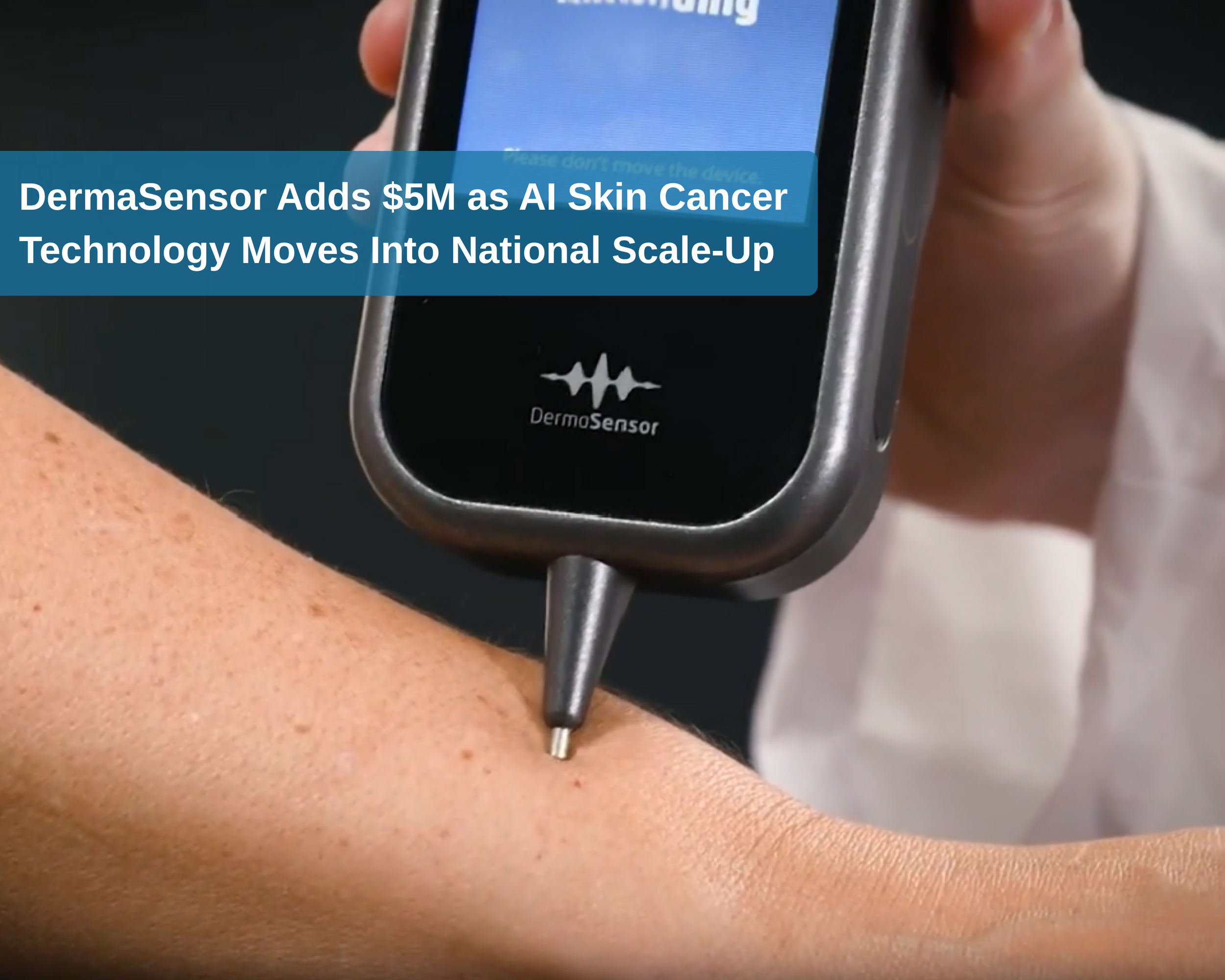
Miami-based health technology company DermaSensor has secured approximately $5 million in new financing, adding fresh capital as the company moves into its next stage of commercial growth across the United States.
The financing includes a $4 million extension of DermaSensor’s Series B round from institutional and strategic investors, along with more than $1 million raised through a community investment offering on Wefunder. The latest capital follows DermaSensor’s $16 million Series B announced in October 2025 and brings the company’s reported total investment to approximately $48 million.
DermaSensor is entering a new phase in which its focus is increasingly shifting from developing and validating its technology to expanding adoption of an FDA-cleared medical device across physician practices, healthcare systems and government healthcare channels.
Bringing AI-Powered Skin Cancer Assessment Into Primary Care
DermaSensor has developed a handheld, non-invasive device designed to help physicians evaluate suspicious skin lesions at the point of care. The technology combines elastic scattering spectroscopy (ESS) and artificial intelligence to analyze cellular characteristics beneath the skin's surface. Within seconds, the device provides physicians with an assessment intended to help determine whether a suspicious lesion should be referred to a dermatologist for further evaluation.
The technology is particularly significant for primary care providers, where potentially concerning lesions may first be identified but where physicians typically do not have access to the diagnostic tools available to dermatologists.
DermaSensor received FDA De Novo clearance in 2024 for evaluating lesions suspicious for melanoma, basal cell carcinoma and squamous cell carcinoma. The device is designed as an aid for physicians evaluating suspicious lesions rather than as a standalone cancer diagnosis or general population screening tool.
According to the company, more than 45,000 suspicious lesions have now been scanned using the technology, with the device being used by hundreds of healthcare-provider organizations.
Published clinical studies cited by DermaSensor have reported 96% sensitivity across the three major forms of skin cancer, while the company says use of the device has reduced missed skin cancer referrals by more than 50%.
Four Partnerships Could Accelerate U.S. Adoption
The latest financing arrives as DermaSensor builds out the commercial infrastructure needed to reach significantly more healthcare providers. Just days before announcing the additional funding, the company revealed four new U.S. partnerships aimed at expanding distribution and adoption.
Among the most significant is Henry Schein, one of the world's largest distributors of healthcare products and services to office-based medical practitioners. DermaSensor has become an approved Henry Schein supplier, creating a new channel through which physician practices and healthcare organizations can access the technology.
The company also entered into a nationwide agreement with a large U.S. healthcare institution employing tens of thousands of providers. While DermaSensor has not publicly identified the organization, it said two divisions are already moving toward implementation.
A partnership with MedTech MedCare (MTMC) adds another national sales channel through an organization with more than 150 medical-device sales professionals.
DermaSensor has also partnered with Medical Place, which will serve as the company's exclusive reseller to the U.S. Department of Veterans Affairs, opening another potentially significant market for the technology.
Together, the partnerships signal a transition that many medical-device startups struggle to achieve: moving from regulatory clearance and clinical validation into broad commercial distribution.
From $16M Series B to Commercial Expansion
DermaSensor’s latest financing builds on the $16 million Series B the company announced in October 2025, providing additional capital as it shifts its focus toward broader commercial adoption and market expansion.
The new financing takes a slightly different approach. Alongside approximately $4 million from institutional and strategic investors, DermaSensor opened the round to individual investors through a Wefunder campaign, raising more than $1 million through the community investment platform.
For the company, opening the round was about more than adding another source of capital. It was an opportunity to give physicians, patients and others personally connected to the problem an opportunity to participate in the company’s growth. DermaSensor's previously disclosed investors and supporters include healthcare entrepreneur Dr. Maurice Ferré, along with Pier 70 Ventures, Kern Venture Group, GenHenn Capital, TiE Global Angels and Bader Family Office.
“Our professional investor partners have supported us through every phase of building this new medical device category. Opening the financing on Wefunder is about extending that ownership to the physicians and patients who are living the problem we're solving, given that 1 in 5 Americans are affected by skin cancer. We want the people closest to it to have a seat at the table,” said Cody Simmons, Co-Founder and CEO of DermaSensor.
The strategy adds an interesting dimension to DermaSensor’s latest raise. Rather than relying exclusively on traditional venture and institutional capital, the company is creating an avenue for a broader group of investors to participate as it enters its next stage of commercialization.
That next stage comes with considerably more market traction than DermaSensor had even a year ago. When the company announced its Series B in October 2025, it reported that approximately 20,000 suspicious lesions had been scanned with its technology. Today, that figure has surpassed 45,000, with the device being used across hundreds of healthcare-provider organizations.
With regulatory clearance already secured, utilization increasing and new national distribution partnerships in place, the company’s challenge is increasingly shifting from proving the technology to scaling its adoption in everyday clinical care.
The additional financing is expected to help DermaSensor do exactly that, expanding its commercial reach while putting its technology into the hands of more healthcare providers across the country.
A South Florida Medtech Company Reaching National Scale
DermaSensor's latest milestone also adds to South Florida's growing presence in health technology and medical innovation. The region has historically been recognized for healthcare delivery, medical practices and life sciences activity. Companies like DermaSensor represent another piece of that ecosystem: locally headquartered ventures developing regulated technologies with the potential for national and international adoption.
For DermaSensor, the next chapter will be less about proving that the technology can work and increasingly about demonstrating how widely it can be integrated into everyday clinical practice.
The combination of additional capital, national distribution relationships, access to the VA healthcare system and growing utilization gives the Miami company significantly more infrastructure to pursue that goal.
And with more than twice as many suspicious lesions scanned as the company reported less than a year ago, DermaSensor's progress provides another example of a South Florida startup moving beyond product development and into the difficult, and potentially transformative, stage of commercial scale.





2150 co-founder Christian Hernandez Gallardo is leaving venture capital to become Executive Chair of Boca Raton-based Blue Frontier, helping the climate-tech company scale manufacturing, expand internationally and capitalize on growing demand for energy-efficient cooling as AI and data centers place new pressure on the electrical grid.