

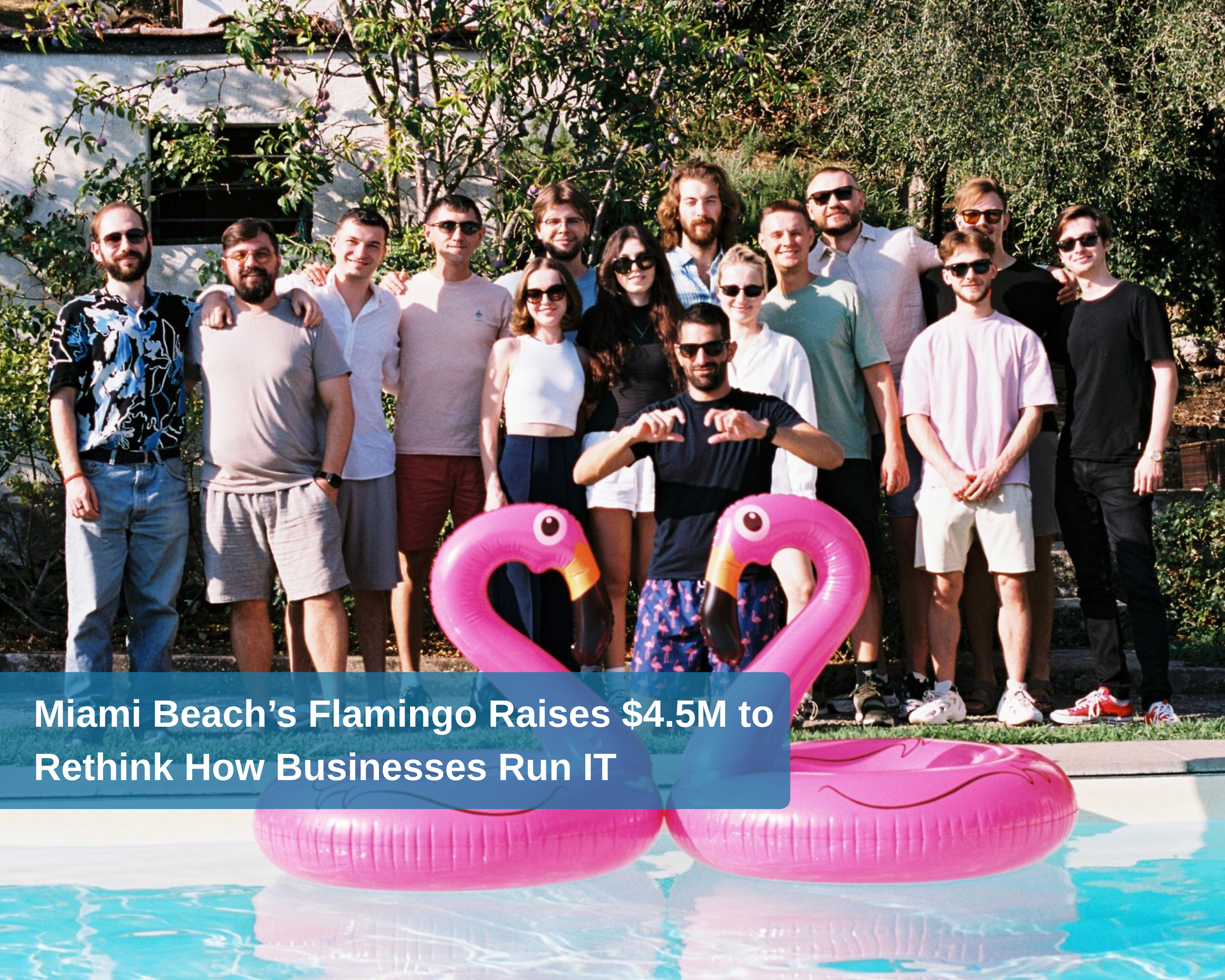
Miami Beach-based Flamingo has raised $4.5 million in seed funding as the startup looks to rethink a costly and increasingly complex part of running a business: IT and cybersecurity. The round was led by Vertex Ventures and brings Flamingo’s total funding to $6.7 million, following a $2.2 million pre-seed round in October 2025.
Founded by cybersecurity and managed service provider veteran Michael Assraf, Flamingo is building what it calls an open, AI-native infrastructure layer for IT and security. But rather than adding another AI assistant on top of the dozens of tools businesses and IT providers already use, Flamingo is taking a more ambitious approach: rebuilding the underlying infrastructure and embedding AI agents capable of actually performing the work.
“Instead of adding another AI assistant to an existing stack, we’re rebuilding the infrastructure layer and putting agents directly into it, so they can actually close tickets,” Assraf said in announcing the round. “Mingo can even hunt down and fix issues before a ticket exists.”
It’s a distinction that gets to the heart of Flamingo’s larger bet: The next generation of enterprise AI won’t simply tell workers what to do. Increasingly, it will do the work alongside them.
Building The ‘Autonomous MSP’
Flamingo is initially targeting managed service providers, or MSPs, which handle IT and cybersecurity operations for businesses that often don’t have large internal technology teams. It is an industry Assraf knows well and one Flamingo believes is ripe for disruption.
MSPs typically rely on a collection of commercial products for everything from remote monitoring and device management to patching, security monitoring, automation, ticketing and remote access. On top of those software costs comes an even larger expense: the people required to operate those systems and respond to customer issues.
Flamingo is attempting to attack both. Its OpenFrame platform consists of two primary layers.
OpenFrame Core consolidates 19 IT and security product categories into a common API and data layer built on open-source foundations. Flamingo says modules are already live for remote monitoring and management, mobile device management, monitoring, automation, remote access, patch management, security monitoring and ticketing.
Sitting on top of that infrastructure are two AI agents designed to move beyond the traditional “copilot” model. Fae operates at the end-user level, handling requests such as password resets and software installations. Mingo works at the technician and fleet level, performing tasks including backups, policy configuration, routine scripts and incident response.
In other words, the goal isn’t simply to help an IT technician resolve a ticket faster. In some cases, it is to prevent the ticket from needing a technician at all.
Early Demand for a Different IT Model
The company is already seeing significant early interest. According to Flamingo, 400 MSPs are participating in its beta and managing approximately 10,000 endpoints through the platform. Another 2,500 MSPs are currently on the company’s waitlist.
Those figures suggest Flamingo may be tapping into a broader frustration within the managed IT industry: businesses continue adding technology while the cost and complexity of managing that technology continue to grow with it. Flamingo is positioning open-source infrastructure as one part of the solution and autonomous AI as the other.
The company has also priced the platform aggressively. OpenFrame costs $1 per device per month with 10 million AI tokens included, or 80 cents per device with 25 million tokens under annual billing.
For MSPs managing thousands, or tens of thousands, of endpoints, Flamingo’s proposition is not simply about buying less expensive software. The bigger opportunity is going after the labor rather than the software. For each dollar spent on software another six are spent on the skilled people who operate it.
Assraf believes that shift could eventually reshape the MSP business model itself, moving providers away from making money by reselling software and billing for human labor toward orchestrating work performed increasingly by AI.
“MSPs stop reselling tools and human hours and become brokers of AI labor running on commodity software underneath,” Assraf said. “Whoever does the work keeps the margin.”
It’s a provocative vision, but one that reflects a broader shift investors are beginning to see across enterprise technology.
“As IT becomes a key enabler of AI adoption, the stack itself has to evolve,” Tami Bronner, general partner at Vertex Ventures, said in announcing the investment. “By combining open infrastructure that reduces software costs with agents that take on the operating work, Flamingo can fundamentally change the economics of IT.”
Bronner sees that shift as part of a much larger change taking place across enterprise software: a move away from businesses assembling fragmented collections of tools and toward platforms capable of delivering the work itself.
“The market is moving from fragmented software tools to a model where the service and the task become the product,” Bronner said.
A Miami Company With a Global Opportunity
For South Florida, the funding also adds another AI and cybersecurity company to Miami’s growing technology ecosystem. Flamingo is headquartered in the City of Miami Beach, while its team is distributed internationally. As the company moves from beta toward broader commercialization, one question will be how much of Flamingo’s next phase of growth happens in South Florida. That includes hiring, but it also speaks to a larger opportunity for the region.
South Florida has developed a sizable cybersecurity community alongside its growing startup, financial services and technology sectors. Flamingo sits at the intersection of several of those trends: cybersecurity, enterprise AI, open-source technology and the growing movement toward autonomous AI agents.
For Assraf, however, the opportunity extends well beyond making existing IT operations more efficient. He believes AI could ultimately reshape the business model of the MSP industry itself stating that “MSPs stop reselling tools and human hours and become brokers of AI labor running on commodity software underneath. Whoever does the work keeps the margin.”
The $4.5 million round gives the company additional capital to turn that thesis into a commercial business. But perhaps the more consequential question is what happens if the thesis proves correct.
If AI agents can safely identify problems, make changes across enterprise devices and resolve IT requests without waiting for a human technician, the technology could do more than make MSPs more efficient. It could fundamentally change what an MSP sells. Instead of software being the product and human labor delivering the service, the work itself increasingly becomes the product.
For Flamingo, that is the bigger bet: The future of managed IT may not be defined by the tools an MSP uses, but by how much of the work those tools can autonomously complete.


Miami-based medical technology company DermaSensor has been named a finalist in the 2026 Digital Health & AI Awards in the Cancer, Screening & Early Detection category. Founded by Cody Simmons, the company developed an FDA-authorized handheld device that uses artificial intelligence and spectroscopy to help healthcare providers assess suspicious skin lesions. With more than 45,000 lesions scanned and approximately $48 million in total funding, DermaSensor continues to expand its clinical adoption and commercial reach. The national recognition highlights South Florida's growing role in AI-powered healthcare innovation, with winners set to be announced at HLTH 2026 in November.