

2150 Co-Founder Christian Hernandez Gallardo Leaves VC Role to Help Scale Boca Raton-Based Blue Frontier
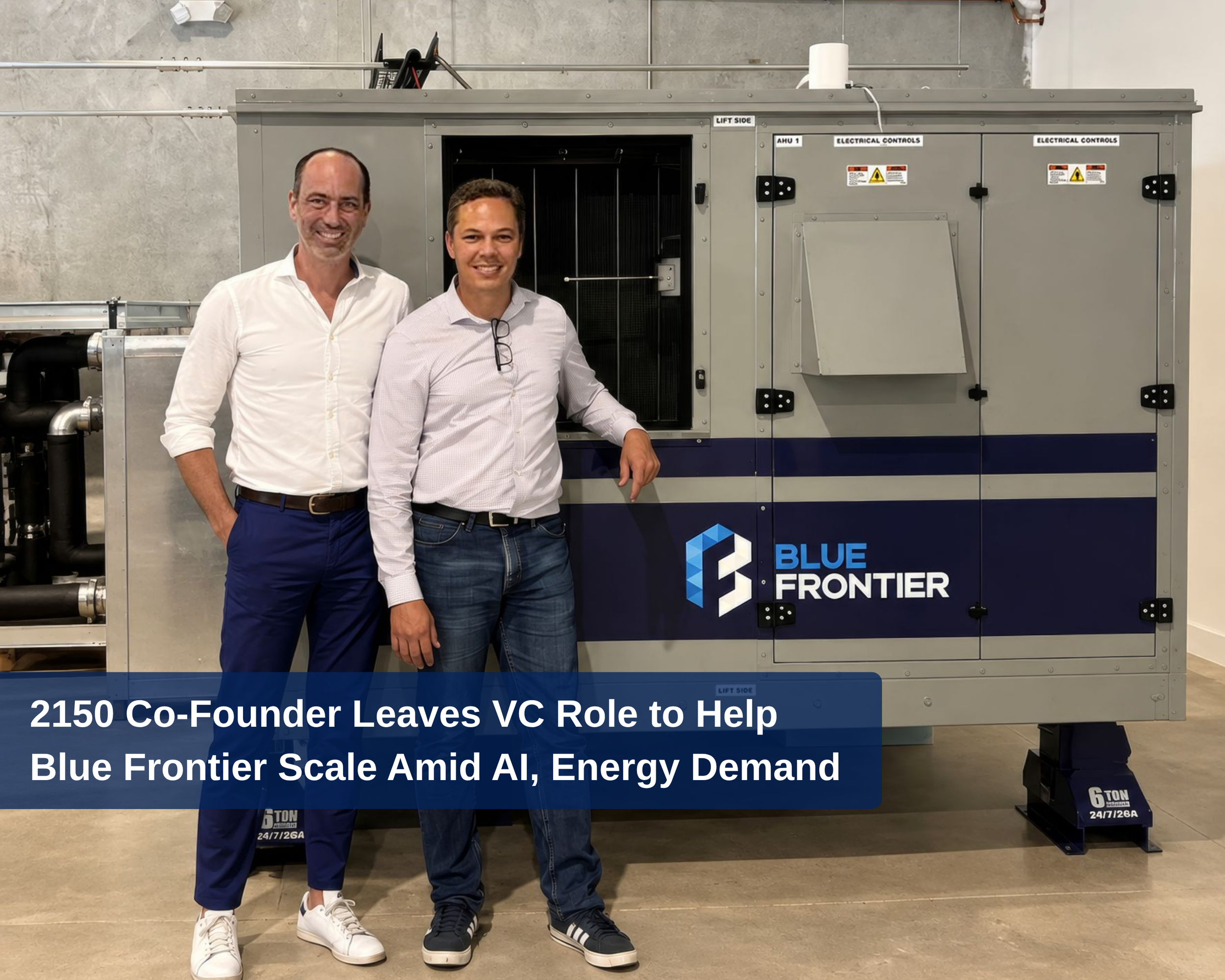
Christian Hernandez Gallardo is moving from investor to operator at South Florida climate-tech company Blue Frontier, and leaving the venture capital firm he co-founded to do it.
Hernandez Gallardo, co-founder and partner at climate-tech venture firm 2150, has been named executive chair of Boca Raton-based Blue Frontier, where he will work alongside founder and CEO Daniel Betts as the company looks to scale its energy-efficient air-conditioning technology amid rapidly growing demand.
The move deepens a relationship that began in 2022, when Hernandez Gallardo co-led 2150’s Series A investment in Blue Frontier. He has remained an active member of the company’s board since then, giving him an inside view of the technology, business and challenges of bringing a new cooling platform to market. Now, he is taking that involvement considerably further.
“I am returning to my operational roots and becoming Executive Chair of Blue Frontier to partner with Daniel and team to scale its amazing — and critically needed — technology,” Hernandez Gallardo wrote in announcing the move.
For Betts, the transition sends an important signal about where Blue Frontier is headed. “He knows what’s under the hood and has helped shape it,” Betts wrote in a social media post. “I consider his transition to Executive Chairman as one of the biggest votes of confidence in this incredible company.”
From Investor to Operator
For Hernandez Gallardo, the decision followed nearly four years of watching Blue Frontier develop from the inside. “Blue Frontier is now at an inflection point, and the need for its hyper-efficient cooling product has never been greater,” Hernandez Gallardo told Venture Tech Chronicle.
He pointed to extreme heat, pressure on electrical grids and the growing electricity requirements associated with artificial intelligence infrastructure as forces increasing the need for technologies capable of reducing and managing power demand. But the transition was also the result of his relationship with Betts and an increasing level of involvement with the company.
“Having worked closely with Daniel over the years, we built a common vision and trust,” Hernandez Gallardo shared. As he began spending more time with Betts and the team earlier this year, he said it became apparent that dedicating more of his time and attention to the company could be significantly additive.
Hernandez Gallardo has described the new position as becoming a “forward-deployed investor,” a play on the forward-deployed engineer model increasingly used by technology companies to embed technical talent directly with customers. For him, it means moving from supporting Blue Frontier externally through capital, board governance and periodic advice to becoming embedded within the company.
In practice, Hernandez Gallardo said his responsibilities will include working with Betts on overall strategy, capital formation and international expansion, as well as coordinating partnerships with utilities and data center operators. The goal, he said, is to use those partnerships to help unlock electrical grid capacity at scale.
Scaling Into Growing Demand
Betts says Hernandez Gallardo’s operating and investing experience comes at a particularly important stage for the company. “Christian has been there; at Microsoft, Google and Facebook. He knows what a rocket ship looks like,” Betts said. “Blue Frontier is at one of the most exciting moments in a technology startup's lifecycle: scaling into huge and growing market demand.”
That growth brings increasing operational complexity. According to Betts, Blue Frontier needs to expand manufacturing, build long-term relationships with channel partners and suppliers, broaden its product offerings, maintain its technology-enabled customer experience and prepare to enter international markets. “I will be relying on Christian to help me see around corners and avoid landmines.”.
The two have also developed a close working relationship during their years together as CEO, investor and board member. “He complements my best qualities and helps me overcome deficiencies,” Betts said.
As executive chair, Hernandez Gallardo will work closely with Betts to shape Blue Frontier’s strategy through 2027 and 2028, including opportunities in the data center market and international expansion. Europe is expected to be a particular area of focus. Hernandez Gallardo is based there, and Betts sees significant opportunity in markets facing both energy infrastructure constraints and ambitious environmental goals.
As Hernandez Gallardo moves into his executive role, Christian Jolck will join Blue Frontier’s board representing 2150.
Commercialization Accelerates
Hernandez Gallardo’s expanded role comes as Blue Frontier says demand for its technology is accelerating faster than expected. The company's latest product was named Product of the Year by the Air-Conditioning, Heating, and Refrigeration Institute (AHRI) earlier this year. Combined with a nationwide expansion of its sales representative network, Betts said the recognition has helped drive significant new demand.
Blue Frontier now has projects across the continental United States providing cooling and energy storage for supermarkets, movie theaters, health centers, military installations, restaurants, schools and universities. Betts told Venture Tech Chronicle that, “the market uptake has been amazing and somewhat overwhelming.”
The company is accelerating manufacturing relationships to prepare for expected demand next year. Betts said it is possible that before the end of 2026, Blue Frontier will have surpassed the manufacturing capacity originally slated for 2027. That makes manufacturing one of the company's most immediate priorities.
Over the next 12 to 18 months, Hernandez Gallardo said Blue Frontier will focus on scaling manufacturing to meet demand while also expanding the ways customers can deploy the technology. That includes launching models such as cooling-as-a-service, which Hernandez Gallardo said could reduce customer friction around deployments, as well as thoughtfully expanding the team and Blue Frontier’s channel partnerships.
The company also plans to deepen relationships with policymakers, utilities and data center operators to connect Blue Frontier’s energy-efficiency and grid-capacity capabilities with growing electricity demand.
Cooling Meets the AI Energy Challenge
One of Blue Frontier’s potentially largest opportunities may come from an industry that, at first glance, has little to do with air conditioning: artificial intelligence.
The rapid buildout of AI infrastructure is intensifying demand for electricity as developers race to construct data centers and secure access to increasingly constrained electrical grids. Blue Frontier believes cooling can become part of the solution.
The company has developed an air-conditioning system designed to significantly improve energy efficiency while storing cooling capacity and shifting electricity consumption away from periods of peak grid demand. Betts argues that this capability could free existing electrical capacity for other uses, including data centers.
“The race to build AI infrastructure is creating a new pole of value and demand for us,” said Betts. “The principal bottleneck for AI interconnection is access to electricity.”
According to Betts, air conditioning plays an outsized role in determining the peak electricity capacity utilities must maintain. He estimates that approximately 45% of grid capacity is dedicated to meeting summer peak demand.
That creates an opportunity for Blue Frontier that extends beyond reducing the electricity consumed by individual buildings. “Each unit we install frees existing grid infrastructure so it can power data centers.”
If Blue Frontier can shift cooling demand away from peak periods at scale, the company believes utilities and property owners could make better use of existing grid infrastructure while accommodating new sources of electricity demand. “The potential is enormous. We can eliminate interconnection wait times, eliminate the need for new power plants, and enable data center buildout behind the meter in existing buildings.”
Hernandez Gallardo sees the same convergence of cooling, grid constraints and AI demand as a major reason the company's opportunity has changed since his initial investment. “It sounded too good to be true when I first led our investment into Blue Frontier in 2022,” Hernandez Gallardo wrote in a recent post, “but since then I have seen Daniel and team scale that promise into a reality.”
Leaving 2150 to Go Deeper
Hernandez Gallardo’s new role also means stepping down as co-founder and partner of 2150 nearly seven years after helping launch the venture firm.
During that period, 2150 grew to more than $500 million in assets under management and more than 30 portfolio companies. Those companies collectively employ thousands of people and generate more than $1 billion in aggregate revenue.
Hernandez Gallardo will remain an investor across 2150’s funds and an advocate for the firm's mission, but his professional focus now shifts toward helping one of those portfolio companies reach its next stage. For Blue Frontier, that means gaining an executive chair who already knows the company as an investor and board member, and who is now betting something more than capital on its future.
The next 12 to 18 months could test that bet. Blue Frontier must translate growing demand into manufacturing scale, new business models, international expansion and partnerships capable of positioning its technology within a much larger conversation about the future of the electrical grid.
For Hernandez Gallardo, it is an opportunity to move from watching that transition from the boardroom to helping lead it from inside the company. And for Blue Frontier, the challenge is increasingly shifting from proving that its technology works to determining how quickly it can scale. “We are poised to fundamentally change the energy sector,” said Betts.




2150 co-founder Christian Hernandez Gallardo is leaving venture capital to become Executive Chair of Boca Raton-based Blue Frontier, helping the climate-tech company scale manufacturing, expand internationally and capitalize on growing demand for energy-efficient cooling as AI and data centers place new pressure on the electrical grid.