
West Pam Beach-Based Powerus Secures Air Force IDIQ Contract Worth Up to $90M
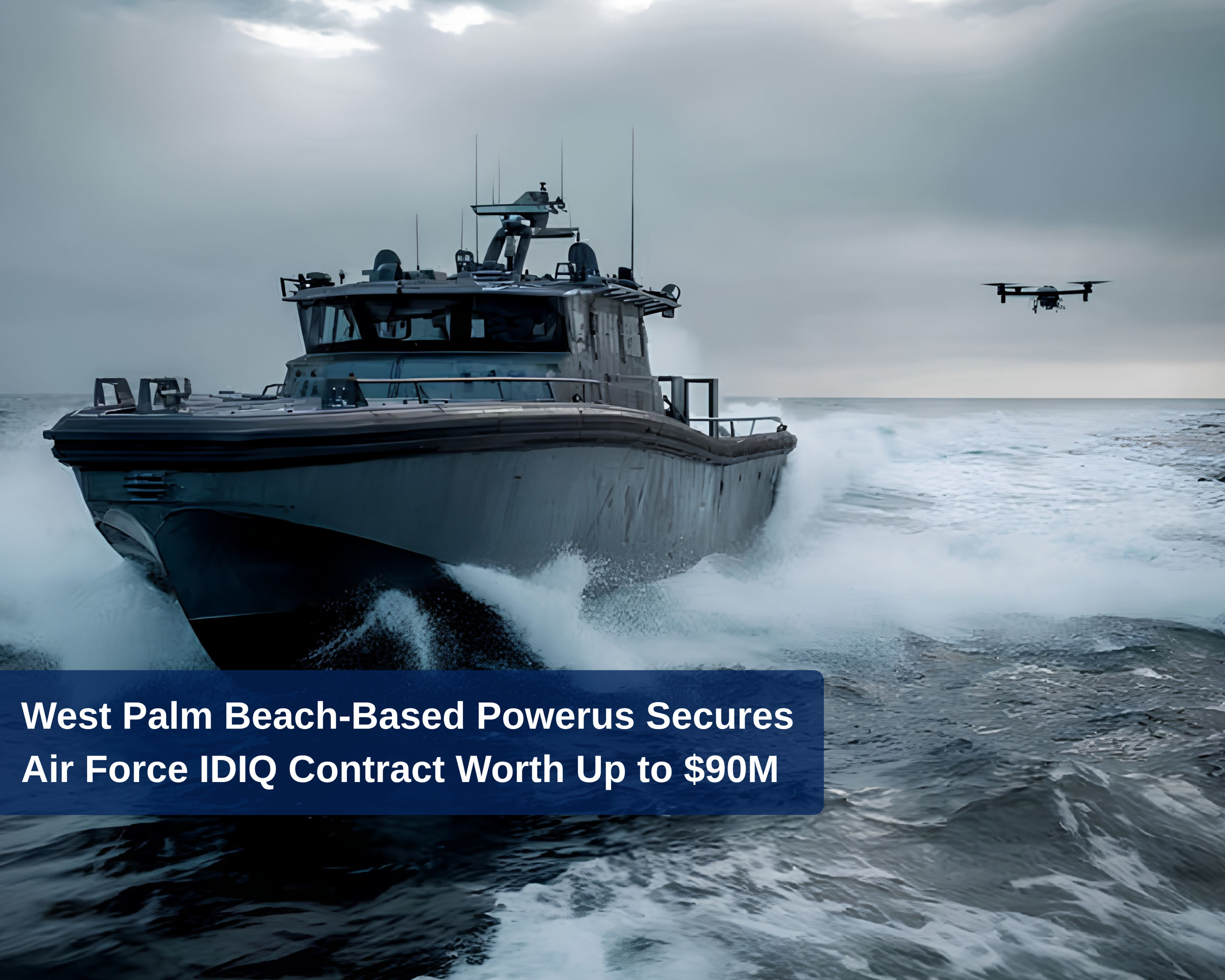
West Palm Beach-based defense technology company Powerus has secured a U.S. Air Force indefinite-delivery/indefinite-quantity contract with a ceiling of up to $90 million, giving the military a vehicle to order the company’s aerial-denial systems as operational needs emerge.
The IDIQ structure does not guarantee Powerus $90 million in revenue. Instead, it allows the Air Force to issue individual orders under the contract without launching a separate procurement process each time, up to the contract ceiling.
The award represents another milestone for South Florida’s growing defense-tech sector, where autonomous systems, counter-drone technology and national security investment are becoming increasingly visible parts of the region’s technology economy.
Momentum Across U.S. and International Defense Markets
More than a drone manufacturer, Powerus is building an integrated autonomous-systems company that can develop, manufacture, and support unmanned air and marine autonomous technologies. Powerus manages autonomous systems ranging from small tactical drones to heavy-lift VTOL aircraft, along with other products that support the systems and their functionality, including sensors, command-and-control software, training support, and a wide variety of complex systems.
The company has three main operating companies: Tandem Defense, Kaizen Aerospace, and Agile Autonomy. Tandem Defense focuses on tactical and mission systems, including the Guardian counter-UAS technology.
In late June, Powerus shared imagery of its Guardian interceptor, a system the company says is designed to address the economics of modern drone warfare by providing a lower-cost approach to countering unmanned aerial threats.
Powerus describes this challenge as the “missile math” problem: relatively inexpensive attack drones can force militaries to respond with interceptor systems that may cost significantly more than the threats they are designed to eliminate. Guardian-1 is a lightweight, high-speed interceptor developed to provide a more scalable counter-UAS option.
According to Powerus, conventional interceptor systems can cost hundreds of thousands, or even millions, of dollars per engagement, while some attack drones cost only tens of thousands of dollars. The company positions Guardian as a lower-cost alternative intended to improve the economics of counter-drone defense.
In April, Powerus announced Guardian-2, which integrates radar detection with automated launch capabilities and semi-autonomous flight designed to assist a single operator. Powerus's relationship with the Air Force predates the new IDIQ contract. Following a Guardian-2 demonstration, the Air Force issued a limited purchase order for the system.
South Florida’s Defense-Tech Ecosystem Gains Momentum
Powerus's Air Force contract comes as South Florida's defense-tech footprint continues to expand, with companies working across autonomous systems, drones, aerospace, cybersecurity and other national security technologies establishing or growing their presence in the region. The region has also attracted increased attention from investors and business leaders, including Peter Thiel and Stephen Ross, as South Florida continues to develop its broader technology and innovation economy.
Public-market activity is becoming another part of that story. Ondas, a Nasdaq-listed company focused on autonomous drone and wireless technologies, relocated its headquarters from Boston to West Palm Beach, adding another publicly traded defense and autonomy company to Palm Beach County.
Powerus is now pursuing its own path to the public markets through a proposed business combination with Aureus Greenway Holdings (AGH), a Nasdaq-listed Florida company. If completed, the transaction could provide Powerus with another avenue to access capital as it scales its autonomous-systems portfolio.
The companies currently expect the transaction to close in early October, subject to remaining closing conditions. If completed, Powerus would join a growing group of South Florida technology companies using the public markets to support expansion.
Taken together, federal contracts, company relocations, private investment and public-market activity are providing additional indicators of South Florida's emergence as a potential hub for defense and autonomous-systems technology.
Defense Leadership Strengthens Powerus’s South Florida Presence
Powerus recently announced additions to its leadership team. In March, Powerus added General Charles Q. “CQ” Brown Jr. as the Strategic Advisor for Government & Defense. Brown previously served as the 21st Chairman of the Joint Chiefs of Staff from 2023 to 2025, making him the nation’s highest-ranking military officer. Prior to his service on the Joint Chiefs of Staff, Brown was the first African-American Chief of Staff of the U.S. Air Force.
Later in March, retired Lt. General Keith Kellogg also joined the Powerus team as a Strategic Advisor for National Security & Defense. Kellogg commanded the 82nd Airborne Division and served as director of command, control, communications, and computers (J6) for the Joint Chiefs of Staff. He later served as National Security Advisor to Vice President Mike Pence.
The experience that Gen. Brown and retired Lt. Gen. Kellogg bring to the table is particularly relevant for Powerus’s battlefield-tested Ukrainian drone and counter-drone technology.
In May, Powerus added former Navy SEAL Rear Adm. Milton ‘Jamie’ Sands III as a Strategic Advisor for Maritime & Defense. Sands served as Commander of Naval Special Warfare Command and as Chief of Staff of U.S. Special Operations Command.
These additions show that Powerus has attracted some of the country's most recognizable military and national security leaders and elevated the national profile of the West Palm Beach company.
What the $90M Air Force Contract Means for South Florida
The significance of Powerus’s $90 million award with the U.S. Air Force extends beyond a single contract. A South Florida-based defense-tech company securing a major federal defense contract adds another marker of the region's influence in defense innovation and national security.
Powerus and other South Florida companies also attract and support startups that could be eligible for the Golden Dome funding for missile defense.
As federal investment increasingly focuses on autonomous systems, counter-drone technology, and next-generation defense capabilities, South Florida has the potential to play a larger role in the defense technology shaping the future of national and global security.




West Palm Beach-based Powerus has secured a U.S. Air Force contract with a ceiling of up to $90 million, expanding its role in autonomous defense technology. The company develops drones, counter-drone systems, sensors, software and other autonomous technologies for defense applications. Powerus is also pursuing a potential public-market transaction as it scales its portfolio. New strategic advisors with senior military and national security experience are further strengthening the company’s leadership. The developments add momentum to South Florida’s growing defense and autonomous technology ecosystem.