
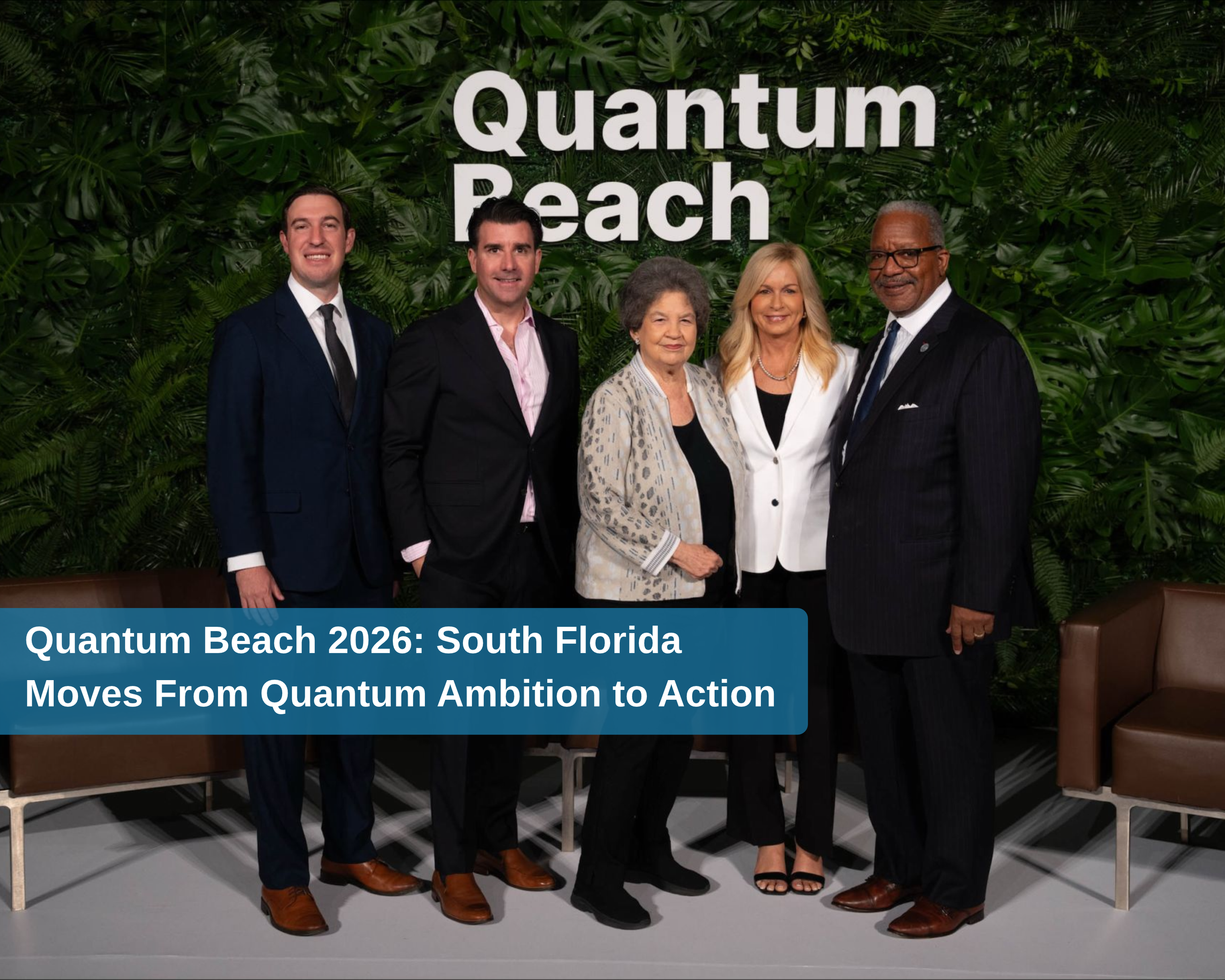
More than 400 business executives, researchers, investors, government officials and technology innovators gathered Oct. 22 at the Palm Beach County Convention Center for Quantum Beach 2026, a statewide conference highlighting Florida's growing role in quantum computing, cybersecurity, advanced research and commercialization.
Now in its second year, the conference brought together some of the nation's leading voices in quantum technology to explore how breakthroughs once largely confined to research laboratories are beginning to translate into real-world applications, economic opportunities and high-skilled jobs.
Hosted by the Business Development Board of the Palm Beaches (BDB), The Quantum Insider and Quantum Coast Capital, with IonQ and D-Wave serving as presenting sponsors, the event reflected the region's accelerating momentum in building a competitive quantum ecosystem.
From Possibility to Progress
Under the theme "From Possibility to Progress," this year's conference emphasized the significant developments taking shape across Palm Beach County and throughout Florida.
Among the most notable milestones is D-Wave's relocation of its global headquarters from Palo Alto, California, to Boca Raton, positioning the region as home to one of the industry's established quantum computing companies.
Florida Atlantic University (FAU) is also making a substantial investment in the emerging sector with its $20 million D-Wave quantum computer initiative, while Palm Beach State College (PBSC) is developing its Quantum Innovation Center to support workforce training, entrepreneurship and industry collaboration. Together, these developments are creating an increasingly connected environment for research, talent development, private investment and business growth.
"A year ago, Quantum Beach was a bet that Palm Beach County could become a home for this industry. Today we have a quantum company headquartered in Boca Raton, a dedicated quantum computer at Florida Atlantic University, a training center at Palm Beach State College and federal agencies in the room," said Kelly Smallridge, president and CEO of the Business Development Board of the Palm Beaches. "The companies building quantum technology are being courted by every region in America. Palm Beach County intends to win them."
Building Florida's Quantum Infrastructure
A major milestone announced during Quantum Beach 2026 was the activation of the first segment of Florida's statewide quantum-safe network, connecting Palm Beach State College (PBSC) and Florida Atlantic University (FAU) in Boca Raton through Palm Beach County's dark fiber infrastructure.
The announcement, made jointly by PBSC President Ava Parker and FAU President Adam Hasner, represents a significant step toward establishing a statewide network designed to support secure communications, advanced research and emerging quantum technologies.
Supported by a $1 million defense infrastructure grant from FloridaCommerce, PBSC is leading development of the network's first segment in partnership with Florida LambdaRail, FAU, Palm Beach County and IonQ.
The network uses IonQ's quantum key distribution technology to strengthen the security of data transmitted between participating institutions, establishing a foundation for expanding quantum-secure communications capabilities throughout Florida.
"This partnership is a model for how higher education, industry and government can work together to build the infrastructure and talent that will drive Florida's future," Parker said.
The initiative also reflects the growing collaboration among Florida's higher education institutions, government agencies and private-sector technology companies as they work to establish the infrastructure needed to support the state's emerging quantum economy.
Cybersecurity Takes Center Stage
While quantum computing offers opportunities to solve complex problems, it also introduces significant cybersecurity challenges.
Representatives from the FBI and the Cybersecurity and Infrastructure Security Agency (CISA) addressed the potential implications of quantum computing for today's encryption systems, which protect financial transactions, healthcare information, critical infrastructure and sensitive government data.
As quantum computing capabilities advance, organizations face increasing pressure to prepare for a future in which some widely used encryption methods could become vulnerable. Dr. Sarah Mohrle, Chief AI and Data Officer at Eclypses, expanded on these concerns through a discussion of protecting mission-critical systems and high-value assets from emerging quantum threats.
The conversations underscored an important reality for businesses: Preparing for quantum technology is not simply an opportunity for future innovation. It is also becoming an essential component of long-term cybersecurity and risk management.
Connecting Research, Talent and Commercialization
Building a skilled workforce capable of supporting Florida's growing quantum industry was another central theme of the conference.
During the "Classroom to Commercialization" panel, Florida Atlantic University President Adam Hasner joined Palm Beach State College President Ava Parker for a discussion moderated by Hillary Matchett, partner and chief investment officer at Quantum Coast Capital.
The conversation explored how higher education institutions can translate quantum research, specialized training and academic partnerships into a workforce prepared to support companies bringing next-generation technologies to market.
"With the state's support, this partnership positions Florida to lead the nation into the next era of computing and cybersecurity," Hasner said.
The discussion reinforced the importance of collaboration between universities, colleges, industry leaders and investors in preparing students for emerging careers while helping companies access the specialized talent needed to grow.
Students also demonstrated the potential of this developing talent pipeline. Members of FAU's Quantum Coders team, Robert Tudor, Jonathan Seepaul and Tegan Dowd, presented their winning project from the Florida Qiskit Hackathon, offering a glimpse into the next generation of quantum innovators emerging from South Florida.
From Scientific Breakthroughs to Business Applications
Beyond research and education, the conference explored how quantum technologies could transform industries ranging from finance and logistics to healthcare, pharmaceuticals, aerospace and manufacturing.
Allison Schwartz, Senior Vice President of Global Government Relations and Public Affairs at D-Wave, discussed practical quantum computing applications for industries already well established in Florida, including logistics, financial services and utilities.
John Licata, Futures Director and Quantum Lead at ServiceNow, explored how large enterprises evaluate emerging quantum technologies and determine when investment makes business sense.
In healthcare and biotechnology, Dr. Matthew Disney of The Wertheim UF Scripps Institute examined how quantum computing could potentially accelerate drug discovery and advance biomedical research.
Additional discussions addressed quantum error correction, the technical challenges of building reliable quantum computers and opportunities to combine quantum computing with artificial intelligence in aerospace research. Together, the sessions illustrated both the promise of quantum technology and the technical and commercial hurdles that must be overcome before its applications become widespread.
Mapping Florida's Quantum Economy
The conference also provided an early look at findings from a statewide quantum ecosystem study commissioned by FloridaCommerce in partnership with the Business Development Board.
Presented by Alex Challans, co-founder and CEO of The Quantum Insider, the study examines Florida's quantum companies, research institutions, infrastructure and emerging industry capabilities.
The initiative aims to provide a clearer picture of the state's existing strengths and opportunities for future investment, collaboration and economic development.
The event concluded with a discussion featuring Dr. Erwin Gianchandani, assistant director for technology, innovation and partnerships at the National Science Foundation, and Matt Cimaglia, founder and managing partner of Quantum Coast Capital, highlighting the importance of federal support and private investment in advancing quantum innovation.
South Florida's Next Innovation Frontier
For Palm Beach County, Quantum Beach 2026 represented more than a gathering of technology experts. It highlighted the tangible progress being made toward establishing a regional quantum economy.
With D-Wave establishing its headquarters in Boca Raton, FAU expanding its quantum research capabilities, PBSC investing in workforce development and industry partners building new infrastructure, South Florida is assembling several of the critical components needed to compete in an emerging global industry.
Significant questions remain about the pace of commercialization, the availability of specialized talent and which quantum applications will ultimately deliver the greatest economic value.
However, the growing alignment among business leaders, research institutions, investors and government agencies suggests that Florida intends to be an active participant in shaping the industry's future rather than simply adopting its technologies after they mature.
As quantum innovation continues to evolve, the challenge for South Florida will be turning its early investments and partnerships into sustainable companies, high-value jobs and measurable economic impact.
Quantum Beach 2026 made one thing clear: Florida is no longer just talking about the possibilities of quantum technology. It is actively building the foundation for what comes next.


The activation of Florida's first statewide quantum-safe network segment, new investments in research and workforce development, and the growing presence of quantum technology companies took center stage at Quantum Beach 2026, where more than 400 business, government and research leaders gathered Oct. 22 in West Palm Beach.