
FAU Lands $1 Million AUKUS Grant to Build the Future of Autonomous Underwater Connectivity
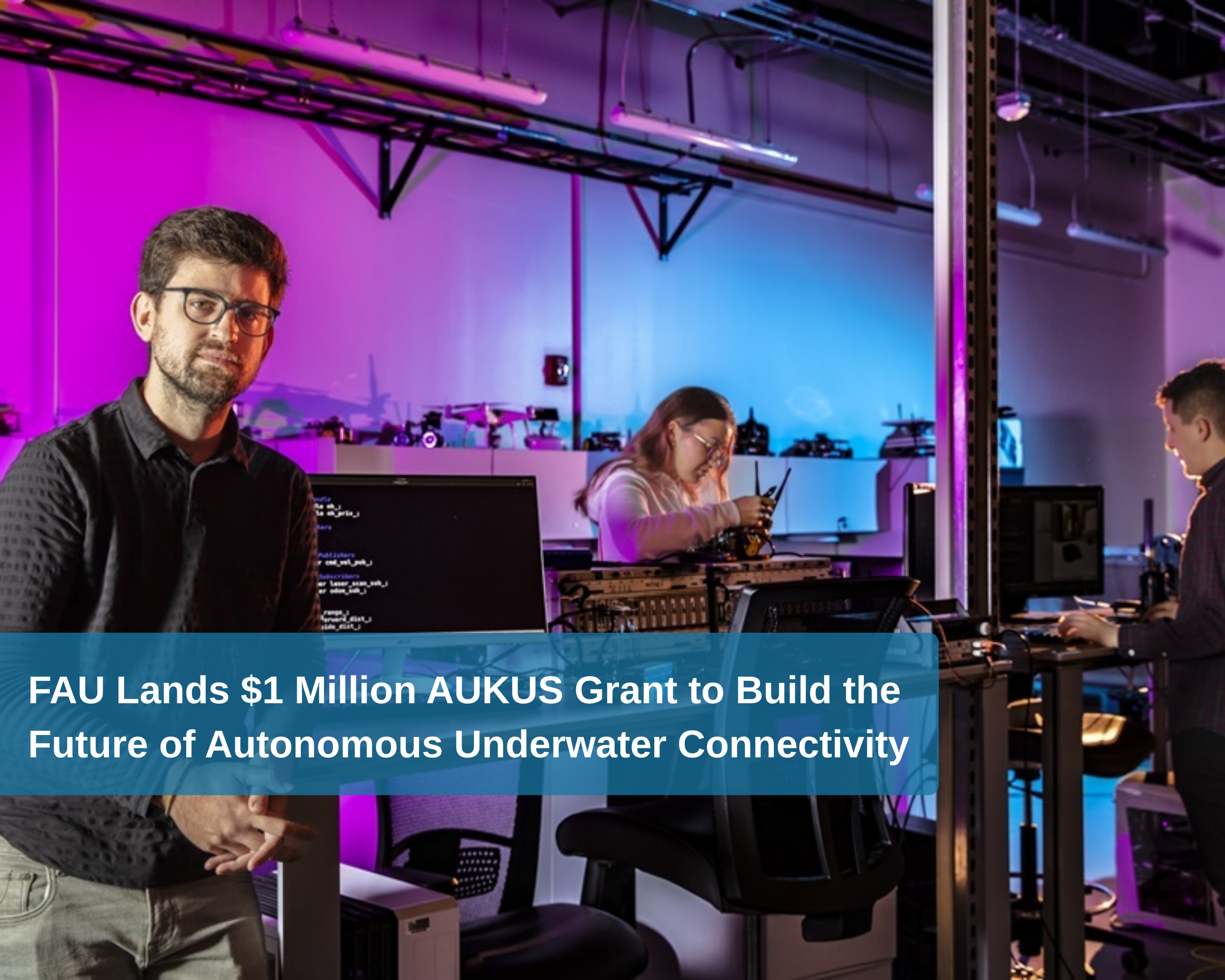
Florida Atlantic University is taking a deeper dive into the future of autonomous technology after securing a $1 million award through the AUKUS Maritime Innovation Challenge, a global defense innovation initiative supported by the United States, Australia and the United Kingdom.
The 12-month project will develop a next-generation underwater communication and networking system designed to allow autonomous underwater vehicles, seabed sensors and maritime operators to exchange information faster, more reliably and more securely beneath the ocean surface.
The award places FAU among a select group of international research institutions working on one of the most complex challenges facing the future of maritime autonomy: how to maintain real-time communication in an environment where traditional wireless technologies fail.
“Today’s underwater communication systems typically force operators to choose between range and speed,” said George Sklivanitis, Ph.D., principal investigator for the project, associate director of FAU’s Center for Connected Autonomy and AI (CA-AI), Charles E. Schmidt Research Associate Professor in Engineering and fellow of FAU’s Sensing Institute.
“Acoustic communication signals can travel long distances but offer limited bandwidth, while optical communications can transmit data quickly but only over short distances.”
FAU’s solution aims to bridge that gap by combining two complementary technologies into a single software-programmable platform.
The system will integrate long-range acoustic communications with high-speed visible-light optical networking, creating a more adaptable underwater communications infrastructure capable of supporting autonomous systems operating in challenging ocean environments.
Building the Underwater Network for Autonomous Machines
Unlike terrestrial environments, where satellites, cellular networks and GPS enable constant connectivity, underwater systems face significant barriers.
Radio waves do not travel effectively through seawater, and GPS signals cannot reach submerged vehicles. While acoustic communication has historically been the most reliable method for underwater connectivity, it comes with limitations in speed and data capacity.
FAU’s hybrid approach could change how underwater systems communicate.
Long-range acoustic links will provide resilient command-and-control capabilities, while visible-light optical links will enable faster data sharing between nearby vehicles and sensors.
The result is a technology platform designed to help underwater systems coordinate, adapt and operate more independently.
“What excites us most is the ability to combine long-range acoustic communications with high-speed optical networking in a single platform,” said Dimitris Pados, Ph.D., co-principal investigator, director of CA-AI, Charles E. Schmidt Eminent Scholar in Engineering and fellow of FAU’s Sensing Institute.
“By leveraging the strengths of both technologies, we can enable new levels of autonomy, coordination and mission effectiveness beneath the ocean surface.”
South Florida’s Growing Role in Maritime Innovation
The project is led by FAU’s Center for Connected Autonomy and AI in collaboration with Hydromea SA, a Switzerland-based company specializing in underwater visible-light communication technology.
Testing and demonstrations will take place at Hydromea’s facilities in Switzerland and at FAU’s SeaTech campus in Dania Beach before advancing to field demonstrations off the coast of Australia involving autonomous surface vessels, underwater vehicles and seabed systems.
The partnership builds on FAU’s ongoing research in networked autonomous underwater vehicles, including previous National Science Foundation-supported work focused on robotic systems that can operate cooperatively.
For South Florida, the announcement represents another signal that the region’s technology economy is expanding beyond traditional software and into advanced engineering disciplines, including artificial intelligence, robotics, sensing, marine technology and defense innovation.
Beyond Defense: The Future of Ocean Intelligence
While the project is part of an international maritime security initiative, researchers anticipate applications well beyond defense.
Potential uses include:
Environmental monitoring and ocean science
Offshore infrastructure inspection
Underwater exploration
Autonomous maritime operations
Persistent ocean data collection
The ability for underwater machines to communicate and coordinate could transform how humans study, protect and interact with the world’s oceans.
“This technology could help fleets of autonomous underwater vehicles coordinate more effectively, support persistent ocean monitoring, improve situational awareness, and enable faster sharing of data collected beneath the sea surface,” said Stella Batalama, Ph.D., dean of FAU’s College of Engineering and Computer Science.
As the global race for autonomous systems accelerates, FAU’s latest award places South Florida at the center of a new technology frontier, one that is not in the sky or on the ground, but beneath the waves.


Palm Beach-based DeLorean Artificial Intelligence has been acquired by healthcare technology company WellStack in a deal combining predictive AI with healthcare data infrastructure. Founded in 2019, DeLorean developed technology designed to identify patient risks, predict disease progression, and support proactive interventions. The company had raised approximately $7.55 million before the acquisition. The transaction adds another healthcare AI exit to South Florida’s growing technology ecosystem.