

How South Florida’s Hidden Underwater Lab Became Part of NASA’s Artemis Future
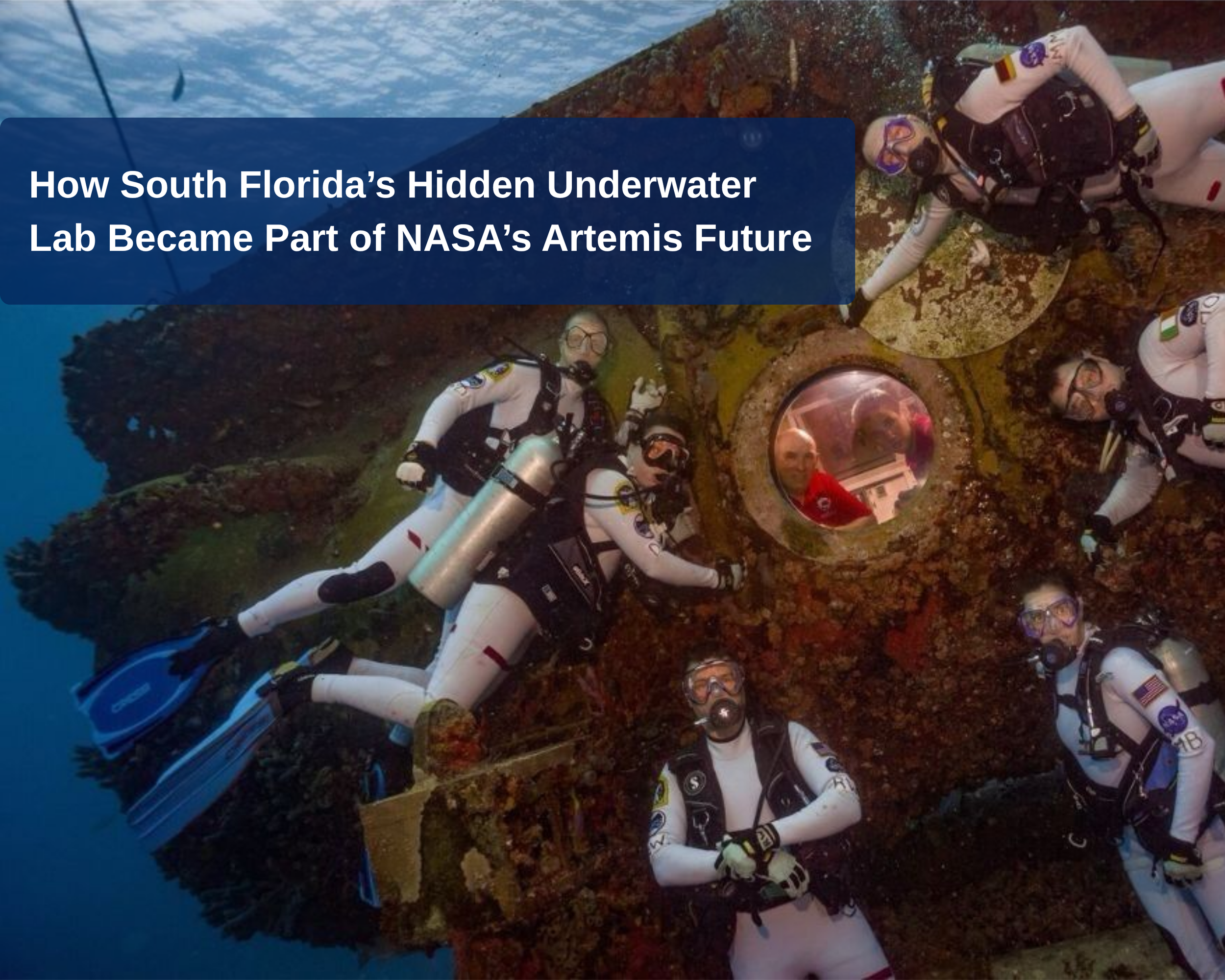
Off the coast of the Florida Keys, where turquoise water gives way to deep Atlantic blue, something unusual is happening far beneath the surface.
Sixty feet underwater, a steel habitat sits anchored to the seafloor like a small outpost on another world. Inside, researchers, engineers, and sometimes astronauts live for days at a time, working, sleeping, and conducting “spacewalks” in an environment that feels less like Earth and more like a rehearsal for the Moon.
This is the Aquarius Reef Base, operated by Florida International University (FIU). And while it may seem far removed from rockets and launchpads, it has quietly become one of NASA’s most valuable tools for preparing humanity’s return to the Moon through the Artemis program.
A Different Kind of Space Program Begins in South Florida
When people think of Florida’s role in space exploration, they picture Cape Canaveral and the towering rockets of NASA. But South Florida contributes in a different, and often overlooked, way.
Instead of launching astronauts into space, FIU helps prepare them to survive it.
At Aquarius, crews enter a world where communication is delayed, movement is constrained, and teamwork is everything. The habitat is small, the conditions are demanding, and the environment outside is entirely unforgiving.
It is, in many ways, the closest thing on Earth to deep space.
That’s exactly why NASA has used it for decades as part of its NASA Extreme Environment Mission Operations (NEEMO) program, a series of underwater missions designed to simulate the physical and psychological realities of spaceflight.
Where Ocean Science Meets Spaceflight Training
Aquarius is not a pool or a simulation tank. It is the world’s only operational underwater research habitat, permanently installed on the ocean floor and maintained through FIU’s Institute of Environment.
Astronauts living inside it must perform tasks while diving in saturation conditions, meaning their bodies are fully adapted to pressure levels equivalent to deep-sea environments. In practical terms, they are “sea astronauts,” or aquanauts, conducting space analog missions in real time.
Here, NASA tests everything from:
Extravehicular activity techniques (spacewalk simulations)
Mission communications protocols
Robotics and remote operations
Human performance under isolation
Emergency response scenarios
These experiments are not theoretical. They directly inform how astronauts will live and work aboard spacecraft bound for the Moon, and eventually Mars.
The Unexpected Path to Artemis
FIU Aquarius operations director Hank Stark, stated, “It’s exciting. It’s always a unique opportunity to work with NASA and always interesting,” he said. “Going to space is something I think everyone dreams about at some point in their life.”
Stark has spent years supporting NEEMO missions, helping astronauts acclimate to life in extreme environments. The experience goes beyond technical training.
“Training at Aquarius and saturating with these astronauts lets us get to know them on a personal level,” Stark said. “We’re living together underwater for a week or more."
Two members of the Artemis II crew, the mission that will carry humans around the Moon for the first time in more than 50 years, once lived and worked inside Aquarius.
Reid Wiseman | NASA astronaut and Artemis II commander
Jeremy Hansen | Canadian Space Agency astronaut and Artemis II crew member
Years before their selection for Artemis, both participated in NEEMO missions at FIU’s underwater lab. There, they practiced the same kind of operations they will one day perform in lunar orbit: coordination under pressure, problem-solving in confined environments, and reliance on a tightly integrated team.
The connection is direct and powerful:
South Florida helped train astronauts bound for the Moon.
FIU’s Turning Point: Saving a Global Asset
Aquarius nearly disappeared.
In 2013, federal funding cuts threatened to shut down the facility entirely. The loss would have ended more than just a research station because it would have erased one of NASA’s most important analog environments.
Then FIU stepped in.
By assuming operational control, FIU transformed Aquarius from a vulnerable federal project into a stable academic research platform. The university not only preserved the facility but expanded its scientific mission, integrating marine science, engineering, robotics, and space analog research under one umbrella.
Today, FIU operates a globally unique asset: a university-run underwater habitat that actively supports space exploration research.
Powering A New Space Economy Beneath the Sea
Inside the Aquarius habitat, astronauts experience a version of spaceflight without ever leaving Earth. The parallels are intentional and powerful.
In space, astronauts face isolation. Underwater, aquanauts experience the same confinement. In space, every movement requires coordination. Underwater, every task depends on precision and teamwork. In space, failure is not an option. Underwater, conditions demand the same discipline.
The ocean becomes a stand-in for the vacuum of space, not because it is identical, but because it forces the same human realities to the surface. It is here that NASA refines the soft skills of exploration: communication, trust, adaptability, and endurance, skills that are just as critical to mission success as rockets and spacecraft.
But the significance of this work extends far beyond astronaut preparation.
Florida’s Space Coast has long been synonymous with exploration, yet South Florida’s contribution is different. It is less visible, more specialized, and increasingly strategic. The Aquarius habitat sits at the intersection of multiple innovation domains such as ocean engineering, aerospace systems, robotics and autonomy, human performance research, and environmental monitoring.
This convergence reflects a broader shift in how space exploration is evolving. The Artemis program is not simply a rocket initiative, it is a systems-driven mission that depends on data, human factors research, autonomous technologies, and cross-disciplinary innovation. Facilities like Aquarius provide a proving ground for these integrated technologies, helping scientists and engineers test ideas that may one day support sustained missions on the Moon and beyond.
Through FIU, South Florida has quietly become part of that foundation—helping shape not just how astronauts train, but how the future of exploration is built.
The Future Beneath the Surface: A Different Kind of Launchpad
As NASA prepares for sustained lunar exploration under the Artemis program and looks ahead to Mars, analog environments like Aquarius are becoming more important, not less.
Future missions will require astronauts to operate farther from Earth than ever before. That means longer isolation, greater autonomy, and deeper reliance on human resilience. Aquarius provides a testing ground for exactly that, a place where astronauts learn not just how to operate equipment, but how to function as a team in environments where every decision matters.
And FIU, once simply the steward of a marine research station, now finds itself connected to one of the most ambitious exploration programs in human history.
Not all space stories begin with a rocket.
Some begin in silence, beneath the ocean, where pressure replaces gravity and visibility fades into blue darkness. In that world, astronauts learn not how to launch, but how to endure. And from that endurance, Artemis begins.
Because before humans return to the Moon, they must first learn how to live in environments that demand everything they have.
In South Florida, that preparation starts underwater.



2150 co-founder Christian Hernandez Gallardo is leaving venture capital to become Executive Chair of Boca Raton-based Blue Frontier, helping the climate-tech company scale manufacturing, expand internationally and capitalize on growing demand for energy-efficient cooling as AI and data centers place new pressure on the electrical grid.