
South Florida's Keith Sonderling Confirmed as U.S. Secretary of Labor
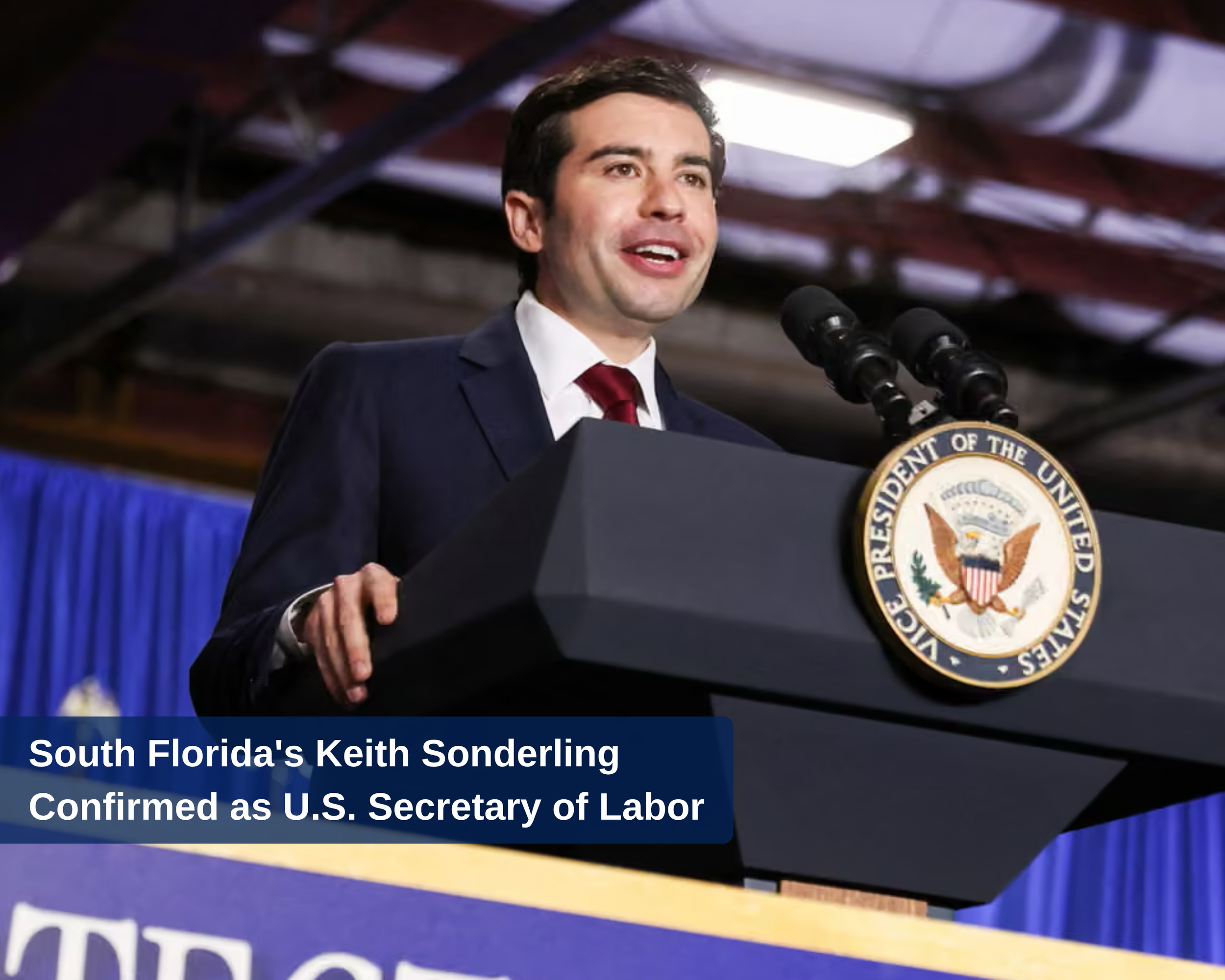
The United States Senate confirmed Keith Sonderling as the 31st United States Secretary of Labor with a 47-41 vote.
Secretary Sonderling has already spent more than five months leading the Department of Labor as Acting Secretary of Commerce. The official Senate confirmation came on September 30. Before becoming Acting Secretary, Sonderling served as the Deputy Secretary of Labor from January 2025 to April 2026 and oversaw the day-to-day operations of the department.
Sonderling’s appointment comes after two decades of working in employment law and shaping federal labor and workforce policy in the United States. His work in private practice seamlessly transitioned to his roles within the Equal Employment Opportunity Commission and the Department of Labor.
Throughout his service in the federal government, Secretary Sonderling has witnessed the rapid evolution of AI in the workplace from 2017 to the present day and has become a leading expert on the subject.
Sonderling’s Path From Florida Universities to Washington
Secretary Sonderling has deep South Florida roots. Sonderling was raised in Boca Raton, Fla., and is a graduate of Spanish River Community High School.
After completing his Bachelor of Science at the University of Florida, Sonderling returned to South Florida in 2008 to pursue his Juris Doctor at Nova Southeastern Shepard Broad College of Law and earned a J.D. magna cum laude. Sonderling’s Florida ties continued after law school through both his legal career and civic involvement.
Before entering federal government service, Sonderling was a partner at Gunster, specializing in labor and employment matters including counseling employers and litigating employment disputes.
In 2012, Sonderling was appointed to the Judicial Nominating Commission for appellate courts by then-Governor Rick Scott. Sonderling later served as chair of the commission along with other South Florida community leadership roles. He also serves on the boards of the Boca Raton Chamber of Commerce, MorseLife Health System, and Leadership Florida as a member of Connect Class 4.
Secretary Sonderling has a deep commitment to better the State that he has called home. In August, Secretary Sonderling visited NEXA's product lab in Hollywood. The discussions were centered around developing the skilled South Florida workforce needed to fill high-tech jobs as the company expands. His visit highlighted the evolution of South Florida’s technology beyond software, startups, and investment capital. It also focused on South Florida’s engineering, advanced manufacturing, and secure communications industries.
Secretary Sonderling has a major focus nationally on workforce development and connecting growing companies with workers who have the skills for high-tech jobs. By taking these concepts and applying them to his home region, he makes the impact of his role even stronger. He understands the South Florida business community and has witnessed its growth and future expansion firsthand.
From Gunster to Federal Leadership
Before leaving for Washington, Sonderling’s private-sector practice at Gunster gave him experience advising employers on workplace laws that would eventually help him administer and enforce at the federal level.
In September 2017, Sonderling began his term as the Acting Administrator and Deputy Administrator of the Wage and Hour Division at the U.S. Department of Labor. He served in this role from 2017 to 2020. During this time, Sonderling helped to administer and enforce federal workplace laws, including minimum wage, overtime, and family and medical leave requirements. During his tenure, Sonderling helped restore the division’s opinion-letter program, helped to develop the division’s first self-audit initiative to encourage employers to identify and correct wage violations voluntarily, and established the labor policy and agency management experience that gave him the experience for his next role.
In 2020, the United States Senate confirmed Secretary Sonderling as an Equal Employment Opportunity Commission (EEOC) Commissioner. Over his four-year tenure at the EEOC, Secretary Sonderling protected the rights of workers and focused on bettering the nation’s workplace.
A Leading Voice on AI in the Workplace
At the EEOC, one of the most defining issues was the intersection of artificial intelligence, workplace technology, and existing employment discrimination law. Sonderling has become a leading global voice on AI in the workplace. He has traveled the world and spoken internationally on AI’s impact on the future of work.
His AI work examined both sides of the AI workplace. Sonderling emphasized that existing employment and civil rights laws continue to apply when employers use AI instead of humans making the decisions.
At a 2023 EEOC hearing, Sonderling argued that AI could potentially help mitigate unlawful discrimination and create more accessible workplaces. He also stressed that emerging technology must remain consistent with the law and equal-employment protections.
Artificial Intelligence and Algorithmic Fairness Initiative was created to make sure that companies don’t discriminate against people when they are using AI to make employment decisions. Sonderling was cognizant and proactive to avoid discrimination involving AI under the Americans with Disabilities Act and Title VII of the Civil Rights Act.
Secretary Sonderling’s work at the EEOC largely examined how AI affects workers and employment law. In January 2025, he returned to the U.S. Department of Labor as U.S.Deputy Secretary of Labor. His knowledge of how AI affects workers and employment law expanded his understanding of how workers can be prepared to use AI.
From AI Policy to Workforce Preparation
Secretary Sonderling returned to the Department of Labor in March 2025. His experience at the EEOC examined how employers could use AI and automated technologies in a manner that complied with employment and anti-discrimation laws. At the Department of Labor, he expanded that work to tackle how Americans can develop skills to work effectively with AI.
Secretary Sonderling positioned AI literacy as a workforce skill and differentiated from being simply a technical specialization. He connected AI adoption with productivity. Workforce preparation and access to emerging career pathways.
The Department of Labor’s approach extended across all industries and connected employers to educational institutions, workforce boards, and apprenticeship programs.
Under the Secretary’s leadership, AI literacy and apprenticeships have taken center stage. The Department of Labor introduced its AI Literacy Framework. There are five foundational competencies within this framework: understanding AI, exploring its uses, directing it effectively, evaluating its outputs, and using it responsibly.
In April 2026, the Department of Labor moved AI literacy into more direct workforce training. It launched an initiative to incorporate AI into Registered Apprenticeships nationwide that will add AI tools to existing apprenticeships, develop programs for occupations that use AI, and strengthen talent pipelines for telecommunications and advanced manufacturing.
Secretary Sonderling promoted apprenticeships as an earn-while-you-learn pathway into emerging careers. The Department of Labor has also launched AI in the Registered Apprenticeship Innovation Portal. This portal gives employers and workforce organizations resources to incorporate AI skills into training programs.
These programs can have a direct impact on the needs of the South Florida business community and tech ecosystem.
Preparing Workers for an AI-Driven Economy
Under Secretary Sonderling, the Department of Labor initiatives reflect a shift from the legal implications of workforce AI to preparing the workforce to learn AI skills for an increasingly AI-driven economy.
Sonderling’s AI work now spans three interconnected areas. It focuses on worker protections, AI literacy, and workforce training.
Secretary Sonderling’s confirmation moves someone who started his employment law career in South Florida to someone who has worked directly on workplace AI during his EEOC tenure and is equipping the national workforce for the future at the Department of Labor.
These focus areas are critically important to South Florida’s economy. As technology, financial services, healthcare, defense tech, and other industries grow, there is a demand for workers with new technical and AI skills.
Secretary Sonderling’s path to the Department of Labor began with his South Florida roots and continues to give back to the region. His work has evolved alongside AI itself. His expertise has the potential to help employers use technology effectively and help workers be prepared to use it.


Miami-based TrustedRouter has raised $1.25 million in seed funding as demand grows for infrastructure connecting businesses with multiple AI models. The startup provides access to more than 600 models across over 81 providers while helping users select models based on performance, cost, privacy, and reliability. TrustedRouter is also emphasizing confidential computing and open-source technology to protect sensitive customer data. The funding adds another AI infrastructure startup to South Florida’s growing technology ecosystem.