
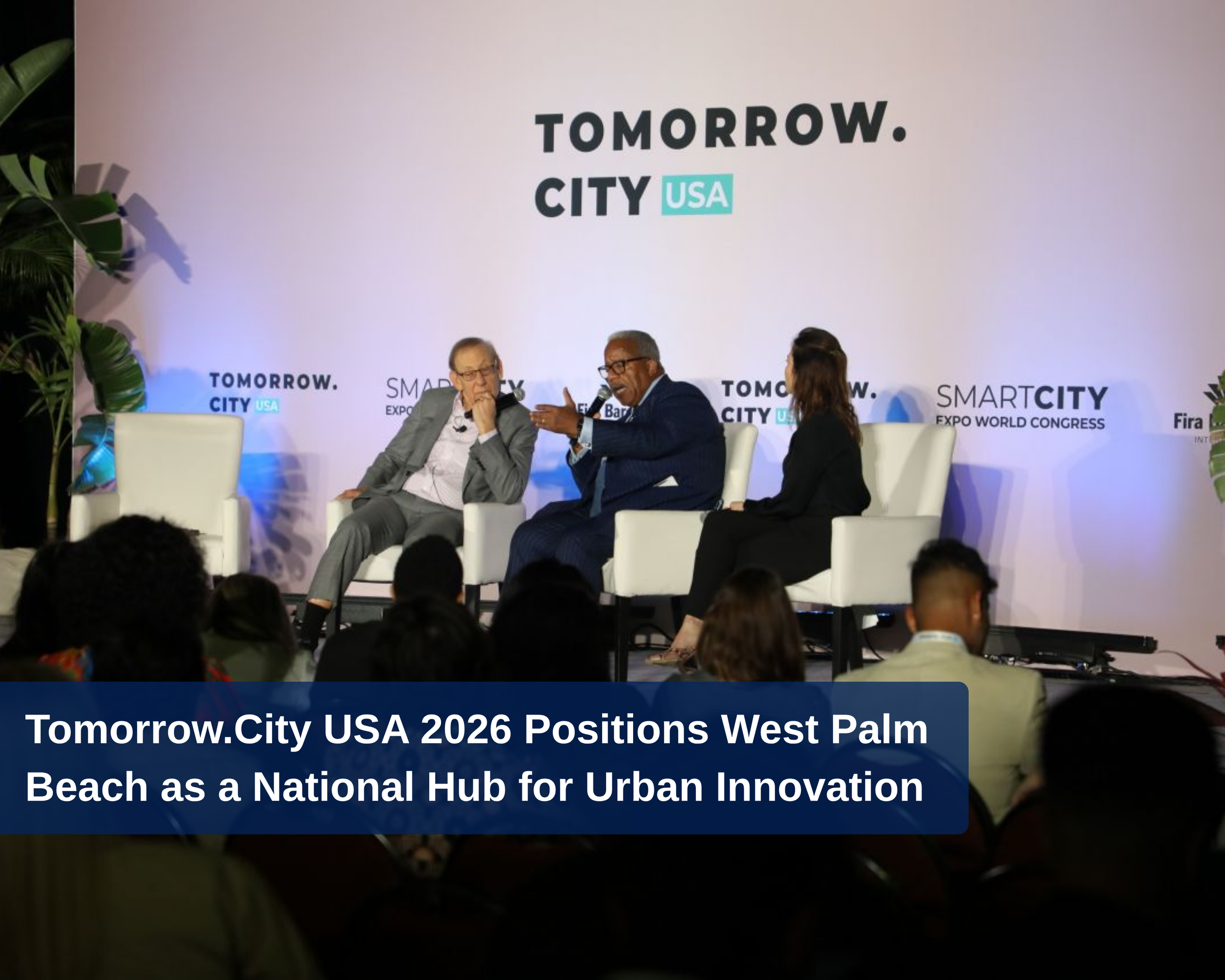
Tomorrow.City USA 2026 Positions West Palm Beach as a National Hub for Urban Innovation
More than 2,000 leaders from government, technology, infrastructure, and investment sectors gathered last week for Tomorrow.City USA, a national summit focused on the future of cities, infrastructure, and economic development.
Held at the Palm Beach County Convention Center, the two-day event brought together over 100 speakers and dozens of public and private sector organizations under the slogan “the future is now” to explore how cities across the United States are preparing for the next generation of mobility, artificial intelligence, climate resilience, and workforce transformation.
The event positioned the Palm Beaches, and the broader South Florida region, as an emerging testbed for urban innovation at a time when cities are facing growing pressure to modernize infrastructure and remain globally competitive.
Cities as Platforms for Growth
Throughout the summit, speakers emphasized that cities are no longer just places to live as they are becoming platforms for innovation, investment, and talent development.
During the opening remarks, Mayor Keith James of the City of West Palm Beach, framed the event as an opportunity for cities to collaborate and share solutions that improve quality of life and expand economic opportunity.
“It was a privilege to join the ‘Public, Private, and Philanthropic Capital Building Cities of Tomorrow’ panel with Stephen Ross and moderator Francesca de Quesada Covey, sharing how West Palm Beach is leveraging strong partnerships to drive meaningful growth,” shared Mayor James.
“By aligning public leadership with private investment and philanthropic support, including collaborators like Related Ross and the Knight Foundation, we are creating opportunities that extend beyond development to truly strengthen our community.”
Leaders across government and industry echoed a common theme: cities that invest in digital infrastructure, transportation, and workforce readiness will be better positioned to attract businesses and talent in the years ahead.
This shift reflects a broader national conversation about how urban centers can adapt to rapid technological change while maintaining inclusivity and sustainability.
Major Themes and Notable Announcements
A central focus of Tomorrow.City USA 2026 was the transformation of traditional infrastructure into intelligent, data-driven systems, supported by new technologies and emerging partnerships.
Artificial intelligence emerged as a major topic across multiple sessions, with discussions centered on responsible deployment, governance frameworks, and the role of predictive technologies in managing urban systems. Speakers highlighted how AI is increasingly being used to optimize traffic flow, improve public safety, and enhance municipal services, signaling a broader shift toward cities powered by real-time data and automation.
Mobility and transportation were also key themes. Leaders from major rail and transit organizations discussed the role of high-speed rail and transit-oriented development in connecting cities and expanding access to jobs and housing. These conversations underscored the growing importance of integrated transportation networks in regional economic development, particularly as cities prepare for population growth and increased mobility demands.
“West Palm Beach continues to redefine what a modern, connected city can be," said Patrick Goddard, CEO of Brightline Trains Florida. "The transformation underway reflects a remarkable commitment to progress and innovation, and Brightline is proud to be part of that momentum. Together, we’re building a more dynamic, accessible, and sustainable future for our region's residents, businesses, and visitors alike.”
Climate resilience remained another priority, particularly for coastal communities. Sessions explored strategies for strengthening power grids, protecting water systems, and preparing cities for extreme weather events, an issue especially relevant to regions facing rising environmental risks.
Several announcements made during the conference reinforced these themes and highlighted emerging technologies that could shape the future of urban infrastructure. Among the most notable was a breakthrough in wireless communications technology demonstrating the ability to transmit data at 400 gigabits per second using optical wireless systems.
Federal agencies also announced the launch of a new export-focused initiative designed to help U.S. technology companies expand into international markets. The program is expected to support companies working in smart city solutions, mobility technologies, and digital infrastructure, opening new pathways for innovation-driven economic growth.
Additional discussions from infrastructure investment leaders signaled growing interest in expanding data centers, fiber networks, and edge computing systems, critical components of the digital backbone required to support AI-driven urban services.
Together, these developments underscored how advances in technology, mobility, and infrastructure investment are becoming deeply interconnected in shaping the cities of tomorrow.
Workforce, Partnerships, and Mega-Events
Beyond technology and infrastructure, workforce readiness emerged as one of the most urgent priorities discussed during the summit, reinforcing the idea that building the cities of the future depends as much on people as it does on technology.
Government leaders and industry executives highlighted the need to strengthen talent pipelines that support emerging industries such as advanced manufacturing, cybersecurity, mobility, and infrastructure technology. Workforce development programs, including apprenticeships, reskilling initiatives, and public-private training partnerships, were repeatedly identified as essential to ensuring that communities benefit from large-scale infrastructure investments. Speakers emphasized that workforce readiness is now viewed as a foundational component of city growth, on par with transportation systems, utilities, and digital infrastructure.
At the same time, large-scale global events such as the 2026 FIFA World Cup were frequently cited as powerful catalysts accelerating urban transformation across the United States. Cities hosting or supporting these events are using the opportunity to modernize transportation networks, upgrade utilities, expand hospitality infrastructure, and improve regional connectivity. These investments are expected to deliver long-term economic and infrastructure benefits that extend well beyond the events themselves, shaping how cities prepare for future growth and global competitiveness.
Underlying both workforce development and large-scale infrastructure planning was a consistent emphasis on the importance of collaboration. One of the strongest recurring themes throughout the summit was the growing reliance on public-private partnerships to drive progress. Large-scale urban projects increasingly depend on coordinated investment and shared leadership across government agencies, private companies, nonprofit organizations, and educational institutions. Developers, technology firms, transportation providers, and municipal leaders are working together to design solutions that balance innovation with sustainability and long-term resilience.
Speakers repeatedly underscored that no single organization can build the cities of the future alone. Instead, success depends on ecosystem-level collaboration, where talent development, infrastructure investment, and strategic partnerships work together to create sustainable and inclusive urban growth.
West Palm Beach and the Rise of AI-Driven Cities
Hosting Tomorrow.City USA 2026 reinforced the City of West Palm Beach’s role as a rising center for urban innovation and positioned the region as a model for how cities can prepare for the next era of digital and physical transformation.
The region’s rapid growth, ongoing development projects, and commitment to infrastructure modernization were cited as key reasons for selecting the city as the summit’s U.S. host location. Local leaders emphasized the importance of continuing to invest in infrastructure, workforce development, and emerging technologies to support long-term economic growth. The summit also introduced new opportunities for pilot programs, strategic partnerships, and infrastructure initiatives that could shape the region’s future and strengthen its role as a national testing ground for urban innovation.
“West Palm Beach is a live case study in what happens when public, private, and philanthropic partners bet on communities building together - pairing catalytic financial, relational, and reputational capital with local leadership to strengthen civic infrastructure, expand economic mobility, and give residents greater agency to shape thriving communities over time,” shared de Quesada Covey in a social media post.
Perhaps the most significant takeaway from Tomorrow.City USA 2026 was the evolving shift from the concept of “smart cities” to what many speakers described as “AI cities.” This transformation reflects a growing reliance on data, automation, and predictive analytics to manage everything from transportation systems to emergency response and public services. As infrastructure becomes more connected and intelligent, cities are expected to function increasingly as digital ecosystems, integrating physical assets with advanced technologies to improve efficiency, resilience, and quality of life.
Together, these developments position West Palm Beach not only as a host city, but as an example of how mid-sized cities across the United States can embrace innovation, collaboration, and technology to drive sustainable growth and prepare for the future of urban living.
A National Platform with Regional Impact
As Tomorrow.City USA continues to grow, organizers signaled plans to maintain a long-term presence in Palm Beach County, positioning the region as a recurring destination for national and international urban innovation leaders.
For South Florida, the summit represents more than an annual gathering. It signals the region’s growing influence in shaping how cities across the country plan for the future.
With infrastructure investment accelerating and new technologies emerging, the conversations started at Tomorrow.City USA 2026 are likely to influence urban development strategies for years to come.

Carnegie Mellon University has named four-time technology founder Jignesh M. Patel as the founding dean and vice president of its new Miami campus. Backed by a $2 billion commitment from Citadel founder Ken Griffin, CMU Miami will focus on artificial intelligence, national security, healthcare, energy, and advanced manufacturing. Patel brings extensive experience in computer science research, startup development, and technology commercialization. Planned for Miami's Wynwood neighborhood, the campus expects to begin enrolling students in 2028, strengthening South Florida's growing innovation and entrepreneurship ecosystem.