

University of Miami Awards $500,000 to Student Startups in Third Annual USTAAR Competition
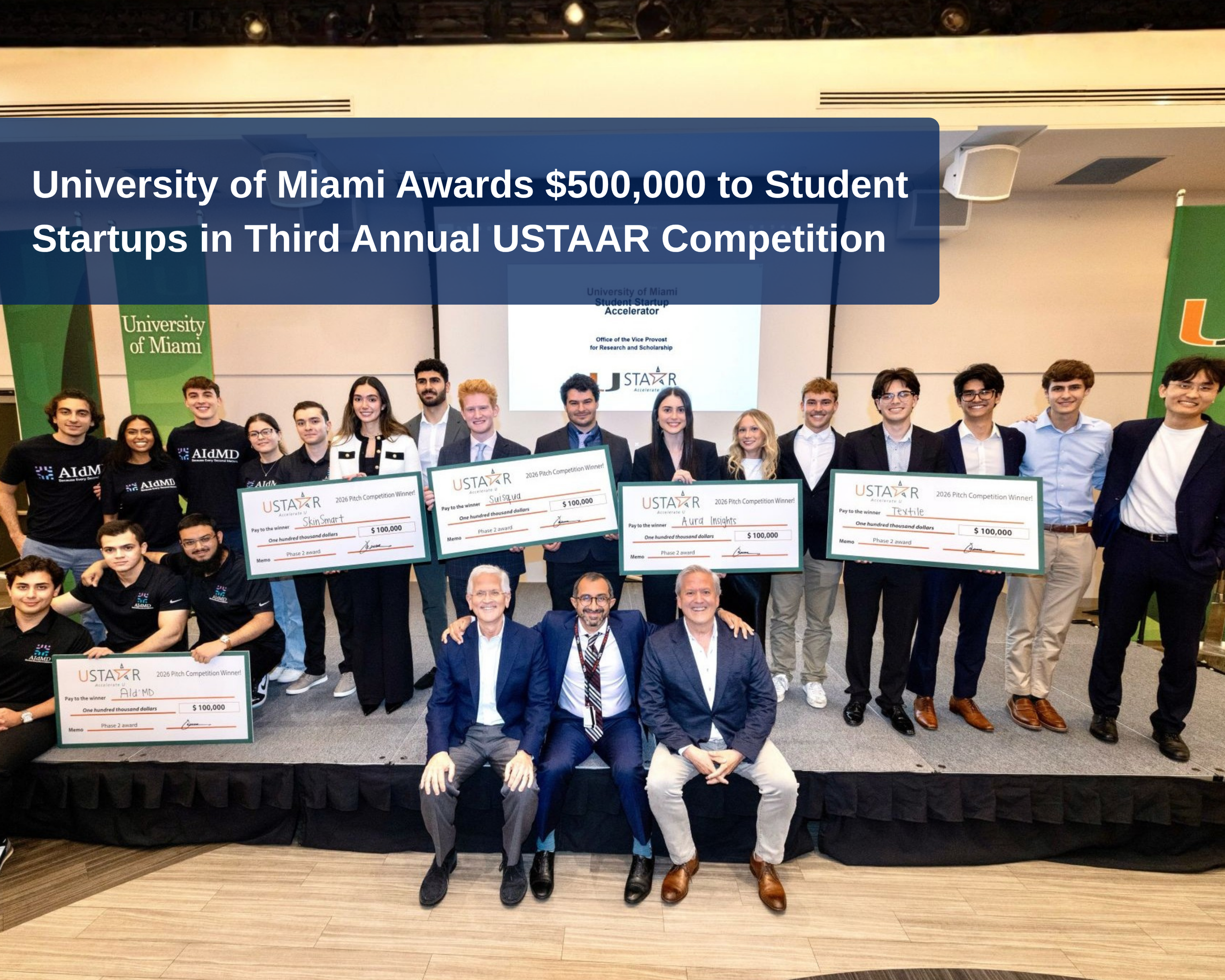
The entrepreneurial momentum at University of Miami continues to accelerate as five student-led startups each received $100,000 in funding through the university’s third annual USTAAR Pitch Competition, marking another milestone in the growth of South Florida’s startup pipeline.
This month, the competition awarded a total of $500,000 to emerging ventures spanning healthcare, materials innovation, consumer products, and artificial intelligence. The awards are part of the university’s University Student Startup Accelerator (USTAAR) program, which provides seed funding, mentorship, and commercialization support to student founders.
As universities increasingly play a central role in regional innovation ecosystems, programs like USTAAR are helping transform student ideas into scalable businesses, many of which are poised to contribute to South Florida’s growing reputation as a hub for entrepreneurship and emerging technologies.
Five Student Startups Receive $100K Each
This year’s competition culminated in funding awards to five standout teams whose ventures reflect a wide range of industries and emerging market opportunities.
AIdMD | Founded by Vagif Kazimli, Yusif Gurbanli, and Yunus Kazimli, AIdMD is developing artificial intelligence-driven tools designed to support healthcare and medical decision-making. The team’s work reflects the broader surge in AI-powered health technologies emerging from university research environments.
Aura | Founded by Julia Mauro, Aura is developing a consumer-focused product solution aimed at improving everyday experiences through thoughtful design and innovation. While still early in development, the concept reflects a growing trend toward user-centered product innovation among student entrepreneurs.
SkinSmart| Founded by Yasmine Mohseni and Eric Sokhn, SkinSmart focuses on skincare and health technology. The startup is exploring solutions designed to improve skin health through technology-driven insights and accessible care tools.
SuiSqua | Founded by Eitan Pritzker and Levi Gell, SuiSqua is developing a product-based innovation designed to solve everyday consumer challenges. The venture reflects a growing interest among student founders in practical, scalable product development.
Textile | Founded by Alexandr Kim, Textile focuses on advanced material innovation. The startup is working to develop new textile-based solutions designed to address modern performance and sustainability challenges across multiple industries.
University of Miami student and Co-founder of AIdMD, Yusif Gurbanli, shared, “The team took a massive step towards product-market fit this past cohort. Through the I-Corps program, we held over 250 interviews with clinicians. The physicians we’re building for deserve better tools. We intend to give them exactly that.”
AIdMD began in 2025 with the company’s co-founder and CEO, Vagif Kazimli, an MD/MBA candidate who experienced firsthand how much time physicians lose to administrative documentation instead of patient care. The company aims to use artificial intelligence-driven tools to assist clinicians and give them time back in their day.
Gurbanli shared, “We are being strategic about partnerships with large health systems such as UHealth, private equity healthcare groups, and international rollouts.The funds from USTAAR will be used primarily for sales and ultimately ensuring every independent physician has access to the platform.”
Together, USTAAR startups represent a cross-section of innovation areas gaining traction across the broader technology landscape, from AI and health solutions to advanced materials and consumer-focused products.
Building a Pipeline of South Florida Entrepreneurs
The USTAAR program at the University of Miami is designed to support student founders at multiple stages of development.
Teams typically begin with early-stage grants of up to $10,000, allowing them to build prototypes, conduct testing, and validate business models. From there, select teams advance to the final pitch competition, where top performers receive $100,000 growth grants to accelerate commercialization.
Since its launch in 2024, USTAAR has quickly become one of the most significant student entrepreneurship initiatives in the region. With the 2026 competition, the program has now awarded at least $2 million in major startup funding across multiple cohorts.
This type of early-stage investment is often critical in bridging the gap between concept and commercialization, particularly for student founders who may not yet have access to traditional venture capital.
Programs like USTAAR are increasingly recognized as foundational to the development of strong regional startup ecosystems. By providing capital, mentorship, and exposure to investors, universities can help retain talent locally while encouraging students to launch companies in the communities where they study.
For South Florida, this approach offers several long-term benefits:
Retention of high-potential founders
Creation of new technology-driven businesses
Expansion of local innovation pipelines
Strengthening connections between academia and industry
The diversity of industries represented in this year’s winners also signals a shift toward multidisciplinary innovation, where breakthroughs emerge not only from traditional tech fields but also from materials science, consumer products, and health-focused solutions.
“We have brilliant students hashtag#canes, with fantastic ideas, and work ethic that is second to none. So incredibly proud of each and every one of them - regardless of the outcome,” shared USTAAR Director, Suhrud Rajguru, in a social media post.
“While the others did not get the investments, each was amazing and I am confident walked away inspired, ready to get back to the grind and continue their journeys. These students, our University of Miami Canes are coming to change the world.”
What Comes Next for the 2026 Winners
With funding secured, the five winning teams will now enter the next phase of growth, building prototypes, refining their products, and preparing for potential investor engagement.
Many early-stage university startups eventually move into regional accelerators, pilot programs, or venture-backed growth cycles. As these teams mature, they may become candidates for partnerships with local businesses, corporate innovation initiatives, or investment networks.
If past cohorts are any indication, several of these ventures could soon emerge as recognizable names within the region’s entrepreneurial landscape.
One example is Smart Aerosol Technologies (SmArT), a 2024 USTAAR winner that has already begun to validate its potential beyond the university. The AgTech startup, which is developing nanoparticle-based fertilizers designed to improve crop efficiency while reducing environmental impact, went on to win first place at the 2025 Startup Showcase during eMerge Americas, one of the region’s most prominent innovation events. With early field testing and strong external recognition, SmArT is often cited as an early signal of how USTAAR-backed ventures can evolve into credible, real-world climate and agriculture solutions.
These early successes suggest that USTAAR is not only fueling student entrepreneurship, but also steadily building a pipeline of ventures with the potential to scale well beyond the university and into the broader innovation economy.
The Bigger Picture
The continued expansion of student entrepreneurship programs reflects a broader shift in how universities support innovation. No longer limited to academic research alone, institutions are increasingly positioning themselves as launchpads for real-world ventures.
The third annual USTAAR competition at the University of Miami underscores this evolution, demonstrating how targeted funding and structured mentorship can turn student ideas into tangible business opportunities.
As the program grows, its long-term impact will likely extend well beyond campus, shaping the next generation of founders and contributing to the continued rise of South Florida as a center for innovation and entrepreneurship.



Aventura-based cybersecurity startup Comp AI has secured $34 million in Series A funding to accelerate product development, expand cybersecurity capabilities, and grow its team. Founded by Lewis Carhart, Claudio Fuentes, and Mariano Fuentes, the company uses agentic AI to automate compliance audits, monitor security requirements, and identify business risks. With more than 1,000 customers and approximately $37.5 million raised to date, Comp AI is developing continuous security monitoring and AI-powered vulnerability detection capabilities. The investment highlights South Florida's growing cybersecurity ecosystem and increasing venture capital interest in AI-driven enterprise technology.