
After Maduro’s fall, what’s next -- Cuba?
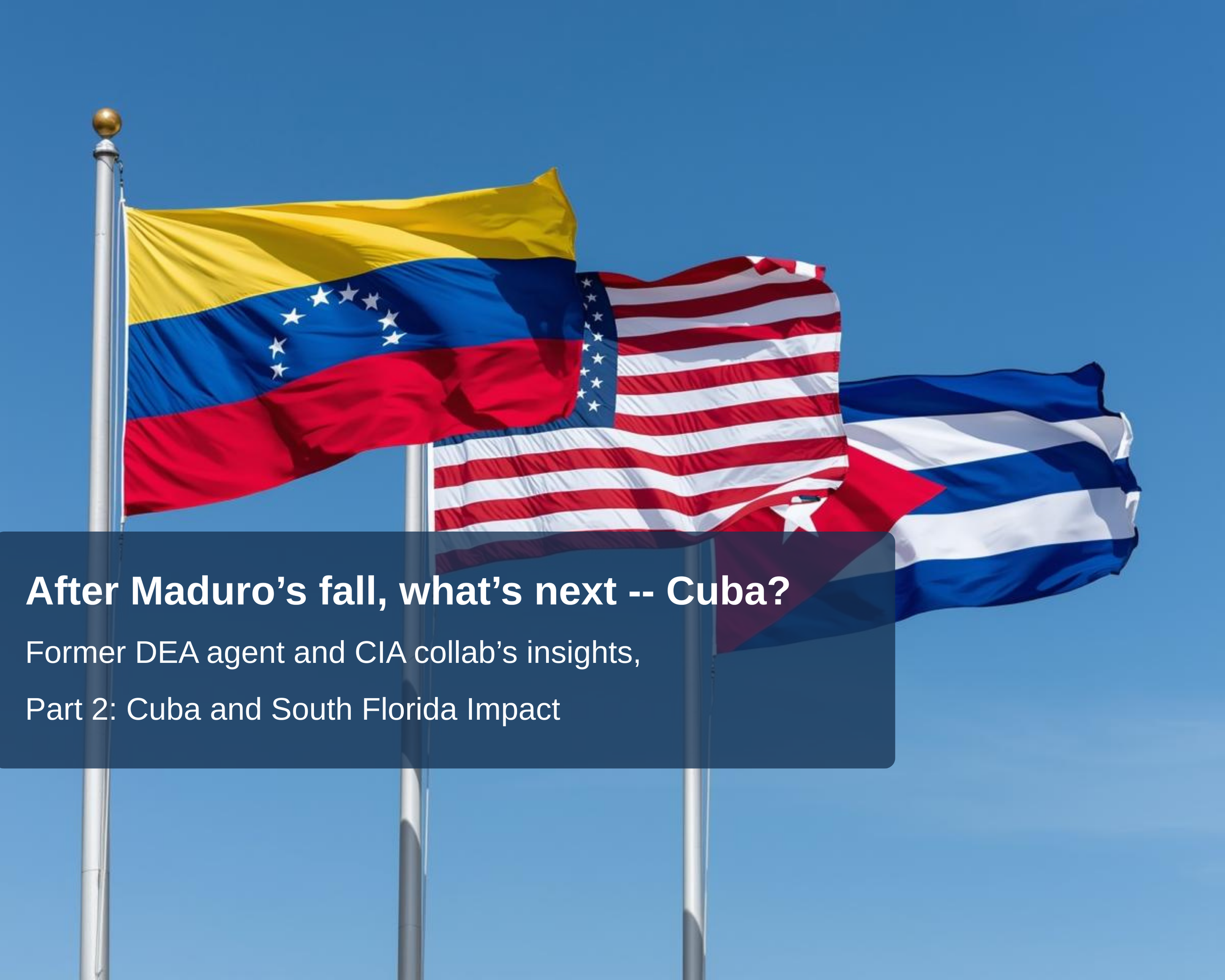
Removing Nicolás Maduro’s oppressive rule from Venezuela on Jan. 3 created geopolitical and economic tremors in the Caribbean and Latin America. For Cuba — long tethered to Venezuela’s oil and financial support — this moment marks a decisive turning point, and morphs South Florida into the epicenter of any potential fallout.
The End of an Era: A Lifeline Severed
Former DEA agent and CIA collab Omar Aleman, who lived in Venezuela for 2 years in the 1970s, sees multiple political dominoes falling.
“Since (former Venezuelan dictator Hugo) Chavez took power (1999), Cuba’s survival hinged on a simple equation: oil for services. Under the framework initiated with Chávez and continued with Maduro, Cuba received heavily-subsidized Venezuelan crude in exchange for medical professionals, teachers, technicians and intelligence/security personnel dispatched across Venezuela,” Aleman said.
“This informal ‘oil-for-doctors and bodyguards’ barter helped prop up the Cuban economy amid U.S. sanctions and Cuba’s own internal bureaucracy,” he continued.
Aleman pointed out that during the Maduro era, the Venezuela-Cuba relationship developed a darker strategic dimension. Caracas financed activities aligned with Cuban interests that Washington labeled anti-American or even “terrorist”. Cuba – not Venezuela -- was actually the driving force behind some of these regional engagements. Aleman described Cuba as the true mastermind, using Venezuelan oil as the resource base for its regional security and intelligence footprint.
With Maduro gone and with him Venezuelan oil subsidies, Cuba faces the loss of its last net benefactor,… and a financial catastrophe.
Already, U.S. pressure on Venezuela drastically curtailed oil shipments to Cuba; shipments all but stopped under a tightened blockade and new sanctions. Before Maduro’s fall, exports already dropped from earlier peaks of ~90,000–100,000 barrels per day to roughly 30,000–35,000 barrels per day — far below Cuba’s needs.
Immediate Impact: Cuban Economic and Social Disruption
The abrupt end of regular Venezuelan oil deliveries created immediate Cuban hardships:
Energy shortages worsened existing rolling blackouts, crippling transportation, water treatment, and industry.
Food, medicine and basic goods have become harder to secure as production and logistics falter.
Public discontent is rising as living standards deteriorate, echoing the worst parts of the “Special Period” after the Soviet Union’s collapse in the early 1990s.
Economists warn that without external support, the situation could devolve into full-blown economic disintegration. Pavel Vidal, a former Cuban central banker who teaches at Javeriana University in Colombia, said that if oil supplies are completely cut off, the Cuban economy grinds to a halt.
Two Possible Roads Ahead
1. Deepening Crisis and Potential State Fragility
The most immediate and severe scenario is an acceleration of economic collapse:
Energy grid failure cripples economic activity.
Social services breakdown intensifies public grievance.
Emigration surges as people flee worsening conditions.
Without oil, Cuba’s military and security apparatus — which has long sustained political control — may struggle to maintain order. A sudden influx of returning Cuban advisors and intelligence personnel fleeing instability in Venezuela could strain an already overstretched system.
2. Forced Economic and Political Reorientation
Some analysts argue that the crisis could force change:
Economic restructuring: Cuba may have to relax its rigid state controls, open space for private enterprise, and seek foreign investment — including from China — to replace lost revenue.
Political recalibration: Facing mass hardship, the regime could pursue controlled reforms to placate public discontent and stabilize its governance structure.
Yet this requires political will that the current leadership has not yet demonstrated.
Geopolitical Vacuum and Isolation
Cuba’s geopolitical options are limited. Unlike during the Cold War, when the Soviet Union offered a powerful counterweight to U.S. pressure, but today China is the primary threat.
“China will do all it can do save Cuba (in it’s current state),” Aleman said. “Cuba is a strategic location and worth the cost. Remember, Cubans are used to living under dire conditions.”
At this point, however, China is still somewhat on the periphery, leaving Havana increasingly isolated. Washington has signaled that it views the removal of Maduro as weakening the broader infrastructure of authoritarian resistance in the region — with Cuba high on that list.
Impact on South Florida
When Cuba – if as predicted -- collapses financially, the consequences won’t stop at the island’s shores. The most immediate and consequential area impacted is South Florida, which will serve as humanitarian, economic, and political Ground Zero.
The first projected pressure points created in South Florida are expected to be :
Housing demand spikes, intensifying affordability challenges
Hospitals and public health systems face surges in uncompensated care
Schools and social services must rapidly expand capacity and language support
For policymakers, the short-term costs are real and unavoidable. Federal assistance would be required quickly, and the absence of preparedness would magnify social and political tension.
In Part 3 coming later this week, we take a deeper dive into direct potential economic effects on South Florida infrastructure, should Cuba collapse financially.




YouTube sensation IShowSpeed, also known as Darren Watkins Jr., has reportedly invested $10.75 million in a Miami-Dade warehouse to establish a dedicated content creation and production studio. The 26,600-square-foot property represents a major step in the creator's expansion from livestreaming into a larger media enterprise. Miami real estate broker Jordan Karp represented IShowSpeed in the transaction. The investment highlights South Florida's growing role in the creator economy, connecting digital entertainment, technology, commercial real estate, and entrepreneurship.